
Across Jammu and Kashmir, some of the most useful pieces of energy infrastructure may already have been built.
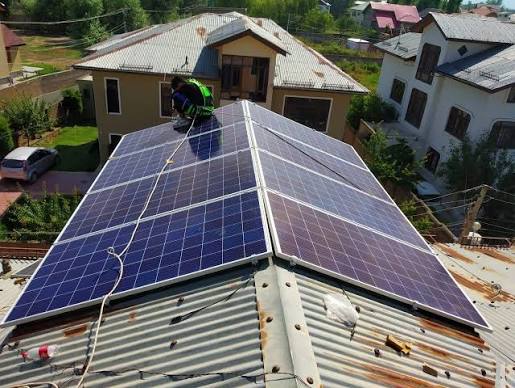
They are not power stations. They are not solar parks. They do not require new roads, new transmission corridors or the acquisition of additional land. They are roofs.
Factories, warehouses, industrial sheds, schools, hospitals, colleges, government offices and other public buildings already occupy land, already have electricity connections and, in many cases, already have large surfaces exposed to the sun. Yet much of that space remains passive: shelter from rain and snow, storage overhead, an architectural necessity.
The policy challenge now is to make those roofs work.
Jammu and Kashmir has begun moving in that direction, particularly through the solarisation of government buildings. But the same idea could extend much further — into the industrial estates and manufacturing units that form another large, largely untapped collection of potential solar sites.
For a region where acquiring land for large renewable-energy projects can be difficult, the logic is simple: build the next generation of electricity infrastructure on structures that already exist.
The scale of the industrial opportunity is suggested by a number that, by itself, says little about rooftops but a great deal about the potential network beneath them.
For 2026-27, the Joint Electricity Regulatory Commission has approved 19,814 industrial electricity connections across Jammu and Kashmir’s two distribution companies.
Under the Jammu Power Distribution Corporation Ltd., the approved consumer base includes 8061 low-tension industrial consumers, 896 high-tension industrial consumers and 26 HT-PIU consumers.
Under the Kashmir Power Distribution Corporation Ltd., there are another 10,498 LT industrial, 331 HT industrial and two HT-PIU connections.
The connections vary considerably in their electricity requirements, and the number of connections cannot be translated directly into several factories or rooftops. But taken together, they point to an extensive industrial electricity footprint — and therefore to thousands of places where solar generation could potentially be integrated.
Industrial buildings have an advantage over many other structures.
Their roofs are often large and relatively unobstructed. The land has already been acquired. The buildings have already been constructed. Electricity infrastructure is already present.
A solar installation on such a roof can therefore add generation without first solving the problem of finding a new parcel of land.
What is missing is a clear measurement of the opportunity.
Jammu and Kashmir does not appear to have a comprehensive, publicly available assessment of the total rooftop area associated with industrial establishments, the structural suitability of those roofs or the amount of photovoltaic capacity they could accommodate.
Until that inventory exists, the potential remains largely theoretical.
A proper industrial rooftop audit could change that.
It could map roof area, assess structural strength, record sanctioned electricity loads, examine historical consumption, identify available grid capacity and calculate the technically feasible solar capacity at each establishment.
For the first time, the government would then have a figure for how many megawatts might be sitting above the factories of Jammu and Kashmir.
The idea becomes more consequential when placed against the way industrial electricity support has traditionally been designed.
Under the existing industrial policy, eligible units can receive a 100 percent subsidy on diesel generator sets ranging from 10 kW to 2,000 kW, subject to a ceiling of Rs 40 lakh in Zone A and Rs 45 lakh in Zone B.
The rationale is familiar: industrial units need a dependable source of electricity when the grid is unavailable or unreliable.
But a generator is fundamentally a recurring expense.
It consumes fuel. It requires maintenance. It produces emissions. And once the fuel is burned, the expenditure is gone.
A rooftop solar system is different. It is an energy asset.
That makes any proposed shift from subsidising diesel-based backup generation towards rooftop solar more than a technology change. It would represent a change in the philosophy of industrial support – from helping an enterprise pay for recurring fossil-fuel consumption to helping it build an asset capable of producing electricity for years.
The design of that subsidy, however, will matter.
Linking subsidised solar capacity to an industrial unit’s sanctioned electricity load could provide a rational basis for government support. But the sanctioned load should not automatically become a ceiling on the amount of solar that a factory is allowed to install.
A factory might qualify for subsidy corresponding to its sanctioned load while possessing a roof capable of accommodating considerably more panels.
There would be little reason to leave that additional surface unused.
Government could subsidise the capacity linked to the sanctioned load while allowing the entrepreneur to finance additional capacity independently, provided the installation meets structural, electrical, safety and grid-integration requirements.
In that model, public money would help establish the core asset while private investment would unlock the larger rooftop.
The distinction is important because it avoids turning a subsidy programme into an artificial limit on renewable generation.
There is another reason industrial rooftops make sense: the timing of electricity consumption.
Factories generally operate during the day. That is also when rooftop solar generates most of its electricity.
The first and simplest use of the electricity would therefore be consumption at the premises itself. Every unit generated and consumed on site can reduce the need for corresponding grid-supplied electricity.
Where regulations permit, surplus generation could be exported or settled through the applicable mechanism.
Over time, industrial estates could begin to resemble decentralised solar clusters.
Instead of treating every rooftop as an isolated project, the government and distribution companies could plan entire estates – identifying common grid requirements, strengthening evacuation infrastructure where necessary and encouraging coordinated solar deployment.
The result would be a network of smaller generators embedded within existing demand centres.
That could also reduce one of the most persistent obstacles to large renewable-energy development in J&K: land.
Rather than searching for new land for solar parks, policymakers could make use of factories, warehouses, parking structures and other already-developed surfaces.
The principle would be straightforward: use the land twice, without acquiring it twice.
The same argument is even more compelling when applied to government buildings.
Schools, hospitals, colleges, universities, administrative offices, warehouses and other public establishments already represent an enormous public estate.
The buildings exist. The roofs exist. The electricity connections exist.
The government has already recognised the opportunity.
In July 2024, the Administrative Council approved solarisation of government buildings through the Jammu and Kashmir Energy Development Agency, initially envisaging 270 MW – 70 MW under the CAPEX model and 200 MW through RESCO – along with smart metering and Virtual Net Metering.
The programme was subsequently given a larger place in the government’s energy and fiscal planning.
The 2025-26 Budget committed to solarising 22,494 government buildings, with an envisaged capacity of 314 MW.
The 2026-27 Budget included another Rs 50 crore for solarisation of 494 higher-education buildings, while continuing the programme across other feasible government establishments.
The numbers are no longer merely projections.
As of July 9, 2026, 8131 of the 22,494 identified government buildings had been solarised.
By July 28, the figure had risen to 8181 buildings, with 85.8 MW of installed rooftop solar capacity.
That placed J&K third among states and Union Territories in the solarisation of government buildings.
But the unfinished portion of the programme is still larger than the completed one.
And the electricity footprint of the public sector suggests that the opportunity extends well beyond the buildings already identified.
For 2026-27, JERC approved 14,213 state and central government departmental electricity connections under JPDCL and another 9022 under KPDCL – 23,235 connections in all.
These are connections, not an equivalent number of buildings. But they indicate the breadth of government electricity consumption.
JERC has also projected more than 1221 million units of annual electricity sales to the state and central government departmental category alone, excluding separately classified public water works, street lighting and other services.
That turns rooftop solar into a fiscal question as much as an environmental one.
For government, the most persuasive argument may not be about carbon. It is about the electricity bill.
A unit of electricity generated and consumed at a government building is a unit that does not have to be purchased from elsewhere.
Rooftop solar can therefore be treated as a long-life public asset capable of reducing recurring expenditure.
That opens several possible financing routes.
Budget allocations can support installations. RESCO models can bring in private investment. Banks and other lenders can structure financing around expected electricity-bill savings. Green finance and climate-oriented funding could potentially support projects where the economics and eligibility align.
The essential question is whether the lifetime savings from avoided electricity purchases can justify the cost of installing and financing the systems.
But before the government can answer that question building by building, it needs a comprehensive map of its own roofs.
Every technically suitable public building could be geo-tagged and assessed for roof area, structural condition, sanctioned load, historical consumption, optimal solar capacity and expected annual generation.
The question should not merely be: How much solar electricity does this building need?
It should also be: How much electricity can this roof safely produce?
That distinction matters because of Virtual Net Metering.
A government building with a large roof but relatively modest electricity consumption need not become a stranded solar asset. Where the regulatory framework permits, generation can potentially be credited against eligible consumption at other buildings of the same department within the relevant distribution area.
That shifts the policy conversation from solarising buildings to solarising departments.
A school with excess roof capacity, for example, could be considered as part of a wider education-sector energy system rather than only as an individual electricity consumer.
The public rooftop opportunity does not end with buildings owned by the J&K government.
The region also contains a substantial estate belonging to central government departments, autonomous institutions, defence establishments, paramilitary organisations, railways and other Union agencies.
Security and operational requirements would naturally limit what can be done at sensitive installations.
But there are also offices, hospitals, schools, warehouses, residential colonies and administrative campuses where rooftop solar may be technically and operationally feasible.
A coordinated effort between the J&K government and Union agencies could create a parallel inventory of these properties.
Schools and colleges are obvious candidates because many have broad roofs and daytime occupancy.
Hospitals and universities combine substantial roof space with significant electricity demand.
Government warehouses, depots and parking areas offer additional surfaces, including the possibility of solar canopies where appropriate.
The cumulative effect could be considerable.
A single government building may produce only a modest amount of electricity. Thousands of them can form something much larger: a distributed power network assembled not from a single giant project but from the roofs of institutions that already serve the public.
The industrial and government opportunities ultimately point towards the same policy idea.
Jammu and Kashmir does not need to choose between large renewable-energy projects and decentralised generation. But rooftop solar offers a way to expand clean electricity without making every additional megawatt a contest over land.
The government could begin with inventories.
Industrial rooftops should be surveyed. Public buildings should be mapped. Grid capacity should be assessed. Financing models should be standardised. Technical and safety requirements should be clear.
Industrial estates could be prioritised for phased deployment. Public departments could establish rooftop targets. Distribution companies could plan grid strengthening around clusters rather than treating each installation as an unrelated project.
Banks could develop industrial rooftop-solar products whose repayments broadly track electricity savings.
And policy incentives could be designed to reward ambition rather than inadvertently constrain it.
J&K has already demonstrated that rooftop solar can move beyond the pilot stage. More than 8,000 government buildings have been solarised.
The next step is to stop thinking of these as isolated installations.
Think of the roofs together, and the picture changes.
There are thousands of government buildings. There are nearly 20,000 industrial electricity connections. There are factories, schools, hospitals, warehouses, colleges, offices and other structures spread across the region, each with some combination of roof space, electricity demand and access to the grid.
Not every roof will be suitable. Not every installation will make economic sense. But the opportunity is large enough that it deserves to be measured before it is dismissed.
The transition could begin with a simple change in perspective. A factory roof is no longer merely the top of a factory. A school roof is no longer merely the top of a school. A government warehouse is no longer merely a warehouse. They can become pieces of the electricity system.
Manufacturing can remain on the factory floor. Classes can continue beneath school roofs. Patients can continue to fill hospitals. Files can continue to move through government offices.
And above them, quietly, the roofs can begin producing power.
The next power plant in Jammu and Kashmir may not require a new site at all.
It may already be standing overhead.
About the Author
Tabish Khan is a multimedia journalist and postgraduate in Convergent Journalism, working across text, video, social media, and digital storytelling.