
Kashmir Impulse Desk
Jammu, Oct 09
Chief Minister Omar Abdullah on Friday invited companies to establish Global Capability Centres (GCCs) in Jammu and Kashmir, saying the region’s security situation had improved and the government was working to overcome concerns about its past.
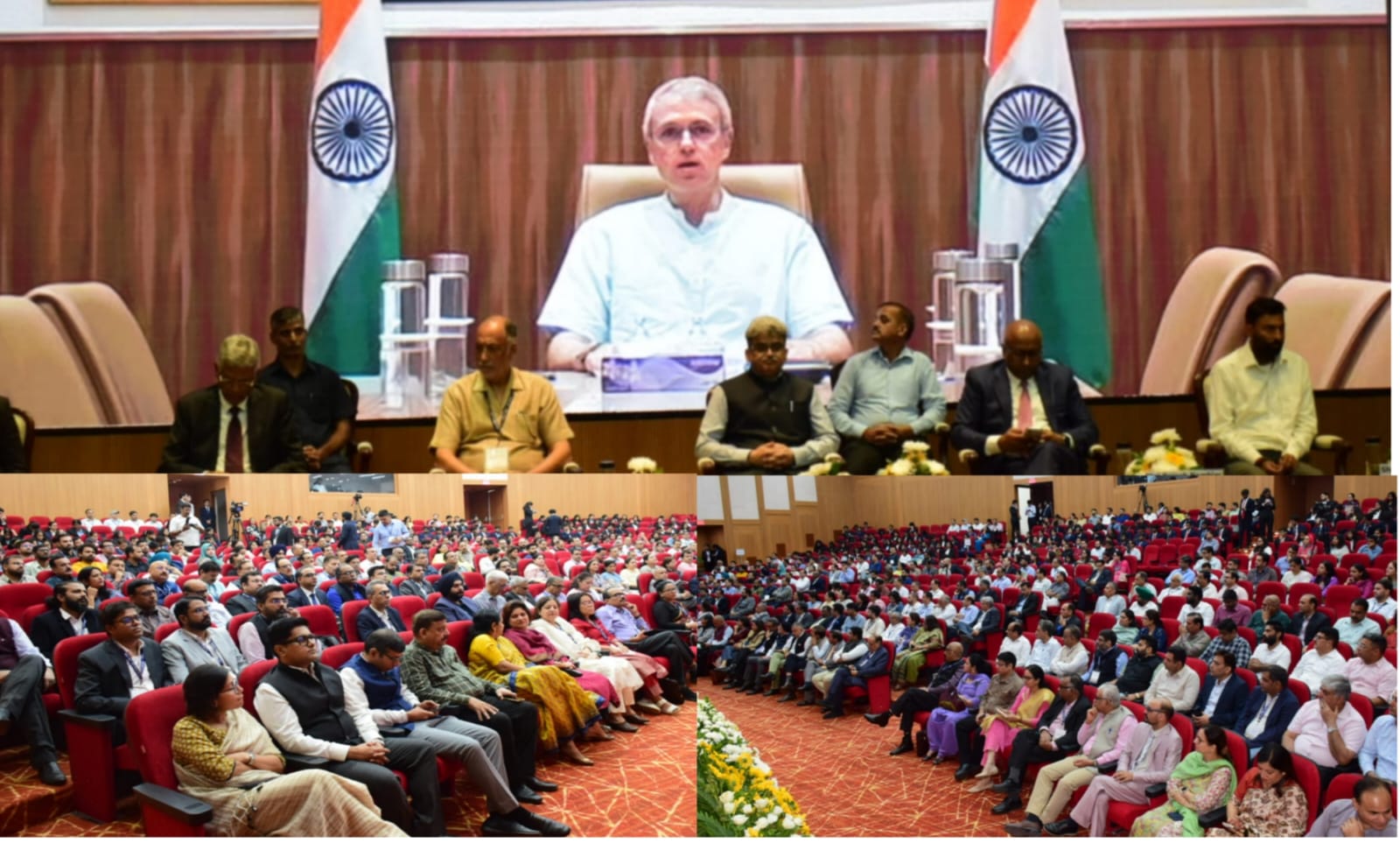
Addressing the inaugural session of the J&K GCC Summit 2026 virtually from New Delhi, Abdullah said the region now counted periods of calm in years rather than days, weeks or months.
“We invite you to come and invest. Give us a chance. Try us out and explore Jammu and Kashmir as an emerging destination for Global Capability Centres,” he said, pledging a business-friendly environment to attract investment, promote innovation and create jobs.
Abdullah acknowledged that Jammu and Kashmir continued to face a perception problem stemming from more than three decades of turmoil. He said the government was seeking to change that image by investing in industry, manufacturing, agriculture, tourism, and emerging sectors such as GCCs.
Recalling an investment event organised by NASSCOM in Srinagar during former chief minister Mufti Mohammad Sayeed’s first tenure between 2002 and 2005, Abdullah said Infosys co-founder N.R. Narayana Murthy had then told Sayeed that he would invest if the region could provide six days of peace and calm.
“Thankfully today, we don’t count our periods of calm in days; we don’t count them in weeks; we don’t even count them in months. I think it’s safe to say that we count them in blocks of years,” Abdullah said.
He said the change reflected Jammu and Kashmir’s evolution and its growing potential to attract businesses, while acknowledging that perceptions built over decades would take time to change.
Abdullah said Jammu and Kashmir did not need to compete directly with established GCC centres such as Bengaluru, Hyderabad and Chennai. Instead, it could seek to attract businesses currently considering tier-two and tier-three cities such as Jaipur, Pune and Mohali.
“We can learn from the experiences of others. We don’t have to reinvent the wheel. We just have to use it better,” he said.
GCCs in India had evolved from call centres and business process outsourcing operations into centres of innovation, talent and enterprise, he said. Rising operating costs in larger cities could create opportunities for emerging destinations such as Jammu and Kashmir.
The region’s network of higher education institutions, including IIM Jammu, IIT Jammu, Shri Mata Vaishno Devi University, the University of Jammu, the University of Kashmir and the Islamic University of Science and Technology, could provide a skilled workforce for such centres, Abdullah said.
He said many educated young people were forced to seek jobs outside the region because local opportunities were limited. Establishing GCCs could help retain talent, generate quality employment and connect young people to technology-driven industries.
Abdullah said the summit’s success should not be measured by an immediate influx of companies but by whether it laid the groundwork for sustained investment.
“We’d be quite happy to have one, the first GCC. One will lead to five. Five will lead to ten. And the story will grow from there,” he said.
He said that businesses should choose Jammu and Kashmir because it made commercial sense, not out of sympathy for the region’s past difficulties.
Abdullah said the government had taken steps to improve the investment climate, including the passage of comprehensive Ease of Doing Business legislation during the recent session of the Legislative Assembly. The legislation had received the lieutenant governor’s assent and become law, he said.
Its effective implementation would be critical, he added, saying the government would make further changes based on experience and feedback from industry.
The region’s climate and road, rail and air connectivity were among its advantages, Abdullah said, promising government support to companies seeking to establish profitable operations.
He also called for sustained engagement with NASSCOM and other industry stakeholders, expressing hope that the two-day summit would lead to tangible investment and employment opportunities.
The summit, organised at IIM Jammu under the theme “Unlocking J&K’s GCC potential for building growth ecosystem and catalysing investment”, brought together around 45 organisations, more than 55 industry leaders and over 300 delegates.
Those attending the inaugural session included Chief Secretary Atal Dulloo, NASSCOM President Rajesh Nambiar, NIIT Chairman Rajendra Singh Pawar and IIM Jammu Director B S Sahay.
Abdullah, who also holds the finance portfolio, joined virtually because of scheduling issues linked to the postponement of the GST Council meeting.
He had been in New Delhi for the council meeting chaired by Union Finance Minister Nirmala Sitharaman on October 8.