
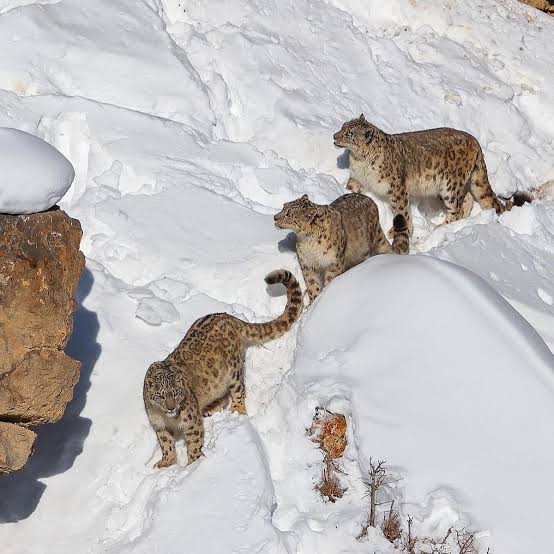
The snow leopard is almost perfectly designed to disappear.
Across the high mountains of Jammu and Kashmir, it moves through cliffs, scree slopes and alpine valleys where even experienced trackers can spend days without seeing one. Its elusiveness has long been part of its mystique. But conservation cannot be built on mystery.
It needs numbers.
It needs movement data. It needs genetic evidence. It needs to know where animals live, how far they travel, what pressures they encounter and whether apparently suitable habitat is actually being used.
That is why the renewed push for scientific monitoring of snow leopards deserves attention in J&K.
The Russia-India Roundtable Meeting on Snow Leopard Study and Conservation in Moscow has placed population estimation, radio telemetry and genetic analysis at the centre of the conversation. For a species inhabiting some of the most inaccessible terrain on the planet, this is not an indulgence in technology. It is increasingly the foundation of sensible conservation.
J&K should make the most of it.
The first nationwide Snow Leopard Population Assessment in India estimated nine snow leopards in J&K.
That number was important because it gave the region a baseline. But subsequent camera-trap research covering roughly 12,000 square kilometres suggested that the actual population could be considerably larger, with estimates of up to 20 individuals across identified habitats.
The difference is significant.
It does not necessarily mean that nine was wrong or that 20 is definitively right. Different surveys use different methodologies, geographic coverage and assumptions. Rather, the gap tells us something more useful: we still have much to learn about the snow leopard population in J&K.
That should be the starting point for the next phase of conservation.
The second phase of the Snow Leopard Population Assessment – SPAI 2.0 – therefore comes at an important moment.
Instead of treating a population estimate as a final answer, authorities should treat it as a continually improving picture.
The snow leopard’s problem is not simply that it is rare.
It lives in landscapes that are also working landscapes.
Livestock graze in high-altitude pastures. Communities depend on alpine and sub-alpine areas. Wild prey and domestic animals can compete for available forage. Human activity can disturb habitats, while encounters between predators and livestock can generate conflict.
For conservationists, this makes the snow leopard a particularly useful test.
Protecting an animal in an entirely uninhabited landscape is one challenge. Protecting it where people live, graze animals and move seasonally is another.
Better monitoring can help bridge that divide.
If scientists know where snow leopards move, they can better understand where livestock grazing overlaps with predator habitat. If radio telemetry identifies recurring movement corridors, those areas can receive greater conservation attention. If genetic sampling reveals how populations are connected, conservation planning can move beyond administrative boundaries.
Science cannot eliminate conflict.
But it can make decisions less dependent on assumption.
There is another reason to improve the quality of the data now: the mountains themselves are changing.
Climate change poses a long-term threat to high-altitude ecosystems and could reduce suitable snow leopard habitat. At the same time, more adaptable common leopards may increasingly move into areas traditionally associated with snow leopards.
The implications are difficult to predict with certainty.
But that uncertainty is precisely why monitoring matters.
A species does not necessarily vanish from a landscape in one dramatic event. Its range can contract gradually. Its prey base can change. Its movements can shift. Competition can increase. Breeding populations can become isolated.
By the time such changes become visible to casual observation, they may already be well advanced.
Long-term camera trapping, genetic sampling and telemetry can provide the early warning system that conservation policy needs.
For J&K, much of this work should naturally focus on the Kishtwar Himalayas.
Kishtwar High Altitude National Park, along with adjoining landscapes such as Paddar and Warwan, has emerged as an important area for snow leopard research. The terrain is difficult, but that difficulty also makes it valuable as a test case for modern wildlife science.
The region should not become merely a location where scientists collect data.
It could become a model for how J&K manages high-altitude wildlife.
That means combining technology with local knowledge. People living around these landscapes often understand seasonal movements, grazing routes, weather patterns and wildlife behaviour in ways that satellite images and cameras cannot fully capture.
A serious monitoring programme should therefore not see local communities simply as potential sources of conflict.
They are also potential partners in conservation.
There is always a temptation in wildlife conservation to celebrate a new population number.
More animals can sound like success. Fewer animals can sound like failure.
But a number is only useful if it changes what authorities do.
If SPAI 2.0 confirms a larger population in J&K, the response should not be complacency. If it produces a smaller estimate, the response should not be panic. In either case, the real question should be: what does the evidence tell us about habitat, threats and survival?
That is where the Russia-India cooperation could matter.
The Moscow roundtable, organised under a partnership involving the Interregional Association “Irbis” and the International Big Cat Alliance, reflects a wider recognition that snow leopard conservation cannot be confined to isolated national programmes.
The animal does not recognise borders.
Its range stretches across mountainous landscapes shared by several countries, making scientific cooperation particularly valuable.
For J&K, participation in this broader effort should translate into better field science, stronger datasets and more sustained monitoring.
Technology, however sophisticated, will not by itself save the snow leopard.
A camera can record an animal. A genetic sample can reveal its lineage. A transmitter can show where it travels.
None can resolve a dispute between a shepherd and a predator.
That requires policy.
J&K will need conservation measures that account for livestock losses, grazing pressures and community livelihoods alongside the ecological needs of the snow leopard. Where conflict occurs, prevention, compensation, awareness and community participation can be as important as population surveys.
The objective should be coexistence based on evidence rather than conservation imposed from a distance.
The snow leopard’s greatest strength – its ability to survive in places that appear almost impossible to inhabit – can sometimes create a false sense of security.
Because the animal is rarely seen, it can be easy to assume that it is doing fine.
It may not be.
And because the available estimates differ, it is equally easy to argue over whether J&K has nine, 20 or some number in between.
That debate misses the larger point.
The important thing is to build a system capable of telling us, with increasing confidence, how many there are, where they are moving, what they are eating, how populations are connected and what is changing around them.
J&K has an opportunity to do that now.
SPAI 2.0 should not merely produce another number.
It should produce a better understanding of an animal whose survival depends on understanding a landscape that is changing faster than ever.
For the snow leopard, invisibility may be a survival strategy. For conservationists, it cannot be an excuse for uncertainty.
About the Author
Syed Sameer Ahmad Nazki is a filmmaker skilled in editing and videography, with an interest in visual storytelling and sports.