
The consignment arrived in Kashmir by a route that, until recently, had attracted less scrutiny than the highways. Inside cardboard boxes packed into Styrofoam containers were hundreds of kilograms of buffalo meat, sent from Delhi to Budgam by parcel train. By the time officials opened the load, the meat was reportedly foul-smelling, leaking and decomposed.
The Food and Drug Administration of Jammu and Kashmir seized and destroyed about 2000 kilograms of the consignment at Budgam Railway Station, according to the material provided for this report. The seizure has revived concerns first brought into public view by the meat scandal of 2025: how food that may be unsafe travels into the Valley, how it passes through transport networks and whether the agencies responsible for inspection have the staff and equipment to detect violations before products reach consumers.
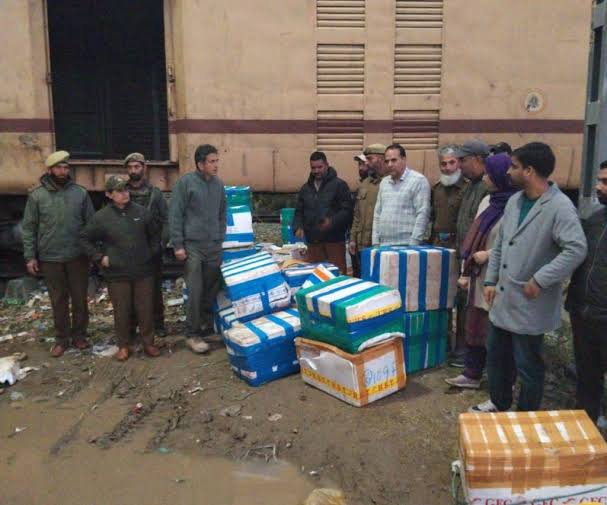
The latest operation followed a tip-off from railway officials. A joint team comprising the FDA, Railway Police, railway authorities, the Budgam district administration and the Municipal Committee Budgam inspected a load described by officials as weighing about 1600 kilograms and packed in 44 boxes. The consignment had travelled without ice or refrigeration, although frozen meat is required to be maintained at minus 18 degrees Celsius or below.
Police descriptions referred to a strong smell and leakage. Preliminary tests conducted through the FDA’s Food Safety on Wheels vehicle found the meat unfit for consumption. Reports said a further 380 kilograms was recovered in similar condition several hours later. The FDA’s public statement did not confirm that additional seizure, a distinction that matters when the total quantity is being reported. The material also says that the consignment was destroyed and that an FIR was registered at the Railway Police Station in Budgam under Section 271 of the Bharatiya Nyaya Sanhita. A handler was reportedly detained as investigators began tracing the source and those involved in its movement.
The seizure was not an isolated episode. Months earlier, the FDA had confiscated about 2,600 kilograms of frozen meat in Srinagar, where it was allegedly stored in unhygienic conditions. With the Budgam operation, the quantity seized during the year was put at about 4200 kilograms. In 2025, raids linked to a scandal described in reports as a “meat mafia” recovered around 12,000 kilograms. Rejected meat from Delhi’s Ghazipur market was alleged to have been treated with chemicals to disguise its condition before being sold to hotels, roadside eateries and other food businesses. The case reached the High Court.
The recurrence raises a question larger than the condition of one consignment: whether the systems that regulate the movement of perishable food are designed to follow the product throughout its journey. Meat can leave a processing or storage facility in acceptable condition and become unsafe if the required temperature is not maintained during transport, unloading or storage. The distance between Delhi and Srinagar makes an uninterrupted cold chain essential. Ordinary parcel handling, officials and food-safety experts say, is not a substitute for refrigerated transport, suitable packaging, traceable documentation and the veterinary and food-safety certificates required for such consignments.
The railway route has now come under closer attention. An FDA official said road check posts and air cargo were monitored, while goods loaded on trains had not been subject to the same level of checking. The Budgam seizure, prompted by information from railway officials, suggests that inspection arrangements at transport hubs need to account for the different ways food enters the region. It does not establish that all railway consignments are unsafe; it does show how a gap in routine scrutiny can become consequential when the cargo is highly perishable.
The problem extends beyond meat. In Jammu, the FDA recently seized and destroyed 115 kilograms of cottage cheese brought reportedly from Kathua. The department said the product had been transported and stored without the prescribed temperature controls. The registration of the food business operator concerned was suspended, and the seized material was destroyed at a designated municipal dumping site. The episode followed the seizure and destruction of 7,665 kilograms of cottage cheese in Jammu and Samba between April and December 2025. The material presented to the Assembly valued that quantity at about Rs 16.32 lakh. In August 2025, 2,100 kilograms of suspected synthetic or adulterated cottage cheese had been seized in Gangyal.
These cases point to a distinction that can be lost in the public reaction to a food scare. Meat or dairy products do not become unsafe simply because they have come from outside Jammu and Kashmir. Nor does local origin, by itself, guarantee safety. Different products require different controls. Frozen meat transported over long distances depends on a documented cold chain and source verification. Freshly slaughtered livestock requires veterinary inspection before and after slaughter, clean equipment and hygienic handling. Processed products require scrutiny of their ingredients, composition and labels. Contamination can occur at several stages, including slaughter, cutting, packing, transport and retail sale.
Experts have also raised concerns about the possible use of chemicals to make stale or rejected meat appear fresh. Formalin is not an acceptable preservative for fresh meat, and its detection would raise serious safety concerns. Chlorine-based compounds can also be misused to disguise spoilage. The supplied reporting says that such tests are rarely carried out locally because laboratory capacity is limited. The concern remains an allegation and a testing gap, not proof that chemicals were used in the Budgam consignment.
That gap is especially important because Jammu and Kashmir has invested in equipment capable of detecting a wider range of contaminants. Food-testing laboratories in Srinagar have instruments including liquid chromatography-tandem mass spectrometry, gas chromatography-tandem mass spectrometry and inductively coupled plasma mass spectrometry. Each machine cost about Rs 3 crore, according to the reporting. Together, they can identify pesticide and veterinary-drug residues, mycotoxins, organic chemical contaminants and toxic metals such as lead, arsenic, cadmium and mercury, including at very low concentrations.
But the equipment cannot operate itself. The laboratories have a sanctioned requirement of 19 technical personnel each, while 11 posts are vacant. The source material says each laboratory is being run by eight technical personnel and that those staff members have not received adequate training to operate the sophisticated instruments. As a result, much of the advanced testing capacity remains unused. Officials say samples are sent to laboratories outside the Union Territory, a practice that adds cost and time to the process.
The shortage is not confined to laboratory benches. The Food Safety Department has 68 Food Safety Officers across the two divisional cadres, with 34 officers in each division covering the districts in their respective areas. Legislators have questioned whether that staffing is sufficient to inspect manufacturers, wholesalers, retailers, restaurants, hotels and street-food vendors. Food Safety Officers are expected to examine premises, collect samples, check storage and hygiene, verify licences and take action under the Food Safety and Standards Act. The reporting says officers are deployed in only about 60 medical blocks, leaving some areas without effective field-level monitoring.
The department’s 12 Food Safety on Wheels vehicles present another example of the difference between equipment and operational capacity. The mobile laboratories have reportedly not been deployed because drivers and technicians are unavailable. Their manpower had been provided through a third-party contract that expired at the beginning of the year. An official said no fresh tender had been issued for six months. In February 2026, the government told the Legislative Assembly that the mobile laboratories were fully functional and that outsourced personnel were being engaged to address staff shortages. The present position of the fleet, according to the reporting, has not been clarified.
The government had also acknowledged vacancies in the technical workforce of the two accredited laboratories and said posts would be referred to recruiting agencies after recruitment rules were finalised. That commitment identifies a procedural step, but the continuing gap raises questions about the pace at which it is being carried out and whether staffing plans have kept pace with investment in infrastructure.
An October 2026 advisory from the Food Safety and Standards Authority of India warned of seizure and destruction in cases involving violations in meat consignments. Enforcement rules matter, but their effect depends on inspection at entry points, laboratory testing, trained personnel and a system that can trace a product from its source to the point of sale. A seizure after a consignment has reached Budgam is evidence that enforcement can act when alerted. It is not evidence that every consignment is being checked.
For consumers, the immediate consequence of repeated seizures is distrust. For businesses that follow the rules, indiscriminate suspicion can be damaging. The answer is not to treat all meat, dairy products or food arriving from outside the region as suspect. It is to make the standards verifiable and the enforcement system capable of applying them consistently.
The Budgam consignment travelled hundreds of kilometres without the temperature control required for frozen meat. Its discovery has exposed a railway inspection gap, but the wider picture is more complicated: laboratories equipped to identify dangerous substances but short of trained operators; mobile testing units without the staff to run them; and field officers expected to monitor a broad and diverse food market. The food-safety system has tools. Its ability to use them remains the central question.
About the Author
Amir Yaseen is a Srinagar-based journalist interested in Kashmir, policy, progress, and the human stories shaping everyday life.