
On a bend of a mountain road, where a stream cuts through the landscape, the evidence is hard to miss.
A plastic bottle rests among stones. Food wrappers collect in the grass. Thin polythene bags catch on bushes, fluttering in the wind before rain carries them toward the water.
Across Jammu and Kashmir, plastic has become difficult to separate from the landscape it is polluting.
It is visible in Srinagar and Jammu, in smaller towns and in villages, along roads and riverbanks, beside markets and in tourist destinations. In the mountains, where the landscape is one of the region’s principal attractions, discarded packaging increasingly travels the same routes as visitors – roads, trails, streams and campsites.
The contradiction is striking: Jammu and Kashmir has spent years restricting polythene and plastic, yet the material remains stubbornly present.
The problem is not a lack of rules.
It is what happens after the rules are announced.
J&K’s battle with polythene is nearly two decades old.
Restrictions began in 2006, when the High Court restricted the use and sale of polythene at tourist destinations and healthcare institutions. In 2008, the government issued SRO-182 under the J&K Non-Biodegradable Material (Management, Handling and Disposal) Act, 2007, imposing a blanket ban on polythene carry bags.
The restrictions were expanded in 2017 through SRO-45 to cover the manufacture, stocking, distribution, sale and use of specified polythene and plastic products.
A year later, the High Court directed authorities to strengthen enforcement, including action against banned material entering through entry points and being stored at wholesale depots.
The Centre added another layer in 2022, restricting identified single-use plastic items nationwide.
Still, banned material continues to appear in markets.
At Lakhanpur, J&K’s principal entry point from Punjab, authorities maintain an anti-polythene checkpoint. Yet the supply chain has proved difficult to close. In 2025, the J&K Pollution Control Committee seized about 1,100 kilograms of banned polythene from a vehicle there.
Stopping one consignment, however, does little to explain how much plastic is already circulating.
The more difficult question is what happens once it reaches the consumer.
In many rural areas, waste collection remains irregular or absent.
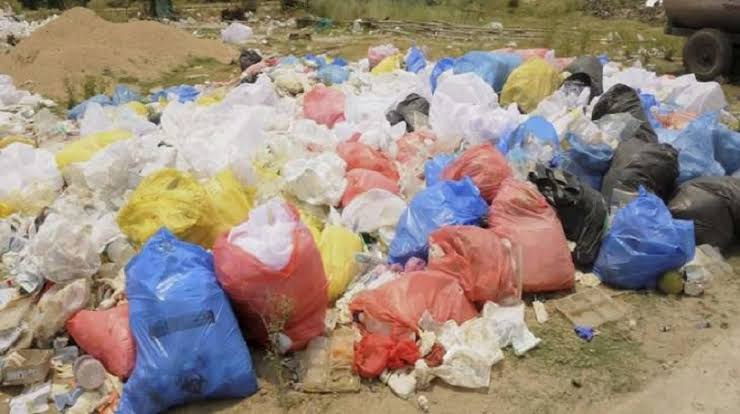
Some villages have solid-waste management sheds, but without reliable collection, garbage can accumulate around the very facilities intended to manage it. In some places, sheds are located close to streams or other water bodies, creating an easy route for waste to enter the natural environment.
Kitchen waste is often mixed with polythene, plastic packaging, diapers and other non-biodegradable material.
That mixture turns a collection problem into a processing problem.
Organic waste that could be composted becomes contaminated. Recyclable plastic becomes harder to recover. What remains is more likely to be dumped, burned or transported to already burdened disposal sites.
The same pattern appears in towns, where limited segregation, processing and disposal capacity leaves waste in open spaces and near water bodies.
Rain does the rest.
Plastic discarded on a roadside does not necessarily stay there. Runoff can carry bottles, wrappers and polythene into drainage channels and streams, eventually connecting urban and rural waste with the region’s rivers and lakes.
Studies have detected microplastics in Manasbal Lake, adding another dimension to concerns about plastic pollution in Kashmir’s freshwater ecosystems.
The problem becomes particularly visible where visitors gather.
Pahalgam, Gulmarg, Sonamarg and Doodhpathri face heavy tourist pressure. But the plastic trail does not stop at the most famous destinations.
Yousmarg, Daksum, Kokernag, Chatapal, Sinthan Top, Margan Top, Aharbal, Gurez, Keran, Warwan and the Marwa valleys are also seeing increasing amounts of discarded packaging along roads, trails and water sources.
For a region that sells its mountains, forests, lakes and streams as part of its tourism economy, the contradiction carries an economic cost as well as an environmental one.
The tourist may leave after a few days.
The bottle does not.
The Jammu and Kashmir Legislative Assembly’s Committee on Environment has now called for a tougher response.
The committee, headed by CPI(M) legislator Muhammad Yusuf Tarigami, recommended in June a comprehensive ban on plastic and stronger checks at entry points, tourist destinations, religious places and other environmentally sensitive areas.
It also sought action against the illegal transportation, sale and use of prohibited products, while asking government departments and public institutions to discourage plastic at offices, meetings and official functions.
“We have been submitting our recommendations to the government about the use of polythene and plastic and suggesting measures to curb it and protect the fragile environment of Jammu and Kashmir,” Tarigami said.
But he acknowledged the central weakness.
“So far, implementation of the ban on usage of polythene and plastic is not seen on the ground,” he said.
The committee has also sought information on environmental impacts, legacy waste, scientific processing and compliance with National Green Tribunal directions at major dumping sites, including Achan in Srinagar and Bhagwati Nagar in Jammu.
Those questions go beyond the familiar ritual of another ban.
They ask whether the waste that has already accumulated is being dealt with scientifically.
Jammu and Kashmir generates more than 50,000 tonnes of plastic and polythene waste annually, according to the figures cited in the report. Between 2018-19 and 2022-23, more than 2.25 lakh tonnes of plastic waste were generated.
The numbers are large enough to make enforcement at shops alone inadequate.
Environmental activist Raja Muzaffar Bhat argues that J&K needs a sustained government-led campaign against plastic pollution, combined with public participation.
“We need a government-led ‘Waste-Free Jammu and Kashmir’ campaign on the lines of the anti-drug drive,” Bhat said.
His emphasis is not simply on banning plastic but on separating waste before it becomes garbage.
He has called for segregation at source and home composting, noting that nearly 80 per cent of municipal solid waste is organic and can be composted rather than mixed with plastic and polythene.
That distinction is crucial.
If food waste, plastic, diapers and other materials arrive at the same dumping point, the system has already lost the opportunity to recover much of what could have been reused, recycled or composted.
Ladakh offers a regional example of a different approach, with stricter restrictions on identified single-use plastic, intensified checks at entry points and powers for authorised field officials to impose penalties.
The lesson is not that a neighbouring administration has discovered a single solution.
It is that restrictions work differently when they are accompanied by visible enforcement, monitoring and consequences.
In Kashmir, enforcement teams continue to conduct seizures. Safeer Hussain Shah, Regional Director of the JKPCC in Kashmir, said teams recently seized 40 tonnes of polythene in Anantnag, following an earlier seizure of 29 tonnes in Rajbagh, Srinagar.
Such seizures demonstrate that enforcement exists.
They also demonstrate how much prohibited material continues to move through the system.
There is an understandable tendency to treat polythene as the villain and a ban as the remedy.
But the waste scattered across J&K tells a more complicated story.
Plastic becomes an environmental crisis when a disposable product enters a system that cannot reliably collect, separate, process and dispose of it.
The answer therefore cannot rest entirely at the point of sale.
It has to begin there – with enforcement against prohibited products – but continue through homes, markets, municipalities, villages, tourist destinations, transport routes and dumping sites.
A bottle thrown beside a mountain stream is the final act in a much longer chain of failures.
For years, J&K has responded to plastic with another notification, another restriction and another enforcement drive.
The landscape suggests that the harder task has been building what comes after the ban: a waste system capable of making the ban real.
Until that happens, the polythene bag will remain a familiar sight in the bushes, the plastic bottle in the stream and the wrapper beside the road — reminders that outlawing waste is considerably easier than keeping it out of the environment.
About the Author
Wajahat Iqbal Kashtwari is a filmmaker and multimedia professional with a keen interest in the environment, ecology, and climate change.