
On paper, Srinagar is nearly a finished Smart City.
Of the 161 projects taken up under the city’s Smart Cities programme, 157 – about 98 percent – had been completed by March 31, 2026. The projects, including those under Water, Sanitation and Hygiene, represent an investment of thousands of crores and have altered some of the city’s most visible spaces.
Roads have been rebuilt. Footpaths have been widened or redesigned. Public spaces have acquired new furniture and lighting. Commercial areas have been pedestrianised. Urban infrastructure has been installed in places that had remained largely unchanged for decades.
The official ledger looks impressive. But a city is not made smart by completing a project. It becomes smarter if the project continues to work.
That is the question now confronting Srinagar after years of construction under the Smart Cities Mission: what happens after the ribbon-cutting?
The city has spent about Rs 3530 crore on the 157 completed projects, according to information reported by Srinagar Smart City. The total value of the 161 projects taken up is about Rs 3633 crore.
The numbers show the scale of the transformation.
They do not, by themselves, show whether the transformation has lasted.
For traders who depend on footfall, access and functioning public infrastructure, the distinction is becoming increasingly important.
“The assets created under the Smart City project have not been adequately maintained, undermining the value of the investment made in them,” said Aijaz Shahdhar, president of the Kashmir Trade Alliance.
His criticism goes to the heart of the next phase of Srinagar’s urban experiment.
The city no longer has to prove that it can build. It has to prove that it can maintain.
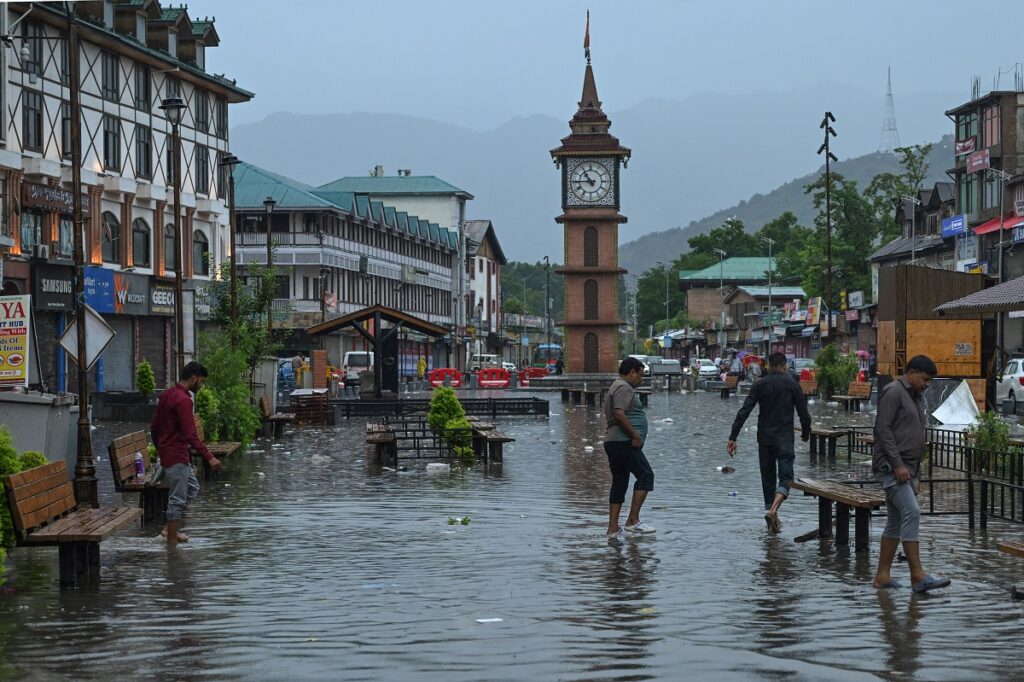
Few places illustrate that transition more clearly than Lal Chowk.
For generations, the city’s commercial heart has been more than a marketplace. It is a meeting point, a transport hub and a public stage. Its redevelopment was therefore expected to do more than improve its appearance.
For a while, traders say, it did.
A retail trader near the Clock Tower, remembers the excitement when the Lal Chowk Plaza was completed.
“When this Smart City project was made, and this Lal Chowk Plaza was created, we were very excited,” he said.
The fountains worked. The public spaces were new. People came in the evenings.
“There was a huge rush in Lal Chowk,” he recalled. “Everything was fine. New and fresh things were there. Fountains were running. It was looking good. People used to come in the evening.”
Then, he said, the novelty faded – and so did some of the infrastructure.
“As time passed, it went towards deterioration because of no maintenance,” he said, pointing to damaged bollards and a fountain that no longer functioned.
The complaint is deceptively simple.
A fountain is not a Smart City. Neither is a decorative bollard, a paved plaza or a row of lights. But each represents public money, and each is supposed to contribute to the quality of a public space. When such assets stop working, the question is no longer whether they were successfully installed. It is whether the system responsible for them can keep them operational.
That may be the least glamorous part of urban development.
Construction has a beginning and an end. Maintenance does not.
A new road requires repairs. A pedestrian plaza needs cleaning and resurfacing. Streetlights need replacement. Drainage systems need clearing. Public furniture wears out. Electrical and mechanical equipment fails.
The first year of a new project can look radically different from its fifth or 10th year.
This is why Srinagar’s Smart City experience is entering a different phase.
The question is shifting from how much has been built to how long it will work.
Shahdhar said traders are less interested in the value of completed projects than in their continuing utility.
Roads, parking facilities, drainage, pedestrian infrastructure and access to commercial areas directly affect businesses. An attractive public space that becomes difficult to access, poorly maintained or disconnected from surrounding streets may not deliver the economic benefits originally expected.
That is particularly significant in a city where commercial activity depends heavily on dense pedestrian and vehicular movement.
Polo View Market offers another example. The market’s pedestrianisation was intended to create a safer and more attractive environment for people on foot. Yet traders have argued that the removal of parking and changes in traffic movement have affected customer access and footfall.
Their argument is not necessarily against pedestrianisation. It is about what comes with it.
A pedestrianised market can work very differently depending on whether nearby parking exists, whether deliveries can be made efficiently, whether public transport is accessible and whether customers can reach the area without excessive inconvenience.
Urban renewal can improve one part of the city while creating pressure somewhere else if the surrounding network is not redesigned with it.
For a trader, that is not an abstract planning question. It can determine whether a customer stops at a shop.
The experience of Polo View therefore raises a larger question about the Smart City approach: how closely were individual projects connected to the economic life of the city?
The government has maintained that Srinagar’s Smart City proposals were prepared locally around identified city needs and through consultation with citizens and other stakeholders.
Traders, however, say they wanted greater involvement in decisions affecting commercial access.
A shopkeeper said that they were not adequately consulted about what facilities businesses and residents would need.
“We were never asked how a Smart City should be made, what facilities shopkeepers and people would need,” he said. “They made the Smart City in their own way.”
The disagreement is important because consultation is not simply a procedural requirement.
It is a test of whether a project understands the people who must use it every day.
Yet the story of deteriorating infrastructure is not entirely a story of administrative failure.
Feroz Ahmed Baba, president of the Lal Chowk Traders Association, offered another account of what happened to parts of the plaza.
He recalled the damage caused when people climbed onto a fountain during its inauguration period.
“When it was inaugurated, on the 14th and 15th of August, some people came and danced on the fountain,” Baba said. “Then the fountain was pressed down, and almost its entire structure was broken.”
Traders subsequently worked with authorities to restore and strengthen parts of the infrastructure, he said.
“We worked together. We made Lal Chowk better,” he said.
But damaged fountain nozzles and lighting have continued to be an issue.
That episode points to an inconvenient truth about public infrastructure.
Governments can build it. Officials can maintain it. But citizens also have to use it responsibly.
A public space cannot remain functional if the people who use it treat its equipment as disposable. Nor can public authorities use vandalism as an excuse for failing to repair damage.
A durable Smart City therefore requires more than engineering. It requires a culture of public ownership.
There is another reason the maintenance question matters.
The Smart Cities Mission was never intended simply as a beautification programme.
Its stated focus extended to mobility, water and sanitation, governance, energy, environment and urban infrastructure.
That broader ambition is especially relevant to Srinagar because some of its most interesting proposed solutions have yet to fully materialise.
Water transport on the Jhelum was discussed as part of the city’s mobility strategy, with the Kerala model reportedly considered as a reference.
The river already runs through Srinagar’s urban core.
Yet years after the Smart City programme began, water transport has not emerged as a major part of everyday urban mobility.
“Years have passed, but till now the water transport concept has not taken off,” Baba said.
That gap illustrates the difference between a collection of projects and a citywide strategy.
A smart transport system is not simply a new road, a renovated footpath or a pedestrian plaza. It is the connection between them.
Can someone park outside the core, walk safely to a market, use public transport and return without negotiating a maze of traffic? Can deliveries reach businesses without undermining pedestrian spaces? Can the Jhelum become part of the city’s transport network rather than merely its landscape? Can drainage, waste management and mobility systems function together?
Those are the questions that determine whether an urban transformation has changed how a city works.
The official completion figure is difficult to dismiss. At least 157 of 161 projects are completed. That represents about 98 percent of the projects taken up.
The investment is equally substantial: about Rs 3530 crore in completed projects, out of a total project value of Rs 3633 crore.
There is therefore little doubt that Srinagar has undergone a significant physical transformation.
The more difficult question is how that investment should now be judged.
Completion is an input. Functionality is an outcome. And maintenance is what connects the two.
The city could have 157 completed projects and still have problems with parking, congestion, drainage, public-space maintenance and access to commercial areas.
Conversely, some projects may already be producing benefits that are not captured by a simple completion percentage.
The figures tell us what has been built. They do not tell us how residents experience it.
Srinagar has reached the point where the Smart Cities Mission cannot remain an endless construction story.
The cranes will eventually disappear. The contractors will leave. The inauguration photographs will become archival material. What remains will be the assets. Their second life will determine the value of the first.
That means Srinagar needs a transparent maintenance system for the infrastructure created under the programme. Citizens should be able to know who is responsible for each public asset, how frequently it is inspected, how quickly complaints are addressed and how much is being spent on upkeep.
The city also needs to measure the less visible outcomes: pedestrian movement, public transport use, commercial footfall, parking availability, drainage performance and accessibility.
And traders need a meaningful place in that conversation. Their businesses occupy the spaces being redesigned. Their customers use the roads and pedestrian areas. Their experience can reveal problems that may not appear in project-completion reports.
The Smart City Mission gave Srinagar a large physical makeover. The next chapter is less photogenic. It involves fixing what breaks, cleaning what gets dirty, redesigning what does not work and listening to the people who use the city every day.
That is not a failure of the Smart City idea. It is the test that comes after it.
Srinagar has spent years learning how to build a new city. Now it has to learn how to keep one.
About the Author
Mir Suneem is a filmmaker and postgraduate in filmmaking from Jamia Millia Islamia, with a strong interest in editing and narrative craft.