
For more than six decades, the road to the Amarnath cave has been a measure of more than devotion.
It has also been a measure of Kashmir itself.
In 1963, an estimated 4000 yatris made the arduous journey to the Himalayan shrine, according to a compilation of historical records. In the decades since, the yatra has expanded into a vast annual movement of people, reaching more than 600,000 yatris in its strongest years.
The scale of that transformation is striking. The number of yatris has risen more than a hundredfold from the earliest figure in the available series, even as the yatra has repeatedly been interrupted or diminished by political unrest, security concerns, natural hazards and, most recently, a global pandemic.
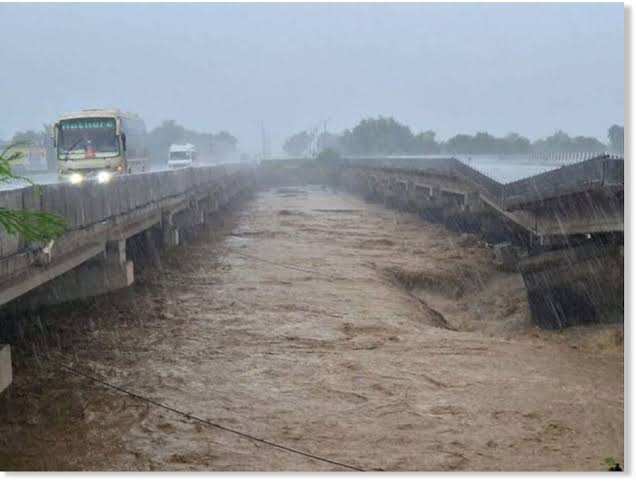
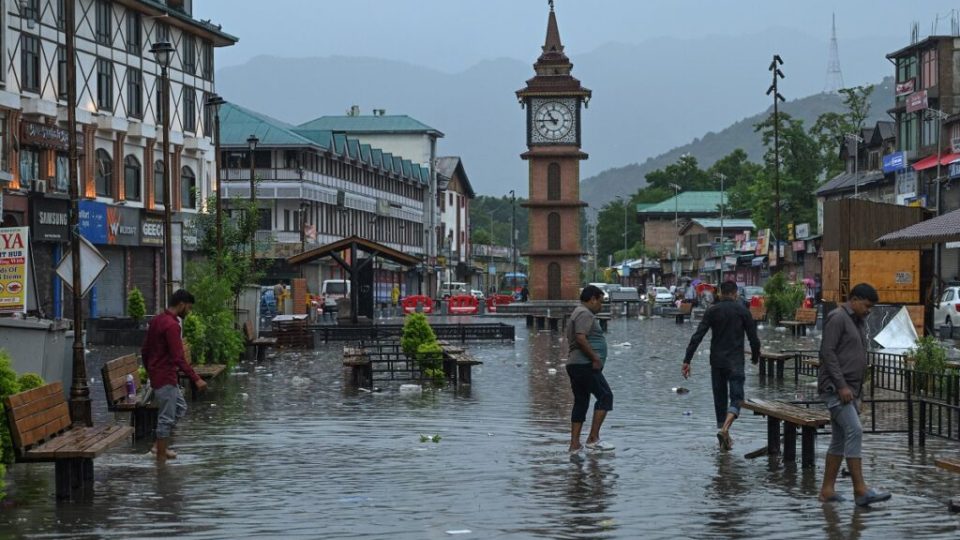
The latest interruption came Sunday, when the Amarnath Yatra was suspended on both the Chandanwari and Baltal routes because of persistent heavy rain and damage to vulnerable sections of the tracks.
About 4.80 lakh yatris had already undertaken the yatra this year.
The yatra, which began on July 3 and was scheduled to conclude on August 28, is now unlikely to resume, officials said, citing safety concerns, adverse weather forecasts and the need for urgent repairs along the mountain routes.
The annual Chadi Mubarak ritual will proceed as scheduled, officials said, preserving an important religious tradition even as the main yatra is not expected to restart this season.
The numbers tell a larger story.
Data compiled by Kashmir Weather from Ministry of Home Affairs records, parliamentary reports, Department of Tourism documents, CRPF annual reports and research papers shows a yatra that has expanded in fits and starts, often reflecting the political and physical conditions of the Valley.
The figures were shared by Kashmir Weather on X.
The first years in the supplied series show a relatively small yatra. About 4000 people are estimated to have travelled to the cave in 1963. By 1980, the recorded number had risen to 19,578.
The increase continued through much of the decade.
There were an estimated 26,000 yatris in 1981 and 25,000 in 1982. The figure dipped to 21,021 in 1983 before falling further to 9,483 in 1984. It then rebounded sharply, reaching an estimated 42,000 in 1985, 51,000 in 1986 and 52,000 in 1987.
By 1988, 96,055 yatris were recorded.
A year later, the figure remained almost unchanged at 95,238.
Then came 1990.
Only 4824 yatris undertook the journey that year, the lowest recorded figure in the supplied series.
The collapse coincided with the eruption and escalation of armed violence in Jammu and Kashmir, which transformed everyday life across the region and severely disrupted travel, tourism and religious yatra.
The fall was not permanent.
In 1991, the number rose to 15,589. A year later it more than tripled, reaching 54,638. The figure stood at an estimated 56,000 in 1993 and 37,000 in 1994 before climbing to 61,045 in 1995.
In 1996, the yatra crossed the 100,000 mark for the first time in the supplied data, with 120,432 yatra making the journey.
The expansion gathered momentum.
There were 79,035 yatris in 1997, followed by 149,920 in 1998. The figure slipped to 114,366 in 1999 but climbed again to 173,334 in 2000.
The first years of the new century were uneven. Pilgrim numbers fell to 119,037 in 2001 and 110,793 in 2002 before recovering to 153,314 in 2003.
Then came another major leap.
About 4 lakh yatris are estimated to have undertaken the yatra in 2004.
The figure remained high in the years that followed, with an estimated 3.88 lakh yatris in 2005 and 347,000 in 2006. In 2007, 296,656 yatris were recorded.
By 2008, the yatra had reached another landmark: 533,368 people.
The number fell to 392,653 in 2009 but recovered to 458,046 in 2010.
Then came the peak.
In 2011, 635,611 yatris undertook the Amarnath Yatra – the highest annual figure in the supplied historical series.
The following year remained almost as large, with 621,145 yatris recorded in 2012.
For a yatra that had begun the series with only a few thousand visitors, the scale was extraordinary.
But the numbers would again retreat.
There were 353,969 yatris in 2013, 372,909 in 2014 and 352,771 in 2015. In 2016, the figure fell to 220,490.
The yatra gradually recovered over the next three years. About 260,003 yatris undertook the journey in 2017, followed by 285,006 in 2018 and 342,883 in 2019.
Then the journey stopped altogether.
The Amarnath Yatra was cancelled in both 2020 and 2021 because of the COVID-19 pandemic, creating an unprecedented two-year interruption in the modern history of the yatra.
When the yatra resumed in 2022, 365,721 yatris made the journey.
The recovery continued.
The number rose to 445,338 in 2023 and reached 512,150 in 2024, putting the yatris once again above the half-million mark.
In 2025, however, the figure declined to 414,311.
This year, despite difficult weather and the eventual suspension, the yatra had already attracted an estimated 4.80 lakh yatris by Aug. 9.
That number is significant not only for its size but for what it represents: the continuing ability of one of Kashmir’s most demanding yatras to draw hundreds of thousands of people to a remote Himalayan destination despite the uncertainties that have repeatedly surrounded the journey.
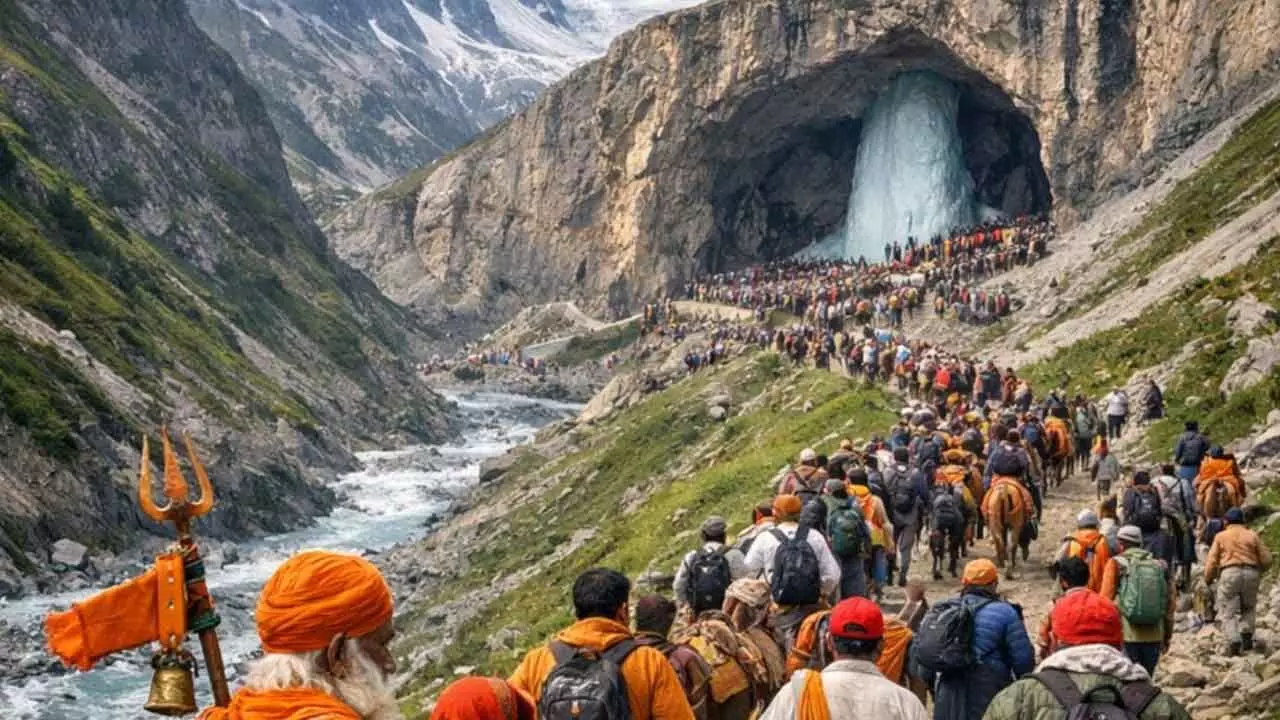
The Amarnath cave is situated at an altitude of roughly 3,888 metres and is reached through difficult mountain terrain. The yatris generally approach the shrine through the traditional Pahalgam-Chandanwari route or the shorter but steeper Baltal route.
Over time, the journey has become a vast logistical operation.
The expansion of the yatra has required increasingly elaborate arrangements for transportation, accommodation, medical care, communications, sanitation, security and emergency response. The routes themselves have had to accommodate a scale of human movement that would have been unimaginable when only a few thousand yatris travelled to the cave each year.
But the mountain remains the mountain.
Heavy rain, landslides, flash floods and damage to tracks can quickly transform a yatra route into a hazardous passage.
That vulnerability was on display this year.
Persistent rain damaged vulnerable sections of the tracks on both major approaches, prompting authorities to suspend the yatra on Aug. 9. Officials said that safety considerations, forecasts of further adverse weather and the requirement for urgent repairs made a resumption unlikely.
The decision effectively brings the main yatra to an early end, nearly three weeks before its scheduled conclusion.
The interruption is a reminder of a tension at the heart of the Amarnath Yatra: its growing popularity has made it increasingly significant, but its location continues to impose limits that cannot be overcome simply by increasing infrastructure.
For yatris, the journey remains a test of endurance as much as an act of faith.
For Kashmir, it is also an annual event of considerable economic and administrative importance, bringing a large seasonal movement of visitors into the region and creating demand across transportation, hospitality, retail and other services.
The historical numbers, however, resist a simple narrative of uninterrupted growth.
The trajectory is jagged.
From 4000 estimated yatris in 1963, the number grew through the 1980s, collapsed during the violence of 1990, recovered through the following decade and surged dramatically in the 2000s. It reached its historical high in 2011, remained above 600,000 in 2012 and then declined again.
The pandemic created another complete break.
The subsequent recovery has been substantial but has not yet returned the yatra to the levels recorded in 2011 and 2012.
Even so, the difference between the beginning and the present is enormous.
A yatra that once involved a few thousand people now routinely involves hundreds of thousands.
The journey has thus acquired a scale that changes the meaning of the word “yatra” itself. What was once a relatively small movement of devotees into a remote Himalayan landscape has become a major annual operation involving yatris from across India, large-scale public administration and extensive security and emergency infrastructure.
And yet, at its centre, the journey remains remarkably simple.
Yatris travel toward a cave high in the mountains.
They walk through difficult terrain, often in rain and cold. They wait, sometimes for hours, amid a moving stream of strangers. They carry their hopes, prayers and expectations with them.
The statistics can count their numbers. They can chart the rises and falls, identify the years of expansion and decline and mark the moments when the yatra was halted.
They cannot measure why people come.
The figures do, however, show how profoundly the yatra has changed.
From 4000 estimated yatris in 1963 to about 4.80 lakh this year, the Amarnath Yatra has grown into one of the most consequential annual religious journeys in the region.
Its history mirrors the history of the Valley in another way: growth has never been guaranteed.
Security can alter it. Politics can alter it. Disease can stop it. Weather can force it to retreat.
This year, the mountains have once again imposed that limit.
The Chadi Mubarak will still proceed, keeping the ritual calendar alive.
But for the hundreds of thousands who have already completed the journey – and for those who hoped to make it before August 28 – the mountain has closed early.
The yatra will return another year.
Its numbers will rise or fall.
And the long record of the Amarnath Yatra will continue to tell the story of a journey shaped as much by the people who make it as by the difficult landscape through which they travel.
About the Author
Mir Suneem is a filmmaker and postgraduate in filmmaking from Jamia Millia Islamia, with a strong interest in editing and narrative craft.