
In a place where orchards produce mountains of seasonal waste, tourism brings surges of visitors, and towns grapple with growing volumes of rubbish, the government of Jammu and Kashmir is proposing a different way to think about what gets thrown away.
Waste, under the new vision, is not simply a problem to be collected and buried. It is a potential source of energy, raw material, employment and enterprise.
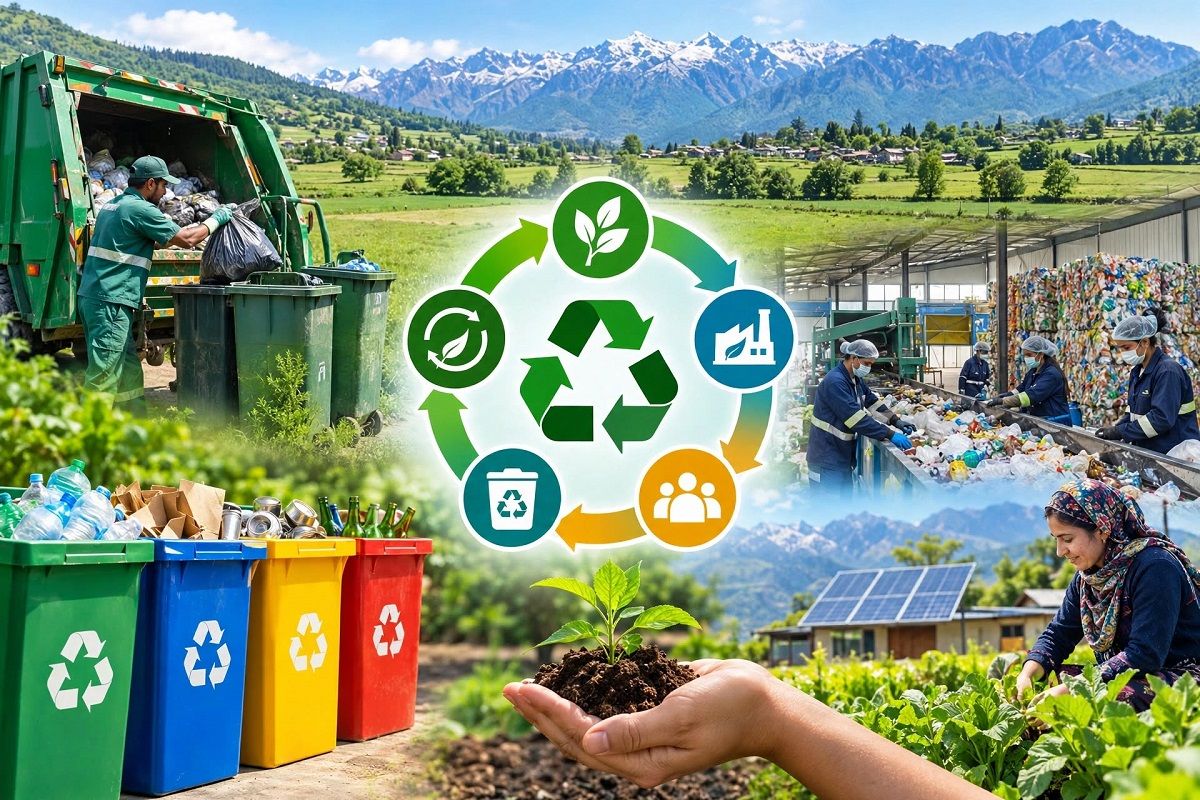
The government has notified the Circular Economy Policy 2026, a 10-year framework intended to move the Union Territory away from conventional waste disposal and towards a system in which discarded materials are recovered, reused, recycled and returned to productive use.
The policy sets out an ambitious agenda spanning municipal rubbish, plastic packaging, orchard residues, construction debris, wastewater and electronic waste. It also seeks to connect waste management with sectors central to J&K’s economy, including horticulture, tourism, food processing, traditional crafts and small businesses.
But the document is more than an environmental blueprint. It is an attempt to build an economic system around materials that are often treated as having little or no value – and to bring informal workers, small enterprises and local governments into that system.
Whether that ambition translates into cleaner towns and viable businesses will depend on the less visible work of implementation: building processing facilities, organising collection networks, enforcing segregation rules, finding buyers for recovered materials and securing money for individual projects.
The policy provides a 10-year direction. It does not, by itself, guarantee that the infrastructure will be built or the jobs created.
The Housing and Urban Development Department has been designated as the nodal department responsible for implementing the policy, which was developed with inputs from the Centre for Innovation and Transformation in Governance and the Planning, Development and Monitoring Department.
The document identifies a baseline financial scenario of Rs 3548.7 crore over 10 years to guide planning and expenditure assessment. The figure, however, is not an automatic budgetary allocation.
Projects will still have to pass eligibility assessments, technical appraisal, administrative approval and financial concurrence before they can proceed. Funding will depend on the availability of resources under relevant schemes and budgetary provisions.
That distinction is important because circular-economy systems require more than a policy announcement. They need a chain of connected services: waste must be separated, collected without being mixed again, transported economically, processed safely and converted into products for which there is a market.
A composting facility, for example, is of limited value if organic waste arrives contaminated with plastic. A recycling plant may struggle if it cannot secure a steady supply of suitable material or find buyers for its output. Construction waste can be recovered, but the resulting material must meet technical standards before it can be used in public works.
The policy attempts to address these challenges by linking waste management to local economic activity rather than treating disposal as an isolated municipal responsibility.
It proposes using existing government programmes, including Swachh Bharat Mission-Urban 2.0 and AMRUT 2.0, alongside municipal resources, user charges, private investment, public-private partnerships and extended producer responsibility mechanisms.
The framework also makes one financial boundary explicit: it does not approve GST reimbursements, tax reductions or tax waivers.
Jammu and Kashmir’s urban areas do not face identical waste-management problems. Their populations, geography, infrastructure and administrative capacity vary, making a single model unlikely to work everywhere.
The policy therefore proposes a three-tier framework for urban local bodies, with interventions calibrated to local conditions.
Smaller and remote towns are expected to concentrate on the fundamentals: segregation at source, recycling, reuse, repair and decentralised processing. The approach is intended to reduce the need to transport waste over long distances and to make better use of local capacity.
Medium-sized and corridor-linked towns could develop aggregation facilities, community composting systems and small biogas plants where conditions permit. These facilities would help collect waste from dispersed sources and process it closer to where it is generated.
Srinagar and Jammu, meanwhile, are identified for a more integrated model. The proposed measures include city-wide waste segregation, construction and demolition waste processing, compressed biogas and biomethanation, and the reuse of treated wastewater from sewage treatment plants.
The government plans to categorise urban local bodies according to factors such as waste generation, geographical location, the availability of segregated waste, processing infrastructure and financial readiness. The classifications would be reviewed periodically, allowing towns to move into a higher category as their operational and institutional capacity improves.
The design recognises a practical constraint: a large city may be able to support specialised processing infrastructure that would be too expensive or difficult to operate in a small mountain settlement.
But differentiated planning will also require careful monitoring. Without reliable information about the quantity and composition of waste being generated, local governments may struggle to choose the right facilities or judge whether their investments are working.
The policy proposes a digital monitoring system to track waste generation, segregation, collection, transportation, processing and disposal. Geographic information systems and urban local body dashboards are expected to help map waste flows, plan infrastructure and improve accountability.
One of the policy’s most consequential ambitions lies beyond municipal streets, in the horticultural economy.
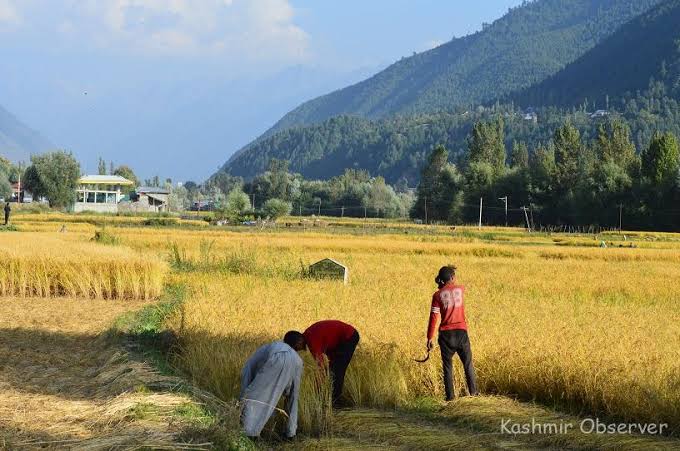
Orchards, vegetable markets and food-processing units generate residues and rejected produce that can become an environmental burden when collection and processing systems are inadequate. The policy seeks to turn these materials into resources for compost, bio-inputs and other marketable products.
It proposes systems to collect and process orchard residues, discarded fruit and vegetables, market waste and food-processing by-products. The aim is to create additional value from material that might otherwise be dumped or left to decompose without being put to productive use.
The government also wants to address post-harvest losses through better aggregation, storage, transportation and processing facilities.
That approach could connect waste recovery with the needs of horticulture-based enterprises and local markets. Organic residues, for instance, could become inputs for composting and other products, while improved storage and transport could help reduce the amount of produce lost before it reaches consumers.
The economic logic is straightforward: waste becomes valuable when there is a dependable system to collect it and a market willing to pay for what can be recovered.
The harder question is whether those systems can be made commercially viable across locations with different volumes of waste, transport costs and access to buyers. The policy sets a direction but does not guarantee that every proposed activity will generate sufficient revenue to sustain itself.
Tourism and pilgrimage present another challenge. Visitor numbers can rise sharply during particular seasons, placing additional pressure on waste collection, sanitation and municipal infrastructure.
Hotels, restaurants, religious institutions, event venues and pilgrimage-related establishments will be expected to comply with applicable waste segregation and management requirements.
The policy envisages destination-specific collection arrangements, better food-waste management and stronger compliance monitoring. It seeks to make waste management part of the infrastructure needed to sustain tourism rather than a service that struggles to catch up after rubbish has accumulated.
Bulk waste generators – including hotels, hospitals, markets, commercial complexes, transport terminals and large institutions – will face specific compliance requirements covering registration, waste minimisation, segregation and reporting.
Depending on feasibility and applicable rules, some may also be required to process waste on-site or send it to authorised treatment facilities.
The government proposes inspections, compliance notices and corrective measures, with graded enforcement for violations. It also envisages incentives for entities that demonstrate sustained compliance, including public recognition and procurement preferences where permissible.
The effectiveness of these measures will depend on whether local authorities have the staff, equipment and information needed to monitor compliance consistently. Rules on paper can have limited impact if collection systems are unreliable or violations go undetected.
Construction and demolition waste is another priority. The policy proposes designated collection points, transportation tracking and authorised processing facilities to improve the recovery of materials from building and infrastructure projects.
Recycled aggregates and other recovered materials could be used in public works and suitable applications, subject to technical standards and the required approvals.
The measure is intended to create a more organised route for construction debris, allowing materials to be recovered instead of being discarded without adequate oversight. Its success will depend in part on the availability of processing capacity and whether public agencies and private builders are prepared to use recycled products that meet required specifications.
The policy extends the same principle to consumer goods.
Repair, refurbishment and reuse markets for furniture, appliances, textiles, handicrafts and other products are expected to receive support. By extending the useful life of discarded goods, the government hopes to reduce waste while creating opportunities for small businesses and skilled workers.
This is a less capital-intensive side of the circular economy. Repair shops, refurbishment enterprises and traditional craftspeople can keep products in circulation without necessarily requiring the large facilities associated with industrial waste processing.
For J&K, where traditional skills and small enterprises form part of the local economic landscape, the approach offers a way to connect environmental objectives with existing forms of work.
The challenge will be to develop viable markets, provide workers with training and ensure that smaller businesses can access the support and supply chains envisaged by the policy.
The government has placed job creation at the centre of its circular-economy ambitions, particularly through the proposed integration of informal waste pickers and sanitation workers into more structured value chains.
The policy envisages registration, training, occupational safety measures and access to formal employment opportunities. The intention is to bring workers who already handle discarded materials into systems that offer more organised work and clearer links to recycling and processing enterprises.
Its baseline fifth-year targets are substantial. The government aims to integrate 60 per cent of informal waste and sanitation workers into formal value chains, support 50 circular-economy startups, and train or apprentice 10,000 young people in circular occupations.
It also sets targets for integrating 2500 artisan, repair and refurbishment enterprises into circular markets, linking 5000 street vendors or micro-retailers to low-waste services, and creating or formalising 15,000 green jobs and livelihoods.
These are targets under the policy’s baseline scenario, not jobs or enterprises already created.
Reaching them will require more than training programmes. Workers need access to equipment, safer working conditions, reliable collection arrangements and employers or markets that can provide sustained income. Startups and small enterprises will need customers, working capital and dependable supplies of recoverable materials.
The policy proposes six priority circular-economy clusters to connect these pieces. They cover urban materials recovery and construction waste in Jammu; organic waste and packaging in the Valley; horticulture biomass and packaging; pilgrimage and tourism services; artisan and repair-based enterprises; and decentralised livelihoods in mountainous areas. A further cluster is proposed for urban water reuse and sludge-linked circularity.
The cluster model is intended to bring collection, transport, processing, markets and enterprise development closer together geographically. By reducing transport costs and improving access to recoverable materials, the government hopes to make investments more practical and sustainable.
The proposed institutional structure includes a J&K Circular Economy Mission, a Circular Economy Cell, district-level coordination mechanisms and implementation arrangements within urban local bodies. The Housing and Urban Development Department will coordinate with departments responsible for agriculture, horticulture, tourism, industries, commerce, the environment, rural development and skill development.
That coordination will be essential. Waste generated by a hotel, an orchard or a construction site may fall under different administrative responsibilities, but recovering it for productive use requires connected decisions about collection, processing, standards, markets and financing.
The policy is scheduled to remain in force for 10 years, with a review every three years or earlier if national regulations, implementation experience, financing conditions or government directions warrant changes. The Housing and Urban Development Department has also been authorised to issue operational guidelines, model bylaws, standard operating procedures and monitoring formats.
Those measures will determine how the broad ambitions are translated into everyday obligations for local bodies, businesses and households.
Mandatory segregation at source is among the central proposals. Households, commercial establishments and institutions will be expected to separate waste and channel it through approved collection and processing systems. That requirement is the foundation on which much of the rest of the plan depends: without reasonably clean streams of recyclable and organic material, recovery becomes more difficult and expensive.
The government’s 10-year roadmap offers a framework for linking environmental management with economic opportunity. It sets out how waste could become a source of materials, livelihoods and enterprise across towns, orchards, tourist destinations and industrial activity.
But the policy’s most important numbers – the financial baseline, startup target and green-job goal – describe an intended future, not an accomplished transformation.
The test will be whether waste is separated before collection, whether processing facilities are built and maintained, whether recovered materials find buyers, and whether workers and small businesses gain a dependable place in the new system.
For now, J&K has set out its ambition: to make less waste the end of the process, and more of it the beginning of something useful.