
Kashmir Impulse Desk
Jammu, Nov 16
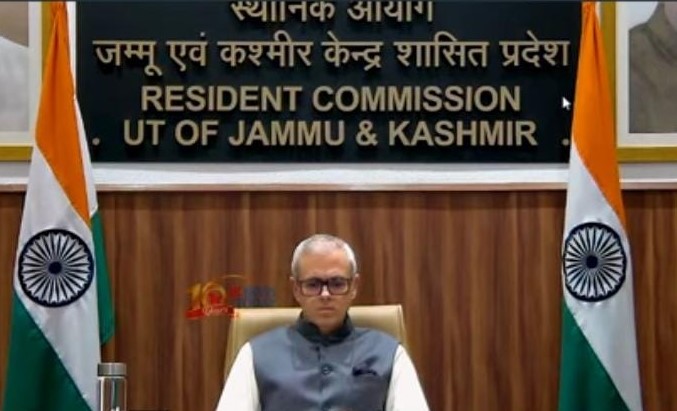
Chief Minister Omar Abdullah on Monday questioned the Centre’s decision to restrict the size of the Union Territory’s Council of Ministers to nine, saying the number of administrative departments and the government’s responsibilities had largely remained unchanged.
Speaking in Jammu, Abdullah said the restriction had created difficulties in distributing ministerial portfolios following the recent cabinet expansion.
About the exercise, he referred to the Hindi saying “Ek Anaar, Sau Bimar”, describing the demand for ministerial positions against the limited number of available berths.
“During the earlier scenario in my earlier government, we used to have around 25 ministers,” he said.
Abdullah said Jammu and Kashmir’s population had largely remained static or increased since the 2019 reorganisation, while the number of Assembly constituencies had risen from 87 to 90 following delimitation.
He said only Ladakh had been separated from the erstwhile state, while the number of departments under the elected government had not undergone any major change.
“Assembly seats rose, the number of departments did not undergo any (major) change and the population almost remained static or rose. But in this backdrop, now we are being asked to work with nine ministers instead of earlier 25. Can anyone explain this logic to me?” he said.
The chief minister said the restriction was linked to Jammu and Kashmir’s status as a Union Territory and described it as unfair to the region.
He said the elected government continued to handle most departments, with the Home Department being an exception.
Abdullah said the arrangement would remain a challenge for future elected governments unless J&K’s statehood was restored.
On whether statehood would be restored by 2029, Abdullah asked journalists to seek an answer from BJP leaders in J&K.
He said his government had initially expected statehood to be restored within six months of the 2024 Assembly elections, but two years had passed without progress.
“We were anticipating restoration of statehood within six months of our election. Now two years have lapsed. We still have kept alive a streak of hope. But with the passage of time, even that hope is diminishing,” he said.
Abdullah urged BJP leaders to clarify whether the Centre intended to restore statehood and explain the delay, saying it had been a promise made by the party.
He said his government would continue to pursue the issue through democratic means, including protests and legal recourse.
Describing the governance structure in J&K, Abdullah said the Union Territory framework involved two parallel administrations, one elected and the other unelected.
He said the arrangement complicated governance while the region continued to face economic, security, geographical and climate-related challenges.
“Had this system been so effective and successful, it would have been implemented across the country,” he said.
Despite the constraints, Abdullah said his government was working to address public grievances and meet people’s expectations. He said no Assembly constituency had been left out of new development initiatives and that work would be expedited over the next two-and-a-half years.
On the proposed digital media policy, the chief minister said regulation was a valid issue but required wider consultation with media organisations.
He said the absence of regulation had allowed individuals without journalistic experience to operate as news platforms, with sensationalism and online engagement often becoming their primary focus.