
In the villages covered by a University of Kashmir study, the distance between a household and its nearest dependable source of water is measured not only in metres. It is measured in hours taken from work, in fatigue carried home and in opportunities that women say they lose while keeping their families supplied.
The survey, conducted across more than 70 villages in Budgam, Pulwama and Kupwara, found that 95 per cent of the women interviewed reported physical and mental exhaustion linked to water-related work. Eighty-three per cent of the households surveyed had experienced water shortages. The findings describe a crisis that is often discussed in terms of supply and infrastructure but is experienced inside homes as a daily demand on women’s time and health.
Led by Dr Shazia Malik, senior assistant professor at the University of Kashmir’s Centre for Women Studies and Research, the study was carried out under the Indian Council of Social Science Research-funded project Nari Shakti and Water Governance. It surveyed 600 women and households, recording the sources from which families obtained water, the time spent collecting it and the consequences for work, education and hygiene.
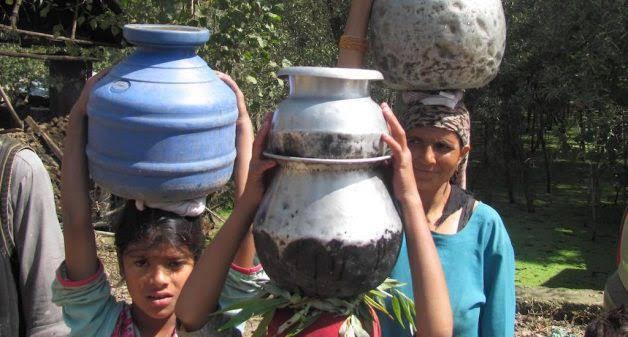
The division of labour was striking. Women were responsible for fetching water in 550 of the 600 households, or 91.7 percent. Men carried out the task in 45 households, while in five the responsibility was shared. The numbers suggest that water scarcity is not simply a household inconvenience. It is a gendered burden, assigned overwhelmingly to women.
The study found that 589 respondents, or 98.2 per cent, considered local water infrastructure inadequate. In Budgam and Pulwama, every respondent surveyed reported deficiencies. In Kupwara, 189 of 200 respondents, or 94.5 per cent, said facilities were inadequate. Only 11 respondents in the district considered the infrastructure sufficient.
The gap between a water source and a home can turn an ordinary domestic task into a substantial journey. In 122 households, the nearest source was more than 500 metres away. Of the 442 households that collected water outside the home, 89 said each trip took more than 30 minutes. Only 100 households reported receiving piped water on all seven days of the week.
Those figures describe a system in which the existence of a pipe or public source does not necessarily guarantee a reliable supply. A household may have a connection but still depend on a spring, stream, tanker, public tap or hand pump when water is unavailable. During the dry season, 415 respondents reported using piped water; 232 relied on springs or streams and 137 on tankers. Some households used more than one source. Tube wells or hand pumps were reported by 117 respondents, public taps by 100 and community wells by 72.
The practical consequence is that women must often manage uncertainty as well as distance. They may have to decide when to collect water, how much can be carried, which source is functioning and whether the household’s stored supply will last. Where a source is far away, the task can be repeated several times. Where supply is intermittent, families must plan around a timetable they do not control.
The survey found that 568 respondents, or 94.7 per cent, said water-related responsibilities reduced their working hours. This is an economic cost that can remain invisible in household accounts. Time spent collecting water is time unavailable for paid work, farming, study, rest or other domestic responsibilities. For women whose work is already concentrated in unpaid household labour, the additional hours can narrow the space available for income and independence.
The impact reaches beyond employment. About 87 percent of respondents believed water scarcity affected girls’ education. The study does not establish that every girl in these households missed school because of water collection, but it records a widespread perception that the shortage interferes with education. When water must be fetched before or after school, or when girls are expected to help with household duties, their time for attendance, homework, and rest can be reduced.
The findings on menstrual hygiene are equally consequential. About 91 per cent of respondents said water scarcity affected their menstrual hygiene. Access to clean water is essential to personal care, sanitation and dignity. When supply is irregular, women and girls may have to ration water for washing or adapt routines around the quantity available. The survey’s response points to a dimension of water insecurity that is rarely captured by measures of household connections alone.
The strain is not distributed evenly across the households surveyed. Nearly half of the respondents, 295 women or 49.2 per cent, were illiterate, while 57, or 9.5 per cent, were graduates. Homemakers accounted for 510 respondents, or 85 per cent. Twelve were salaried employees, and 10 ran businesses. By economic category, 333 respondents belonged to below-poverty-line households, 144 to Antyodaya Anna Yojana households, 116 to above-poverty-line households and seven to priority households.
These characteristics matter because the capacity to respond to a shortage depends partly on a family’s resources. A household with money may be able to purchase stored water or arrange a tanker. A poorer household may have fewer alternatives and depend more heavily on a nearby public source or a long walk. The study’s sample included a large proportion of households in lower-income categories, making the burden of collection especially relevant to questions of economic vulnerability.
The findings also reveal a gap between the reach of government programmes and public awareness of them. A total of 466 respondents, or 77.7 per cent, said they were unaware of government water schemes, including the Jal Jeevan Mission. Only 134, or 22.3 per cent, reported awareness. Education appeared to make a difference, though it did not eliminate the gap: 24 of the 57 graduates surveyed, or 42.1 per cent, knew about the schemes, compared with 54 of 295 illiterate respondents, or 18.3 per cent.
Awareness is not the same as access, and access is not the same as a reliable supply. But low awareness can make it harder for households to understand what a programme promises, whom to approach when a connection is not functioning or how to report a service failure. If a scheme is intended to improve household water access, communication must reach the people who manage water in daily life.
The survey also records a strong perception of seasonal change. Ninety-nine per cent of respondents reported variations in water supply across seasons, while 98 per cent linked those variations to climate change. These are respondents’ reported experiences and interpretations; the survey figures alone do not establish the precise hydrological causes of each local shortage. They do, however, show that households perceive supply as unstable and increasingly shaped by changing conditions.
That perception deserves attention in a region where communities rely on a mix of piped networks, springs, streams and other local sources. Infrastructure planning must account for seasonal reliability, not simply the number of connections installed. A pipe that supplies water for only part of the week cannot remove the need to collect water elsewhere. A source that becomes unreliable in a dry period leaves households exposed even if it functions during the rest of the year.
The study’s central finding is therefore not only that many households face shortages. It is that the shortage is translated into labour, and that labour falls overwhelmingly on women. The burden is visible in the time spent walking to sources and carrying water, but its full cost appears in reduced working hours, concerns about girls’ education and the difficulty of maintaining menstrual hygiene.
The findings point towards several practical tests for water policy. Authorities need to measure continuity of supply alongside household connections; identify settlements where the nearest source is far away; ensure that local infrastructure is maintained; and make information about schemes understandable and accessible. The needs of women should be part of planning and monitoring, rather than an afterthought once a project is complete.
For rural households, a dependable supply would mean more than convenience. It could return time to women, reduce the physical effort of daily collection and make household hygiene less dependent on uncertain availability. It could also help girls spend more time on education and allow women to participate more fully in paid work and community life.
A water connection is often counted as a completed service. For the women in this survey, the more meaningful measure is whether water is actually available when it is needed, close enough to collect without exhausting the day, and in sufficient quantity to meet the needs of a household. Until that standard is met, the work of bridging the gap between a tap and a home will continue to be carried, largely, by women.
About the Author
Mir Suneem is a filmmaker and postgraduate in filmmaking from Jamia Millia Islamia, with a strong interest in editing and narrative craft.