
The first hurdle in a visit to a government hospital is often not a diagnosis. It is finding the right queue.
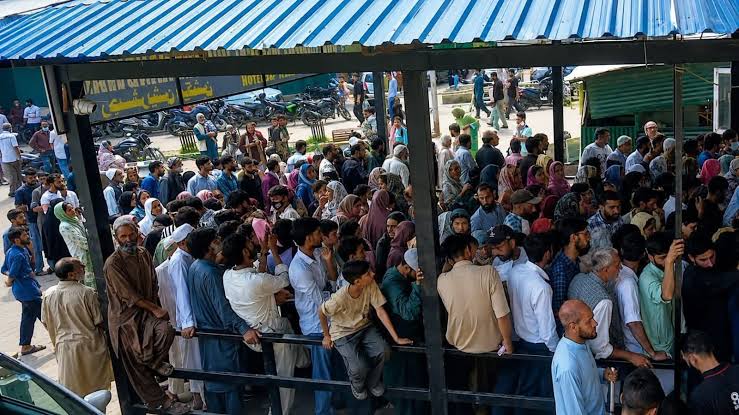
At the registration counter, patients wait with prescriptions, identity documents and the details of the illness that has brought them there. Some have travelled from distant villages. Others have arrived before the hospital day has properly begun, hoping that an early start will bring an early consultation. The queue moves, but rarely at a pace that matches the number of people waiting.
For many, registration is only the beginning. Once a card has been issued, patients must find the outpatient department, identify the relevant chamber and wait again. The doctor’s room may be only a short walk away, but the time between obtaining a token and being called can stretch across much of the day. The uncertainty is part of the burden: people do not always know how many patients are ahead of them, which doctor will see them or when their turn is likely to come.
A few years ago, hospitals in Srinagar began displaying PVC banners carrying QR codes. The idea was straightforward. A patient could scan a code, enter personal details, generate a registration card and move towards the department without first joining a conventional counter queue. The technology offered the prospect of a less crowded entrance and a more orderly route through the hospital.
The promise has proved easier to announce than to sustain.
Under the Ayushman Bharat Digital Mission, QR-code-based outpatient registration was introduced in 2023. The facility was extended to more than 55 hospitals, according to the mission statement cited in the original reporting. It was meant to reduce repetitive paperwork, make registration faster and allow patients to share a health profile and obtain a token.
Yet the experience at major public hospitals in Srinagar, including Super Speciality Hospital, SMHS Hospital and Lal Ded Hospital, suggests that the presence of a digital system does not necessarily mean that it is working as a dependable alternative. Patients continue to rely on registration windows, and the queues that the technology was expected to ease remain a familiar feature of hospital corridors.
The distinction matters. A QR code on a wall is an interface; a functioning registration system requires much more behind it. The patient must be able to scan the code, enter accurate information, receive a usable token and have that information recognised by the hospital’s staff and software. The process must work across departments and during the busiest hours. If any part of that chain fails, people return to the counter.
A senior official at Government Medical College Srinagar acknowledged that the digital registration system had not taken off as intended. He attributed the problem partly to the back-end arrangements and partly to the limited manpower available in hospitals. The system, he said, was only partially automated and still required physical staff to make it work.
That qualification exposes a central difficulty in the promise of hospital digitisation. Technology can shorten a task, but it cannot by itself replace the staff needed to guide patients, resolve errors, verify information and keep departments connected. A registration process that depends on a worker at several stages may still be constrained by the number of workers available.
The official said hospitals generally had four registration windows and that opening more counters was not possible because of a shortage of staff. The explanation is administrative, but its consequences are visible to patients. When a limited number of windows must serve a large flow of people, even a simple registration can become a prolonged exercise.
The queue is also not an equal burden for everyone. A person who is young, mobile and familiar with the hospital may be able to stand, move between counters and ask for directions. An elderly patient may find the same sequence physically exhausting. People with disabilities, pregnant women and those who need assistance face additional obstacles. A hospital visit can involve repeated movement from one desk to another, from the registration area to a department and then to a diagnostic or pharmacy counter. Each stage adds another demand on a patient who may already be unwell.
For families accompanying patients, the day can become a logistical exercise. One person may hold a place in a queue while another searches for a department or completes paperwork. Those who come from far-flung areas must also account for transport, food and the possibility of missing a return journey. A consultation that lasts only a few minutes can therefore consume hours.
The waiting time outside outpatient chambers can be as difficult to navigate as registration. The number of patients, the availability of doctors and the way appointments are sequenced all affect how quickly a queue moves. In sparsely equipped hospitals, unclear arrangements can leave patients unsure whether they are waiting in the right place or whether a particular doctor is available. The result is not merely delay; it is a lack of predictability at a moment when people need reliable information.
The official said a new smart-hospital system was being developed to make it easier to navigate health facilities. The proposal suggests that the administration recognises that digital registration cannot be treated as an isolated intervention. Patients need to move through a connected system in which registration, consultation, diagnostics and follow-up are coordinated.
But a new platform will have to answer practical questions that have shaped the experience of the existing one. Will it reduce the number of steps a patient must complete? Will staff be available to help people who cannot use a smartphone? Can it accommodate patients who arrive without prior digital records? Will the system work when internet connectivity is unreliable or when a hospital is dealing with a surge in attendance? And, crucially, will the digital route be integrated with the physical counters rather than operating as a separate layer that leaves the old queue intact?
These are not minor design details. A system that works only for people who have a smartphone, stable connectivity and the confidence to navigate an online form could shift the burden rather than remove it. Hospitals must retain accessible alternatives for patients who are unfamiliar with digital tools or unable to use them. The purpose of technology should be to widen access, not to create another threshold.
Jammu and Kashmir has recorded progress on several health indicators, and public hospitals remain central to the region’s health-care system. But the experience of a patient is shaped not only by broad indicators. It is also shaped by the time required to register, the clarity of directions, the availability of staff and the ability to obtain a consultation without spending most of the day waiting.
The queues at registration counters are therefore more than an inconvenience. They are a measure of the distance between a policy’s stated purpose and its everyday delivery. The QR system was introduced to make entry into public health facilities easier. Its limited use points to the need for stronger back-end support, adequate staffing and a design that reflects how patients actually move through hospitals.
There is no single technological fix for a crowded outpatient department. More counters may require additional personnel; better scheduling may require coordination between departments; digital registration may require sustained technical support and staff training. Hospitals also need clear signs, assistance for vulnerable patients and a transparent way of telling people when they can expect to be seen.
The senior official’s acknowledgement that the current system is only partially automated is important because it shifts the discussion away from the mere installation of QR codes. A digital service must be judged by whether people can use it reliably, not by whether a banner has been put up or a platform has been launched.
For the patient who has travelled hours to reach a hospital, the difference is concrete. A registration card is not the end of the journey. It is the pass to another queue, another corridor and another wait. Until the entire route is made more predictable, the promise of a faster hospital visit will remain suspended somewhere between the screen and the counter.
About the Author
Amir Yaseen is a Srinagar-based journalist interested in Kashmir, policy, progress, and the human stories shaping everyday life.