
The haze over Srinagar has acquired a second, less visible presence: a dispute over what the air-quality numbers actually mean.
For several days, private air-monitoring platforms have presented sharply elevated readings for the city, at times placing Srinagar among the most polluted urban centres in the world. Official monitoring stations, meanwhile, have continued to report air quality in the good, satisfactory or moderate categories.
The contrast has unsettled residents and fuelled discussion over whether the city is experiencing a serious pollution episode that official measurements are failing to capture, or whether the private platforms are presenting a distorted picture.
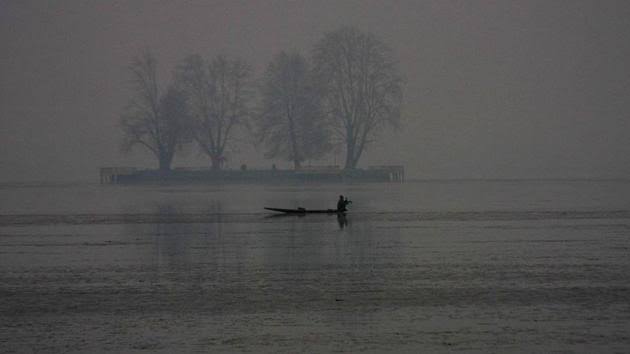
The disagreement has become difficult to ignore because it is unfolding alongside visible haze. Cold and cloudy weather has left parts of the city under a blanket of misty air, while the seasonal end of agricultural activity has brought renewed attention to the burning of farm waste and leaves in areas around the Valley.
On Sunday evening, the website aqi.in showed Srinagar’s live Air Quality Index at 627, placing it in the hazardous category. Its readings put PM2.5 at 389 micrograms per cubic metre and PM10 at 507 micrograms per cubic metre. The platform ranked Srinagar at the top of its list of the world’s most polluted cities.
Other local readings displayed by the platform were also exceptionally high. Sensors in Jawahar Nagar, Lal Bazar and Rawalpora Colony recorded values above 500, while Kanipora showed a reading exceeding 700. IQAir also placed Srinagar in its severely polluted category.
The official figures presented a markedly different picture. The CPCB-linked Rajbagh station, as reflected on aqicn.org, recorded an AQI of 38 during the day. The Central Pollution Control Board website later showed Srinagar at 33, while Khanmoh recorded 140. These readings placed the monitored locations in the good and moderate ranges rather than the hazardous category.
The divergence was not confined to Sunday. On Saturday, aqi.in showed Srinagar’s live AQI at 269 around 5 pm, with PM2.5 at 194 micrograms per cubic metre and PM10 at 252. IQAir reported an AQI of 181 and PM2.5 at 97.9 micrograms per cubic metre. The platforms placed the city in severe or unhealthy categories, while the CPCB-linked Rajbagh station recorded an AQI of 38 and Khanmoh registered 103.
The numbers have raised an obvious question: how can different monitoring systems describe the same city in such sharply different terms?
The J&K Pollution Control Committee has pointed to differences in the equipment and methods used by official and private monitoring networks. CPCB stations use calibrated, reference-grade equipment and report readings that are averaged and validated under the National Air Quality Index framework.
Third-party platforms, according to committee officials, often draw on denser networks of lower-cost sensors. They may display real-time snapshots, use different averaging periods and, in some cases, apply indices based on the United States Environmental Protection Agency system. Those differences can produce readings that are not directly comparable with the official figures.
The distinction is important. An AQI number is not simply a measurement of pollution that can be compared across every platform without considering how it was generated. The index translates measurements of pollutants into a scale intended to communicate health-related conditions. Different scales, averaging periods and sensor systems can therefore produce different results.
Lower-cost sensors can also capture conditions close to local emission sources. A reading from a neighbourhood sensor may reflect pollution at a particular location and moment, while an official station reports conditions based on its own location, equipment and averaging method. Neither figure should automatically be treated as a complete description of air quality across the entire city.
But the explanation for the discrepancy has not ended public concern. The presence of haze, the high readings displayed by private platforms and the seasonal conditions that can favour the accumulation of pollutants have kept attention on the quality of the air people are breathing.
JKPCC chairman Vasu Yadav said Srinagar was not as polluted as some online rankings suggested. He said the city’s AQI generally remained between satisfactory and moderately polluted levels.
Yadav also questioned the apparent similarity between readings shown for Srinagar and Jammu, despite differences in the weather conditions observed in the two cities. He said Jammu had remained bright and clear while the platforms were showing the two places at comparable pollution levels.
To provide additional information, the chairman said he had directed officials to carry out daily manual monitoring at the Rajbagh station throughout the winter. The exercise would use filter-based monitoring, with results expected to become available the following day. The findings would then be uploaded to the committee’s website after a delay of one or two days.
The manual readings, he indicated, would help provide greater clarity about the city’s air quality during the winter months. They would also offer another basis for examining the gap between the readings appearing on private platforms and those recorded through the official monitoring system.
The issue is not limited to a technical disagreement between monitoring networks. It also raises a broader question about how pollution is communicated to the public. When one platform describes the air as hazardous and an official station reports good conditions, residents are left to decide which information should guide their understanding of the risk.
The visible haze adds to that uncertainty. A hazy appearance does not, by itself, establish the concentration of a particular pollutant, just as a low reading at one monitoring station does not necessarily describe conditions in every neighbourhood. But the contrast between what people see and what different monitoring systems report has made reliable, accessible and clearly explained data especially important.
There are several seasonal factors that could contribute to particulate pollution in Kashmir. Agricultural activity is winding down, and the burning of crop waste and biomass, including fallen leaves, has been observed in parts of the Valley. Such burning releases particulate matter into the air.
Winter heating adds another potential source of emissions. As temperatures fall, households and other establishments increasingly rely on heating. The resulting emissions can contribute to pollution, particularly when weather conditions do not allow the air to disperse efficiently.
Stagnant air can make the problem more pronounced. During periods of weak atmospheric movement, pollutants may remain concentrated close to the ground rather than dispersing. Temperature inversion, a condition associated with winter weather, can further restrict vertical movement of air and trap pollutants near the surface.
Kashmir’s basin-like geography is another factor cited in discussions of winter pollution. The surrounding terrain can limit the movement of air and contribute to the accumulation of particulate-laden air under certain weather conditions.
The India Meteorological Department had forecast mostly dry conditions in the coming days. In the absence of conditions that help disperse pollutants, emissions from burning and heating may remain a concern.
The health implications of particulate pollution are particularly relevant during winter, when exposure can affect people with existing respiratory conditions and other sensitive groups. Pulmonologists have expressed concern over winter haze and the pollutants associated with it. The available reports, however, do not establish that the city was experiencing the hazardous conditions suggested by the highest private readings.
That distinction should not be mistaken for an argument that pollution requires no attention. Even the official position, as conveyed by the JKPCC chairman, places Srinagar’s air quality within a range that can move between satisfactory and moderate. The committee’s decision to conduct daily manual monitoring also reflects the need for more information during the season.
The central challenge is to establish a dependable picture of air quality across the city. That requires monitoring systems whose readings can be understood, compared and communicated transparently. It also requires an explanation of why different platforms produce different numbers, rather than leaving residents to navigate competing claims without guidance.
A single citywide ranking cannot capture every neighbourhood’s exposure. Equally, a reading from one official station cannot automatically settle questions about air quality elsewhere. The location of monitors, the pollutants measured, the time period covered and the method used to calculate the index all matter.
For Srinagar, the debate has arrived at the beginning of the season when pollution concerns traditionally become more pronounced. The disagreement between private and official readings may be resolved only through sustained monitoring and a clearer public account of the methods behind the numbers.
But the sources of pollution identified in the reports are not dependent on which platform ranks the city first. Crop-residue and leaf burning, winter heating and conditions that trap polluted air remain issues that require attention. Reducing emissions from these sources is a task that extends beyond the argument over the AQI.
The immediate need is for reliable evidence. The longer-term need is to ensure that the air-quality debate leads to action on the emissions that contribute to winter haze, rather than becoming a contest over whose numbers are more alarming.
About the Author
Mir Suneem is a filmmaker and postgraduate in filmmaking from Jamia Millia Islamia, with a strong interest in editing and narrative craft.