
The construction of a road through a mountain begins long before the first vehicle passes through it. It begins with surveys, clearances, land acquisition and decisions about where roads will cut into slopes and where forests will give way to approach routes.
On the Kashmir side of the proposed Singhpora-Vailoo tunnel, that process has already left a measurable mark. Around 543 kail pine and fir trees have been felled near Gadole-Ahlan in Anantnag district to make way for the project’s approach road. The trees yielded an estimated 50,000 cubic feet of timber and stood across about 40 hectares of forest land.
The felling has been completed after the Union Ministry of Environment, Forest and Climate Change granted final Stage-II forest clearance in 2026. The project’s environmental footprint is now part of a larger infrastructure plan intended to provide an all-weather connection between Anantnag and Kishtwar by bypassing the snowbound Sinthan Pass.
The National Highways and Infrastructure Development Corporation Limited has said that around 16,000 saplings will be planted over eight hectares as compensatory afforestation under the Compensatory Afforestation Fund Management and Planning Authority. Divisional Forest Officer Anantnag Muhammad Ashraf Katoo said the funds had been released by NHIDCL. Nearly 700 saplings, he said, had also been transplanted to other areas as part of forest-management measures.
The scale of the proposed plantation is considerably larger than the number of trees felled on the Kashmir side. But the figures describe different interventions: the felling is a completed activity, while the plantation is a compensatory measure planned over a specified area. The source material does not establish how the new plantation will compare, over time, with the forest that has been diverted.
The forest clearance applies to the approach road near Gadole-Ahlan, not to the underground tunnel itself. The distinction is important because the project involves a long road package, with forest land required for surface infrastructure even as the main passage is planned beneath the mountain.
The work on the Kashmir side has been completed, while tree felling near Chatroo-Singhpora on the Kishtwar side is yet to begin. That area falls under the Marwa Forest Division.
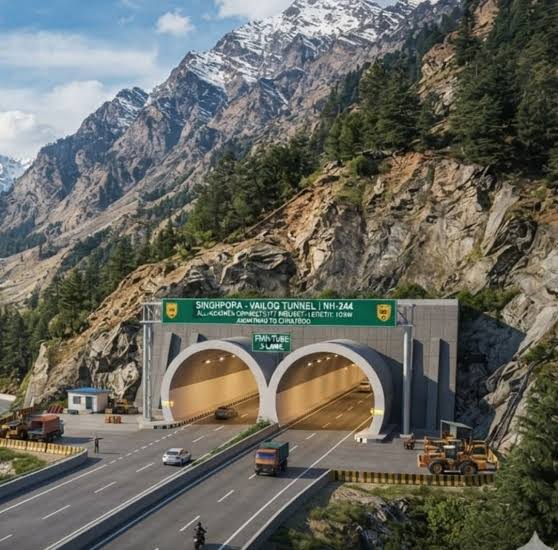
The tunnel is intended to connect Ahlan-Vailoo in Anantnag with Chatroo-Singhpora in Kishtwar. The existing Anantnag-Kokernag-Kishtwar road frequently faces closures during heavy snowfall at Sinthan Pass. A tunnel beneath the pass is expected to provide a more dependable year-round route between the two regions and strengthen the NH-244 corridor.
The project has an estimated cost of Rs 3,567.51 crore. NHIDCL has extended the deadline for submission of bids to November 25, after which the bids are to be opened, project engineer Tanveer Sheikh said.
The latest tendering process follows an earlier setback. NHIDCL floated fresh bids on September 10 after the 2024 tender was cancelled when the lowest bidder, a joint venture of Transrail Lighting and Azerbaijan-based EVRASCON, was denied security clearance.
The revised proposal received approval after an earlier version was declined by the Public Investment Board in April 2025 on cost and technical grounds. Revised proposals for the Singhpora-Vailoo and Sudhmahadev-Dranga tunnels were approved in April 2026 through an Office Memorandum issued by the Department of Expenditure in the Ministry of Finance. Union Minister of State in the Prime Minister’s Office Jitendra Singh announced the Centre’s approval for the two projects at a combined estimated cost of Rs 9779.42 crore.
The Singhpora-Vailoo project forms part of a 38.611-km highway package connecting Chatroo in Kishtwar with Vailoo in Anantnag along the Kishtwar-Vailoo-Khanabal section of NH-244.
Its central engineering component is a pair of tunnel tubes beneath the Sinthan Pass, measuring 10.331 km and 10.363 km. The eastern approach from Chatroo to the tunnel portal will cover 17.088 km, while the western approach towards Vailoo will extend 11.160 km.
The eastern portal near Singhpora is planned at an elevation of around 2243 metres, while the western portal at Gadole will be around 2404 metres above sea level. The package also includes 20 cross-passages, 21 major and minor structures and a 1345-metre viaduct. More than 54 km of roadside and catch drains are part of the design.
Each tunnel tube will have a nine-metre carriageway, footpaths and emergency facilities. The two tubes will be connected through 20 cross-passages, each 6.1 metres wide and 18.5 metres long, at intervals of around 500 metres. These passages are intended to facilitate emergency evacuation.
The planned safety systems include semi-transverse ventilation, fire detection and firefighting arrangements, CCTV surveillance, emergency communication, traffic control, lighting, drainage and waterproofing. Fire hydrants are to be installed at intervals of 250 metres.
The approach roads will be two-lane roads with paved shoulders. The project is to be executed under the engineering, procurement and construction model, with a construction period of 60 months followed by 120 months of operation and maintenance.
Land acquisition for the approach roads has been completed on both the Kashmir and Jammu sides. NHIDCL has sanctioned Rs 78 crore in compensation, of which more than half has been disbursed.
The project’s expected benefit is straightforward: a route that does not depend on the seasonal opening of Sinthan Pass. But the infrastructure will also require a long construction period, and its completion depends on the tendering and execution process now underway.
A separate tunnel proposal on the Srinagar-Jammu National Highway is at an earlier stage. The National Highways Authority of India has submitted a Detailed Project Report estimated at Rs 3449.63 crore to the Union Ministry of Road Transport and Highways for another tunnel of approximately nine kilometres, parallel to the existing Chenani-Nashri Tunnel.
The proposed structure is intended to increase traffic-carrying capacity and ease congestion on the stretch connecting Udhampur and Ramban districts. The NHAI regional office in Jammu prepared the report and forwarded it to the ministry through the authority’s headquarters. Officials were expecting final approval by the end of December 2026.
NHAI Project Director Udhampur Ish Gupta said construction could begin in February or March 2027 if the ministry grants approval. The authority would then invite global tenders. The process of technical and financial evaluation was expected to take around 45 days before the contract could be awarded.
The proposed tunnel is to be built on the left side of the existing alignment, with adequate separation between the two structures. One significant feature of the plan is that the existing tunnel is expected to remain operational during construction. NHAI says there will be no need to divert all traffic to the older Chenani-Kud-Patnitop-Batote road, which is comparatively narrow and could face severe congestion if required to carry the full volume of traffic.
Geological and environmental clearances have been obtained, while the process of securing forest clearance is being initiated. The new tunnel is expected to take approximately four years to complete, with the overall project timeline estimated at four to five years.
It is to include ventilation systems, automatic surveillance cameras, firefighting equipment and modern lighting. These facilities are intended to support traffic management and commuter safety through the underground route.
The existing Chenani-Nashri Tunnel, measuring approximately 9.28 km, was inaugurated by Prime Minister Narendra Modi on April 2, 2017. Construction began in May 2011 and cost approximately Rs 3720 crore. It provides an all-weather link on the Srinagar-Jammu National Highway, connecting Chenani in Udhampur district with Nashri in Ramban district and reducing the distance and travel time between the two areas.
The proposal for a parallel tunnel was announced by Union Minister Jitendra Singh on June 9, 2026, when he said the proposal for a new two-lane tube alongside the existing structure had been accepted. The project is intended to address increasing traffic pressure on the highway and improve its carrying capacity.
The two tunnel projects address different geographical and transport problems. Singhpora-Vailoo is intended to bypass a high mountain pass that is frequently closed by snow, creating a more reliable link between Anantnag and Kishtwar. The Chenani-Nashri proposal is designed to add capacity along an existing national highway corridor where a major tunnel is already operational.
Their common promise is more dependable movement across difficult terrain. Their timelines, however, remain at different stages. Singhpora-Vailoo has reached a fresh tendering process after earlier delays and now carries a defined construction period. The parallel Chenani-Nashri tunnel still requires ministry approval, followed by tendering and construction.
For the Singhpora-Vailoo project, the environmental question is already visible in the trees felled for the approach road and the compensatory plantation planned in response. The underground passage may reduce the need to cross the snowbound pass, but the surface infrastructure needed to reach it has its own footprint.
The planned 16,000 saplings and the transplantation of nearly 700 plants form part of the stated mitigation measures. Their longer-term contribution will depend on implementation and survival, matters not established by the available project information.
The larger infrastructure programme is being justified by the need for all-weather connectivity, improved road capacity and safer movement. Whether those gains are realised will depend on projects moving from approval and tendering to construction and operation. In the meantime, the Singhpora-Vailoo work offers a reminder that a road through a mountain is not only an engineering undertaking. It is also a decision about the land and forests through which the road must reach it.
About the Author
Wajahat Iqbal Kashtwari is a filmmaker and multimedia professional with a keen interest in the environment, ecology, and climate change.