
The apple harvest is among the busiest times of the year in Kashmir’s orchards, drawing workers into fields for long hours as fruit ripens and the season’s income is gathered. But this autumn, the orchards have become places of danger, too, as bears descend in search of fallen apples and leopards venture closer to homes.
Since August 1, wildlife attacks across Kashmir have killed six people and injured nearly 90, according to official figures. The victims include two children, aged five and 12, killed in separate leopard attacks, and a 45-year-old woman who was attacked by a bear while working in an orchard in south Kashmir.
The toll has renewed concerns about the risks faced by orchard workers, families living near forest fringes and children moving through settlements where leopards have been sighted.
The pattern varies across the Valley. Bear attacks have intensified during the apple harvest, when ripening fruit and discarded apples draw animals into orchards. Leopard encounters, meanwhile, have raised concerns throughout the year, particularly in residential areas where wildlife officials say changes in land use and the availability of stray dogs have altered the relationship between predators and people.
For residents, the danger is no longer confined to remote forest areas. It can emerge in an orchard during a working day, along a village path or near a home after dark.
The official figures show that north Kashmir recorded three deaths and 39 injuries during the period, including 33 injuries in bear attacks and six in leopard attacks.
The Anantnag-Kulgam Wildlife Range reported two deaths, both attributed to bears, and 20 injuries. Pulwama-Shopian recorded 16 injuries, including one in a leopard attack, while central Kashmir reported one death and nearly 15 injuries.
Among the victims was five-year-old Ada Nisar, who was killed in a leopard attack in Ompora, Budgam, on September 7. On September 28, 12-year-old Ayan Asif was killed in a separate attack in Marsery, Kupwara.
In south Kashmir’s Kulgam district, 45-year-old Latifa Banoo was killed by a bear while working in an orchard at Tarigam on August 31.
The deaths underline how differently the encounters can unfold. Bears are drawn to orchards by seasonal food, bringing them into spaces occupied by workers picking and transporting fruit. Leopards, which can move through inhabited areas in search of prey, pose a different challenge, particularly where children are outdoors or walking without adult supervision.
October, along with August and September, is considered a particularly sensitive period for encounters. Apple harvesting coincides with the availability of maize and other crops, creating opportunities for wildlife to find food close to human settlements.
“Once apples ripen, bears come down to orchards. This has become an annual phenomenon,” said Suhail Intesar, the wildlife warden for north Kashmir.
The attraction does not end with fruit still on trees. Fallen apples and discarded produce can draw bears towards homes, storage areas and frequently used paths, increasing the chances of an unexpected encounter.
Wildlife officials have advised orchardists to dispose of fallen fruit safely and keep food waste away from homes and other places where people regularly gather.
For those whose livelihoods depend on the harvest, avoiding orchards altogether is rarely an option. The work must continue, often over long hours and in fields close to wooded areas.
In Kulgam’s Damhal Hanji Pora area, 68-year-old Abdul Salam Teeli was seriously injured by a bear after he tried to help another orchard worker who was crying for assistance.
“When I heard the cries, I tried to run away with my wife and daughter-in-law. The bear then turned towards me and attacked me as well,” Teeli said.
His account illustrates the danger of approaching an animal during an attack or attempting to intervene without trained assistance. A person responding to cries for help may suddenly find himself within reach of an animal that feels threatened or is trying to escape.
The advice from wildlife officials is to report encounters promptly and avoid approaching or provoking wild animals.
In Kupwara, orchardist Muhammad Akbar said the anxiety had become familiar during the harvest.
“Last year, also during the apple harvest season, we lived in constant fear of wildlife attacks, and this year has been the worst,” he said.
For orchard communities, the recurring encounters bring uncertainty to a season that is already demanding. Workers must weigh the risks of entering fields against the need to gather fruit before it deteriorates or loses market value.
The presence of bears near orchards also complicates the movement of families living and working close to forest boundaries, where a short walk or an ordinary task can bring people into contact with wildlife.
While bear attacks are closely linked to the harvest, leopard sightings and attacks have become a year-round concern for wildlife officials.
In the Anantnag-Kulgam range, a 10-year-old girl, Zikra, was injured in a leopard attack in the Hayar area of Bijbehara on September 25. On October 3, seven-year-old Shahida Akhtar was injured in the Damhal Hanji Pora area of Kulgam. At least three other children in central Kashmir were also injured in leopard attacks, according to the information provided by wildlife officials.
The incidents have heightened concern among families, especially in settlements where children may move between homes, schools and play areas close to fields or wooded patches.
Suhail Wagay, the wildlife warden for Pulwama-Shopian, said changes in land use were bringing leopards closer to residential areas.
The loss of agricultural land and grazing areas had reduced the buffer between forests and villages, while stray dogs provided an accessible source of food, he said.
“Many leopards now live and breed within urbanized populations. They rely on stray dogs as prey, and apple orchards offer year-round food,” Wagay said.
The combination of food availability and changing landscapes can bring predators into places where people are not accustomed to encountering them. Orchards, residential areas and open spaces may provide cover and prey, allowing leopards to move through inhabited environments.
Sajad Bhat, wildlife warden for the Anantnag-Kulgam range, said leopards generally ventured out in search of food after dark and primarily preyed on stray dogs.
“However, when they spot a child, they can attack him,” he said.
The danger is especially troubling because a leopard may be difficult to detect in vegetation or darkness. A sighting does not necessarily lead to an attack, but repeated appearances near homes can leave residents uncertain about when it is safe to move around.
Wildlife officials say sightings of black bears and leopards have increased manifold across Kashmir. The information provided does not establish a quantified change in animal populations, but the frequency of reported encounters has put pressure on the department to respond quickly.
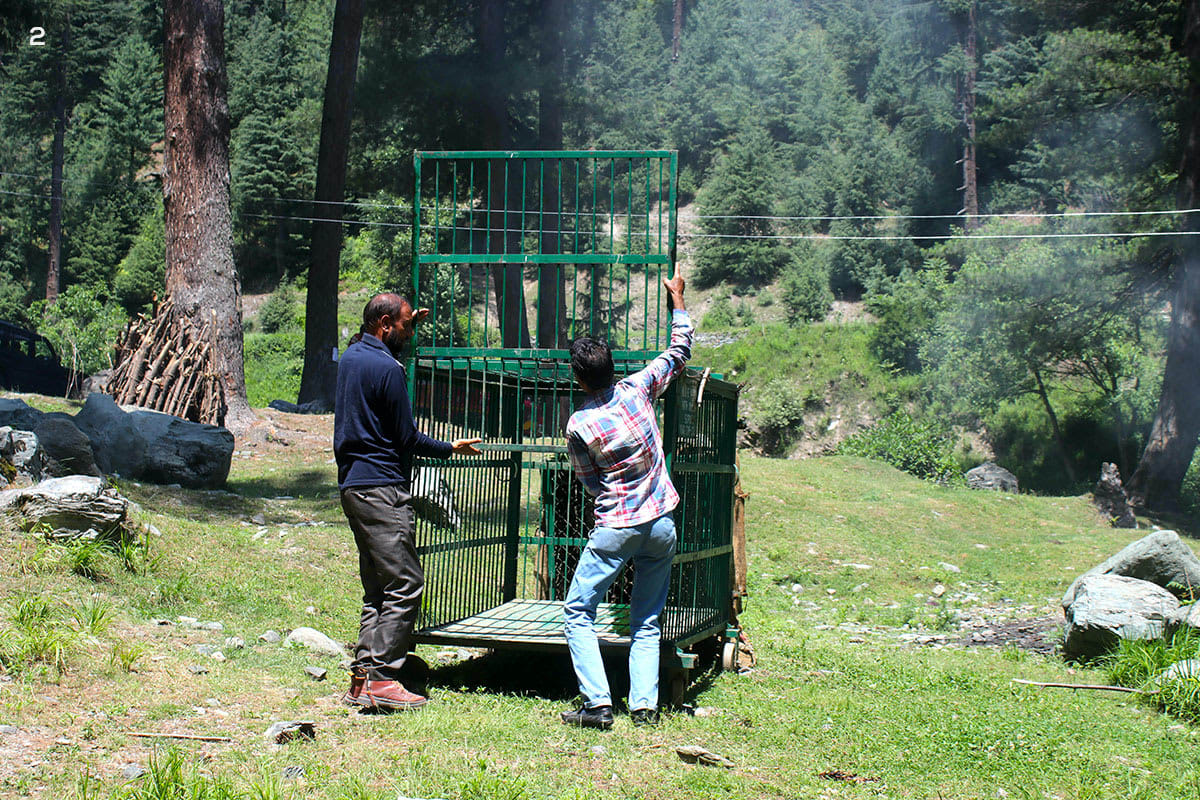
The Wildlife Department says timely interventions, including the use of bear traps and tranquilisation, have helped avert potential fatalities and injuries.
Control rooms have been established in north, south and central Kashmir, as well as in the Wetlands, Jammu, Rajouri-Poonch and Chenab divisions.
Response teams have been equipped with cages, capture nets, tranquilising guns, thermal cameras, GPS devices, protective gear and rescue vehicles. These resources are intended to help staff locate animals, manage encounters and carry out capture or rescue operations when required.
But responding to a sighting is only one part of the challenge. Wildlife teams must also deal with the conditions that repeatedly bring animals close to people: accessible food, fragmented habitats, expanding settlements and human activity near forest edges.
Trapping or tranquilising an animal may resolve an immediate threat, but it does not necessarily prevent another encounter in the same area. The seasonal attraction of orchard waste, meanwhile, can persist as long as fallen fruit and discarded produce remain readily available.
The advice to residents reflects the need to reduce opportunities for sudden contact. Families have been asked to keep children under supervision, avoid walking alone after dark and refrain from approaching or provoking wild animals. Orchardists have been urged to dispose of fallen apples safely and keep food waste away from homes. Sightings should be reported promptly to the nearest wildlife control room.
Such precautions cannot eliminate all risks, particularly in places where people depend on agricultural work and wildlife moves through settled landscapes. They can, however, reduce some of the circumstances in which an encounter turns dangerous.
The recent attacks expose a difficult problem for Kashmir’s communities and wildlife managers. The same landscape supports livelihoods, settlements and wildlife, but the boundaries between them are becoming increasingly porous.
During the harvest, bears can be drawn towards orchards by food that is abundant and easy to reach. Leopards can exploit the availability of stray dogs and move through areas where agricultural land, vegetation and residential development meet.
For residents, the consequences are immediate: injured workers, frightened families and children whose daily movements may have to be restricted. For the authorities, the task extends beyond responding to individual incidents to reducing the conditions that make repeated encounters possible.
That requires practical steps, including safer handling of orchard waste, prompt reporting of sightings, public awareness and trained emergency responses. It also calls for attention to how settlements and agricultural activity intersect with wildlife habitat.
The deaths of Ada Nisar, Ayan Asif and Latifa Banoo have given the issue a human cost that cannot be captured by totals alone. Their cases also illustrate the different settings in which wildlife encounters are taking place – from residential neighbourhoods to orchards where workers spend their days earning a living.
As the harvest continues and winter approaches, wildlife officials expect animals to remain a concern near settlements. For orchard workers, the season cannot simply be put on hold. For families, vigilance has become part of everyday life.
The challenge is to make that coexistence less dangerous: to protect people without treating every wild animal as a threat, and to ensure that the work of gathering Kashmir’s autumn harvest does not come at the cost of more lives.