

The survival of an old craft does not always depend on preserving it exactly as it was.
Sometimes, it depends on finding a reason for people to wear it again.
For Aqsa Hafiz, a young Kashmiri entrepreneur and MBA graduate, that reason lies somewhere between tradition and fashion.
In her early twenties, Hafiz is building an apparel venture around two of Kashmir’s distinctive embroidery traditions, Tilla and Aari, with an ambition that extends beyond selling clothes. Through her brand, Girly Sherly, she is attempting to make traditional craftsmanship relevant to a generation that may admire Kashmir’s cultural heritage but does not necessarily encounter its older forms in everyday life.
Her premise is simple: if traditional embroidery is to survive, it has to remain part of people’s lives.
“Kashmir is not just a place; it is a feeling that lives in its colours, its craftsmanship and the stories passed from one generation to another,” Hafiz said.
That feeling, she believes, can be translated into clothing.
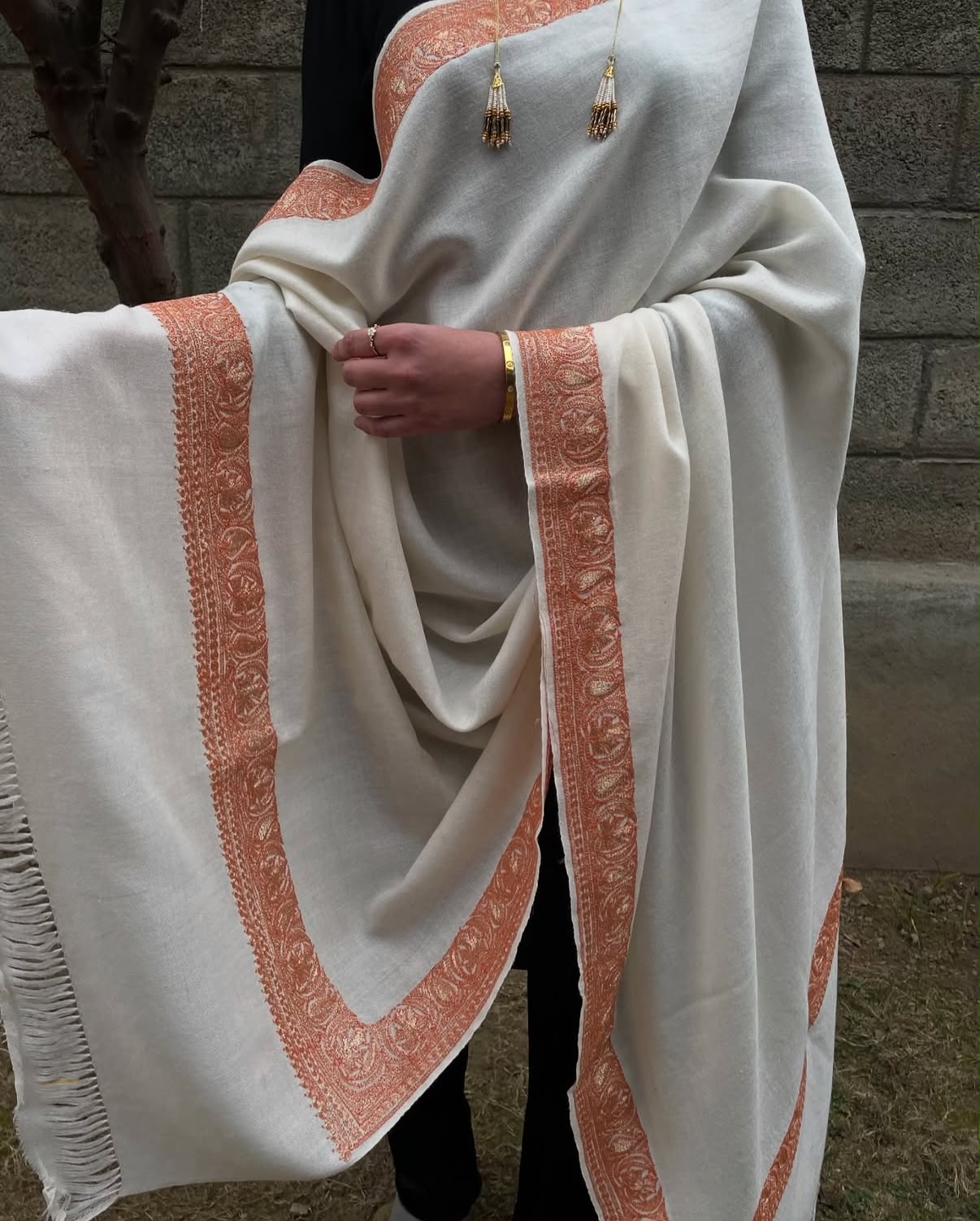
Girly Sherly operates primarily through its Instagram account, @Girly.sherly_, presenting itself as a premium Kashmiri clothing brand specialising in authentic Tilla and Aari work.
Its garments combine handcrafted embroidery with contemporary clothing designs and quality fabrics, an approach intended to make familiar Kashmiri techniques accessible to modern consumers.
The brand also accepts customised orders, allowing customers to influence aspects of their garments while retaining the traditional embroidery techniques at their core.
For Hafiz, that balance is important.
She does not see tradition and modernity as competing ideas. Instead, she sees contemporary fashion as a possible vehicle for carrying traditional craftsmanship into the future.
“I want our traditions to be something that the younger generation wears with pride, not something they only hear about as a part of history,” she said.
It is a challenge faced by many traditional crafts.
Techniques that once formed an ordinary part of everyday clothing can gradually become associated primarily with ceremonial wear, heritage collections or special occasions. The craftsmanship survives, but its relationship with everyday consumers can weaken.
Hafiz wants to reverse that process by putting the work back into circulation.
Tilla and Aari embroidery are among the traditional forms of Kashmiri craftsmanship that depend on painstaking manual work and skills transmitted across generations. Their intricate patterns require patience, precision and an intimate knowledge of fabric and thread.
The finished garment may appear effortless.
The work behind it is anything but.
Tilla embroidery is particularly associated with the use of metallic thread to create elaborate decorative patterns on garments, while Aari work uses a hooked needle to produce fine, chain-stitch embroidery. Both traditions have long been part of Kashmir’s textile culture and have been adapted over time to different garments, designs and tastes.
For Hafiz, preserving such work does not mean freezing it in time.
“Tradition stays alive when we carry it forward,” she said. “If we give our art a place in the lives of our children and in the fashion they choose, we give it another generation to live.”
That philosophy shapes the business she is building.
Her MBA education has provided her with an understanding of business, marketing and consumer behaviour. But the identity of Girly Sherly comes from somewhere much closer to home: Kashmir’s visual language and its inherited traditions of textile craftsmanship.
The combination is deliberate.
Rather than presenting traditional embroidery solely as heritage, Hafiz is positioning it as a design element that can coexist with contemporary fashion preferences.
That requires a certain willingness to experiment.
Traditional motifs may be incorporated into silhouettes that appeal to younger consumers. Embroidery can be used in ways that make an outfit feel distinctly Kashmiri without making it appear disconnected from contemporary fashion.
The objective is not to replace tradition with something new.
It is to create enough space for the old and the new to exist together.
The brand’s social-media presence is central to that strategy.
For a young business, Instagram functions as both a shop window and a means of storytelling. Photographs of embroidered garments can reach customers beyond the physical spaces where Kashmiri craftsmanship has traditionally been encountered.
The platform also allows a brand built around a local craft to speak directly to consumers accustomed to discovering fashion online.
A customer does not necessarily have to walk into a traditional Kashmiri market to encounter Tilla or Aari work anymore.
A garment can appear on a phone screen.
A design can be shared, discussed and customised through messages. A customer can discover an embroidery technique without having grown up around the artisans who practise it.
For Hafiz, that digital audience represents an opportunity to widen the conversation around Kashmiri craftsmanship.
Traditional crafts have often depended on physical markets, established networks and personal relationships between artisans and buyers. Social media can expand that circle, allowing Kashmir’s embroidery to be seen by people who may have little direct connection with the workshops where such pieces are produced.
But visibility alone is not enough.
A craft needs customers.
That is where customisation becomes part of Girly Sherly’s business model.
Customers can specify their preferences and participate in the design process, while the traditional techniques remain central to the finished garment.
It is a model that treats craftsmanship not as a fixed product but as a process that can adapt to individual tastes.
For younger consumers, that flexibility can matter.
Fashion has increasingly become a way of expressing individuality. People want clothing that reflects personal preferences, occasions and identities rather than simply reproducing established designs.
Customisation allows traditional craftsmanship to enter that space.
A customer can choose a particular colour, fabric, pattern or design direction while still receiving the painstaking embroidery associated with Kashmir.
The result is a conversation between the artisan and the consumer.
The consumer brings a contemporary preference.
The artisan brings a traditional skill.
The garment becomes the meeting point.
For Hafiz, the larger goal is cultural continuity.
She believes that preservation can take many forms. It can involve learning traditional skills. It can mean supporting artisans whose livelihoods depend on those skills. And it can mean creating platforms through which their work reaches new audiences.
Her own venture attempts to combine all three ideas.
At its heart is the belief that craftsmanship survives when there is demand for it — and that demand can be created by showing consumers how traditional techniques can belong in contemporary wardrobes.
The approach reflects a broader question confronting traditional crafts in Kashmir and elsewhere: How do inherited skills survive when the habits and markets that once sustained them change?
There is no single answer.
Some crafts survive through government-backed exhibitions and cultural institutions. Others depend on families passing skills from one generation to the next. Some find new markets among tourists and collectors.
Increasingly, however, young entrepreneurs are looking toward fashion, branding and digital commerce.
Their challenge is to make heritage commercially relevant without reducing it to a decorative label.
Hafiz appears to regard that challenge as part of the work itself.
Her venture is still young, but its ambition is larger than the scale of the business.
She wants Tilla and Aari to be recognised not merely as symbols of Kashmir’s past but as living techniques capable of shaping what Kashmiri fashion looks like next.
That distinction is important.
A tradition can become frozen when it is treated only as something that must be protected. It can remain alive when people continue to reinterpret it.
For Hafiz, reinterpretation is not necessarily a betrayal of tradition.
It can be a form of respect.
If a young woman chooses to wear a contemporary outfit featuring traditional Kashmiri embroidery, she is not simply consuming fashion. She is helping create a market in which that embroidery remains useful.
That, in turn, creates a reason for artisans to continue practising their craft.
The chain is simple: demand sustains production; production sustains skills; skills sustain tradition.
But every link matters.
A traditional craft can be admired and still disappear if the people who practise it cannot earn a livelihood from it. Conversely, a craft that finds a viable contemporary market has a stronger chance of surviving beyond the generation that inherited it.
For Hafiz, entrepreneurship therefore becomes a form of cultural work.
She is not describing her business only in terms of products and customers. Her language repeatedly returns to heritage, pride and continuity.
“Kashmir is not just a place,” she said, describing it instead as something that lives through its colours, craftsmanship and stories.
Her ambition is to make those elements visible in what people wear.
That effort will move into a physical setting this week.
Girly Sherly is scheduled to showcase its collection at Bazm-e-Kashmir at Nigeen Club in Srinagar on Aug. 12 and 13.
The exhibition will feature the brand’s premium collection and allow visitors to see its interpretation of Kashmiri fashion in person.
For a business that has primarily built its presence through social media, the exhibition offers something a digital storefront cannot: the chance for customers to stand close to the garments, examine the embroidery and appreciate the work in its physical form.
“We are bringing our apparel to Nigeen Club from the 12th,” Hafiz said. “I look forward to welcoming people and sharing the beauty of Kashmiri craftsmanship with them.”
For a young entrepreneur, the event is an opportunity to sell.
For Hafiz, it is also an opportunity to demonstrate an idea.
The idea is that traditional craftsmanship need not remain confined to the past in order to remain authentic.
A Tilla-embroidered garment can belong in a contemporary wardrobe.
Aari work can be incorporated into designs aimed at younger consumers.
A centuries-old technique can be photographed, displayed and sold through a smartphone screen.
The medium may change.
The craft does not have to disappear with it.
That tension – between inheritance and reinvention – is increasingly central to the future of Kashmir’s traditional arts.
Every generation inherits a culture it did not create. The question is what it does with it.
For Hafiz, the answer is to wear it.
That answer may sound simple, but it carries a larger proposition.
Cultural preservation does not necessarily have to happen in archives, museums or textbooks. It can happen in wardrobes, workshops, businesses and homes.
It can happen when a young entrepreneur decides that an old technique still has a place in a new market.
It can happen when an artisan sees that the painstaking work of embroidery is still valued.
And it can happen when a young consumer chooses a garment not despite its traditional character, but because of it.
Hafiz’s venture is built around that possibility.
She is not trying to turn back the clock. Nor is she attempting to make Kashmir’s craftsmanship conform entirely to global fashion.
Instead, she is trying to create a middle ground – a place where the inherited and the contemporary can meet.
The success of such an approach will ultimately depend on more than one entrepreneur or one brand.
It will require artisans, designers, consumers and businesses to keep finding new reasons for traditional skills to matter.
But every tradition that survives into another generation begins with someone choosing to carry it forward.
For Hafiz, that choice is both personal and entrepreneurial.
Her ambition is not simply to remind young Kashmiris that Tilla and Aari exist. It is to make them want to put those traditions on again, in forms that feel contemporary and distinctly their own.
That may be the most practical way to keep an old tradition alive.
Not by placing it behind glass.
Not by treating it as a relic.
But by giving it somewhere to go.
About the Author
Tabish Khan is a multimedia journalist and postgraduate in Convergent Journalism, working across text, video, social media, and digital storytelling.