

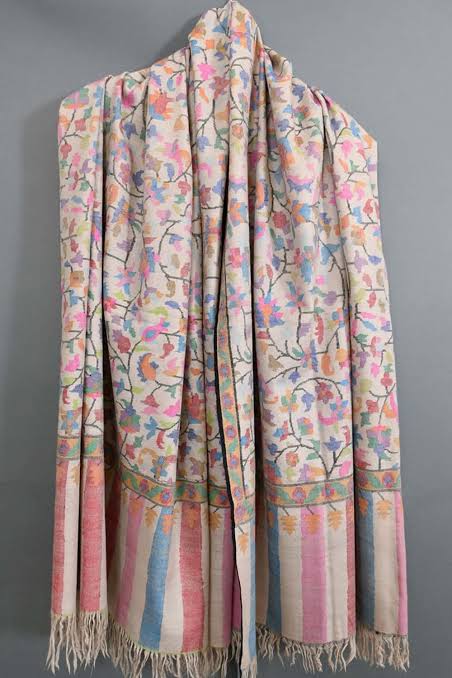
A shawl can be a piece of clothing.
It can also be a record.
In Kashmir, where generations of artisans have turned thread and wool into intricate patterns, some shawls carry within them something more difficult to measure: the memory of a craft, the discipline of a technique, and the accumulated knowledge of hands that learned their work long before modern machines transformed textile production.
For two master weavers from Kanihama in Jammu and Kashmir’s Budgam district, that tradition has now brought national recognition.
Manzoor Ahmad Hajam and Fayaz Ahmad Wani have received the National Handloom Award for their work in Kani shawl weaving, one of Kashmir’s most distinctive and demanding textile traditions.
President Droupadi Murmu presented the award to the two craftsmen at a ceremony in New Delhi marking National Handloom Day.
Their award-winning entry was a Chand-Daar Kani Shawl, produced using the traditional Kani weaving technique.
The recognition places two craftsmen from a small Kashmiri weaving community on a national stage, but the significance of the award extends beyond the two men.
It draws attention to a craft whose survival depends on skills that cannot be learned quickly, automated easily or separated from the patient rhythm of the loom.
Kani weaving is a slow craft.
Its designs emerge through an intricate process in which weavers work with coded Talim scripts – traditional written instructions that guide the reproduction of complex patterns with precision.
The award-winning shawl incorporates nearly 20 distinct hues to recreate an antique design.
Every colour, motif and transition has to be coordinated.
What appears from a distance to be a seamless pattern is, on the loom, a sequence of decisions.
For the weaver, the shawl is not simply an object to be completed.
It is a design to be read, interpreted and reconstructed thread by thread.
The Handicrafts and Handloom Department described the award as recognition of Hajam and Wani’s contribution to one of Kashmir’s distinctive indigenous weaving traditions.
The department congratulated the two craftsmen and said their achievement could bring greater attention to Kani weaving while creating new commercial opportunities for the high-value craft.
The award carries a citation and a cash prize of Rs 2.5 lakh.
For the artisans and the wider handicrafts sector, however, the value of such recognition is not limited to the prize.
Traditional crafts often face a paradox.
The more intricate the work, the longer it takes to produce. The more time it requires, the more difficult it can become to compete with cheaper, faster alternatives.
Yet the very qualities that make traditional crafts difficult to produce are what give them their value.
Kani shawls belong to that category.
They are associated with Kashmir’s centuries-old shawl-making tradition and have long been recognised for their elaborate patterns, intricate construction and painstaking workmanship.
The craft demands patience from both the artisan and the customer.
The artisan may spend long periods translating a design into woven form.
The customer must understand that the value of the finished shawl lies partly in the labour hidden within it.
The National Handloom Award offers a different kind of visibility to that labour.
For Hajam and Wani, the ceremony in New Delhi was a moment of national recognition.
For Kashmir’s weaving community, it was also a reminder that some of its most valuable cultural traditions remain capable of attracting attention far beyond the Valley.
Kanihama, in Budgam district, has long been associated with weaving traditions that form part of Kashmir’s broader textile heritage.
In such communities, craftsmanship is more than an occupation.
It can be a family inheritance.
Skills are passed from one generation to another, often informally, through observation and practice. A young apprentice learns not only how to handle the loom but how to understand the rhythm of the work, interpret patterns and recognise the subtle differences between materials and techniques.
Kani weaving adds another layer of complexity.
The Talim system acts as a kind of coded language for the design.
The instructions allow the weaver to reproduce intricate motifs systematically, converting a visual pattern into a sequence that can be followed on the loom.
It is an example of how traditional crafts often contain sophisticated systems of knowledge that are not immediately visible in the finished product.
A shawl hanging in a showroom can look decorative.
The process behind it can resemble a form of engineering.
The weaver must keep track of colour, pattern, sequence and structure while maintaining the consistency of the fabric.
The award-winning Chand-Daar Kani Shawl is an expression of that discipline.
Its nearly 20 hues recreate an antique design, linking the present work of the two craftsmen with a visual vocabulary inherited from earlier generations.
That connection between past and present is at the heart of traditional craft.
A weaver does not begin with an empty canvas.
He inherits motifs, methods and techniques.
But he also has to interpret them for the present.
This is where the National Handloom Award carries significance beyond ceremonial recognition.
By highlighting a specific piece and the people who made it, the award helps place attention on the process behind the product.
That distinction matters at a time when consumers are surrounded by mass-produced textiles.
Machines can reproduce patterns at extraordinary speed.
Digital technology can generate designs almost instantly.
But traditional handloom work operates according to a different logic.
Its value comes partly from the time involved.
Each completed piece represents hours, days or longer periods of concentrated labour, depending on the complexity of the design.
The department said the work of Hajam and Wani has helped preserve the Kani technique while attracting wider recognition.
It described the two craftsmen as role models for other weavers in Kashmir and the wider handicrafts sector.
That role may become increasingly important.
Traditional crafts survive only when there are people willing to learn them and customers willing to value them.
The first challenge is transmission.
If younger generations decide that traditional weaving cannot provide a viable livelihood, the chain of knowledge can weaken.
The second challenge is the market.
Even when artisans remain committed to their craft, they need buyers.
That is why authorities increasingly view traditional handicrafts not only as cultural assets but also as sources of economic activity.
The promotion of Kani weaving sits at the intersection of those two objectives.
Preservation without livelihoods can become difficult to sustain.
Commercialisation without attention to authenticity can diminish the very qualities that make a craft valuable.
The task is to find a balance.
The award given to Hajam and Wani provides an example of how recognition can help create that balance.
Greater visibility can attract buyers.
It can encourage younger artisans to consider traditional crafts as viable professions.
It can also strengthen the reputation of Kashmir’s handloom products in markets where consumers increasingly place value on handmade and heritage goods.
The department said the award could help create new commercial opportunities for Kani weaving.
Those opportunities will depend on whether recognition can translate into sustained demand.
A prize can bring attention to a craft for a moment.
A functioning market can keep it alive for generations.
That is the larger challenge facing Kashmir’s handicrafts sector.
The region is home to an extraordinary range of traditional skills, many of which are deeply tied to particular communities and production methods.
But the knowledge embedded in those crafts is vulnerable.
When a skilled artisan retires without passing on his techniques, a small part of that knowledge can disappear with him.
When consumers choose cheaper substitutes without understanding the difference in workmanship, the economic incentive to maintain traditional production weakens.
When young people leave craft-based occupations in search of other livelihoods, workshops and looms can fall silent.
The opposite is also possible.
Recognition can create pride.
Demand can create livelihoods.
And livelihoods can create reasons for younger generations to stay connected to inherited skills.
For Kanihama’s weavers, the National Handloom Award is therefore more than a certificate.
It is a signal that the work done at a traditional loom can still command attention at the highest levels.
The ceremony in New Delhi brought that contrast into sharp focus.
The President of India presented an award for a craft rooted in Kashmir’s centuries-old weaving culture.
The shawl had travelled from the loom to the national stage.
Its journey was symbolic.
A craft that depends on painstaking manual work had been recognised in an era increasingly defined by automation and speed.
The award-winning piece itself contains a similar conversation between time periods.
Its design recreates an antique pattern, but the shawl was produced by living craftsmen working today.
The past has not been reproduced mechanically.
It has been interpreted by human hands.
That is perhaps the central strength of traditional craft.
It carries memory without being entirely frozen by it.
The Kani tradition has changed over generations, responding to changing designs, markets and consumer preferences.
But the core discipline remains.
The Talim script still guides the weaver.
The loom still demands patience.
The colours still have to come together with precision.
And the finished shawl still carries the imprint of the person who made it.
For Hajam and Wani, the National Handloom Award acknowledges that continuity.
For the department, it offers an opportunity to promote Kani weaving as both cultural heritage and economic activity.
And for the wider handicrafts sector, it presents a question that extends far beyond one award.
Can Kashmir’s traditional crafts find enough space in the modern economy to survive?
The answer will not be determined by awards alone.
It will depend on whether artisans are paid fairly, whether younger people see a future in the craft, whether consumers understand the labour behind handmade products and whether markets can be developed without compromising authenticity.
But recognition matters because it changes the conversation.
It tells artisans that their skills are valued.
It tells consumers that a handmade shawl is more than an expensive piece of fabric.
And it tells the next generation that the knowledge inherited from their elders does not necessarily belong only to history.
It can still have a future.
In Kanihama, that future remains tied to the loom.
The award-winning Chand-Daar shawl is a reminder of what can emerge when patience, technical knowledge and inherited design come together.
Nearly 20 hues were brought together to recreate an antique pattern.
The work required the interpretation of coded instructions, the coordination of colours and the repetition of a technique refined across generations.
The final object is beautiful.
But its deeper value lies in what it represents.
A tradition has been carried forward.
Two craftsmen have been recognised for carrying it.
And a piece of Kashmir’s textile memory has travelled far beyond the Valley.
The National Handloom Award cannot guarantee that Kani weaving will flourish indefinitely.
But it can help create the conditions in which it has a chance.
For traditional crafts, survival is rarely a single moment of triumph.
It is a long chain of choices – by artisans who continue to practise, families that continue to teach, customers who continue to buy and institutions that continue to recognise.
Hajam and Wani have added another link.
Their shawl began with an old design.
Their technique came from generations before them.
Their work was completed in the present.
And now, through the award, it has been given a place in the national record.
The loom remains where it has always been.
The challenge is to make sure there are still hands willing to work it.
About the Author
Amir Yaseen is a Srinagar-based journalist interested in Kashmir, policy, progress, and the human stories shaping everyday life.