
There is something revealing in the arithmetic of government accommodation in Kashmir.
The Estates Department controls 1608 accommodation units in the Kashmir Division. According to an RTI response, none is vacant. Yet, when the summer session arrives, the government still has to hire 78 hotels and guest houses to accommodate its employees.
Two figures, taken together, tell a story about a public estate under pressure – and perhaps about the difficulty of matching government housing with the people and purposes it is expected to serve.
The arrangement is not, by itself, evidence of waste. Kashmir’s summer brings a seasonal concentration of government activity, and the administration has legitimate security and logistical requirements. Hotels are selected through an Expression of Interest and tender process, and employees are allotted rooms only after a government-appointed committee is satisfied with the accommodation standards. Police personnel are deployed at the selected properties for security and frisking.
Still, the scale of the hotel dependence raises a basic question: if government accommodation is a permanent public asset, why does the administration repeatedly need a parallel private accommodation market?
The answer may lie less in a shortage of buildings than in a mismatch between supply, location, category and demand.
Government quarters are not interchangeable hotel rooms. A Type-II quarter in one locality cannot necessarily substitute for a suitable accommodation unit near an employee’s place of work. Senior officers, visiting officials and personnel with particular security requirements may require different arrangements. Seasonal requirements can also overwhelm a housing pool designed for a permanent workforce.
But that explanation should lead to better planning, not permanent improvisation.
The RTI response reveals that the Directorate of Estates, Jammu and Kashmir, together received a budget allocation of Rs 61 crore between March 2025 and March 2026, of which Rs 58.43 crore was spent. Estates Kashmir alone has a substantial housing inventory, yet its accommodation is fully occupied.
The government is also building more.
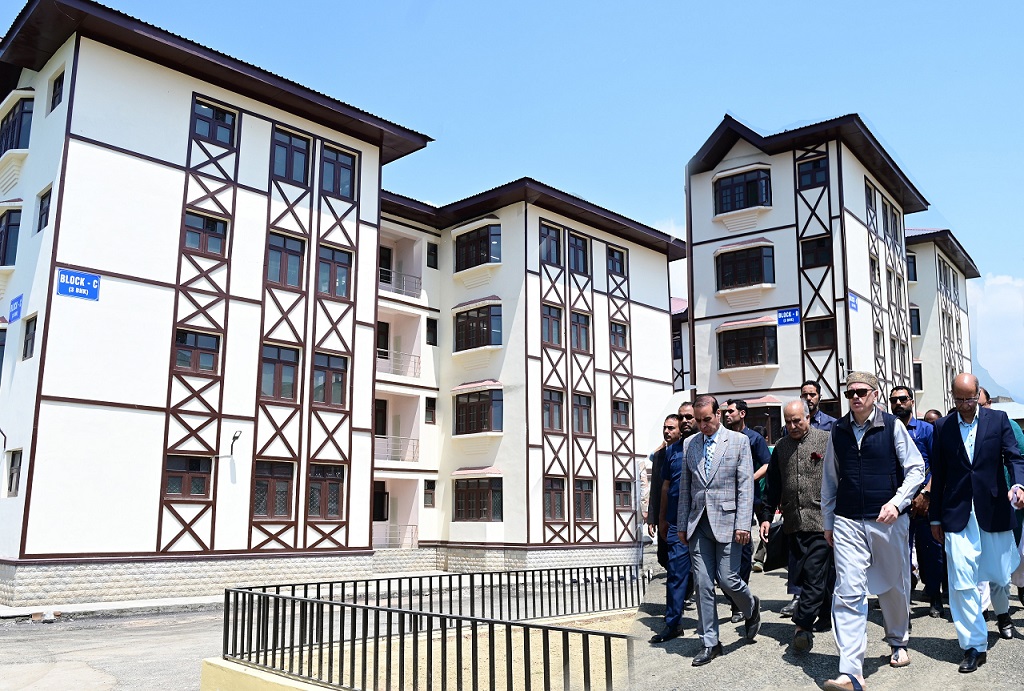
Over the past six years, 192 flats have been constructed at Sempora in Pampore — 16 one-bedroom, 112 two-bedroom and 64 three-bedroom units. Another building containing four three-bedroom flats is coming up at Jawahar Nagar, on the site of a two-storey government building that was gutted two years ago.
These are useful investments. But construction alone will not solve the underlying problem if government housing continues to be planned primarily as a collection of buildings rather than as a managed housing system.
A modern estates policy should begin with a simple question: who needs government accommodation, where do they need it and for how long?
The answer should be based on actual occupancy data, employee transfers, retirement patterns, departmental requirements and seasonal demand. Housing that is permanently occupied by employees who may no longer qualify for it, or units allocated according to outdated categories, can create artificial scarcity even when the physical stock appears substantial.
The RTI response says seven quarters have been allotted to political parties. It also says no government accommodation was illegally occupied by employees or political leaders.
The department declined to disclose details relating to accommodation allotted to social activists, journalists and political leaders, citing security considerations. That is understandable where disclosure could create genuine security risks. But security-sensitive information and public accountability do not have to be opposites.
The public can be told how many units exist, how many are occupied, what categories they fall into, how allocation is governed and how long occupants may retain them without revealing sensitive locations or identities.
That kind of transparency matters because government accommodation is not private property. It is public infrastructure.
There is another figure worth examining.
Estates Kashmir generated Rs 19.24 crore in revenue between 2020-21 and 2025-26. Annual revenue rose from Rs 2.11 crore in 2020-21 to Rs 4.70 crore in 2024-25 before standing at Rs 3.55 crore in 2025-26. Yet Rs 2.68 crore in licence fees remained outstanding as of June 30, 2026.
That is not necessarily a crisis by itself. Government departments inevitably carry receivables. But unpaid licence fees weaken the ability of a public housing system to recover part of its operating costs and reinvest in maintenance.
The larger issue is that public housing has two sides: construction and circulation.
A government can keep adding flats, but if existing units remain locked into rigid allocation arrangements, if maintenance is delayed, if occupants retain quarters beyond reasonable tenure or if the distribution of housing does not correspond with where employees actually work, new construction will merely push the problem forward.
The 78 hotels are therefore more than a procurement statistic. They are a symptom of a system trying to satisfy immediate demand with temporary accommodation while its permanent housing stock remains fully absorbed.
There may be perfectly rational reasons for every individual hotel booking. The problem emerges when temporary arrangements become a recurring feature of administration.
The solution need not be another grand construction programme.
It could begin with a comprehensive audit of the Estates pool: every unit, its category, location, occupant, eligibility, tenure, condition and likely date of availability. That inventory could be paired with an annual forecast of seasonal demand. Where shortages are structural, construction can follow. Where shortages are seasonal, long-term framework contracts with accommodation providers may make more sense than repeated emergency-style arrangements.
At the same time, licence-fee recovery needs attention, as does maintenance. A well-managed government estate should generate enough information to show not merely how many buildings exist, but how efficiently they are being used.
The irony of Kashmir’s Estates Department is therefore not that it has too little accommodation.
It may be that it has too little flexible accommodation.
The 1608 units are full. The two vacant special bungalows at Tulsi Bagh hardly alter that picture. And 78 hotels have entered the equation because the government still has people to house.
That should prompt a rethink of what “government accommodation” means in 2026.
Buildings are only the physical part of the equation. The real public asset is a housing system that can respond to changing government needs without repeatedly reaching for the hotel directory.
For now, Kashmir has a curious arrangement: no vacancy in the official estate, but plenty of demand beyond its walls.
The question is not simply how many quarters the government owns.
It is whether those quarters are being managed as intelligently as they are being counted.
About the Author
Syed Sameer Ahmad Nazki is a filmmaker skilled in editing and videography, with an interest in visual storytelling and sports.