
For electric vehicles, the future is often imagined in terms of clean cities, cheaper running costs and charging stations replacing petrol pumps.
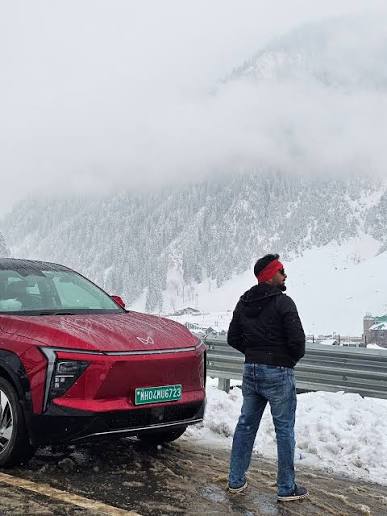
In Jammu and Kashmir, the future will have to pass another test first. Winter.
The administration is preparing to make a significant push toward electric mobility, with a draft policy proposing that electric vehicles account for 40 percent of new personal four-wheeler registrations within six years of its adoption. The proposed targets are equally ambitious for other categories: 35 percent for two-wheelers, 30 percent for buses and 25 percent for taxis and shared-mobility vehicles.
But the government is approaching the transition with an unusual emphasis on what can happen when temperatures fall below freezing, roads become difficult, and a vehicle’s advertised range meets the realities of Himalayan weather.
The Draft Jammu and Kashmir Electric Vehicle Policy 2026 has not yet been notified. It was recently reviewed by Chief Secretary Atal Dulloo, who directed officials to build the framework around what the administration described as a “reliability-first and fiscally prudent” approach. The Law Department has been asked to vet the draft before it is finalised.
The caution reflects a central problem for J&K: encouraging people to buy electric vehicles is one thing. Ensuring that those vehicles remain dependable across the region’s varied terrain and climate is another.
A policy designed around registration numbers alone could move faster than the infrastructure supporting it.
The government appears determined not to let that happen.
Electric vehicles are particularly sensitive to low temperatures because cold weather affects battery chemistry, charging behaviour and energy consumption. Cabin heating can also draw additional energy, reducing the range available for driving.
Those effects become more consequential in a place where winter temperatures can remain below freezing and where journeys can involve steep gradients, long distances and difficult road conditions.
J&K is not a single driving environment.
A vehicle operating in relatively mild winter conditions in Jammu may face very different demands in Kashmir’s colder areas. A city commute in Srinagar is different from a journey through mountain roads, where elevation, snow, traffic and limited charging options can all compound the problem.
The draft policy therefore proposes a dedicated Winter Validation Protocol to assess battery thermal behaviour, low-temperature charging and the effect of cabin heating on vehicle performance.
That may prove to be one of the policy’s most consequential provisions.
Instead of assuming that vehicles validated under standard conditions will automatically perform adequately in J&K, the administration wants their performance tested in the environment where they will actually be used.
Dulloo has also directed that EV deployment take account of J&K’s terrain, climate and operational requirements, particularly on difficult routes, with vehicles and charging infrastructure validated under field conditions.
The principle is simple: before the government asks consumers to trust the technology, the technology must demonstrate that it can cope with the place.
The policy’s targets would represent a substantial change in the composition of J&K’s vehicle fleet.
A 40 percent share for new personal four-wheelers would mean two out of every five new cars being electric within six years of the policy’s adoption.
For two-wheelers, the proposed 35 percent target would mean more than one in three new registrations being electric.
Those numbers sound ambitious because they are.
But the administration’s challenge is not merely to create incentives large enough to move consumers from internal-combustion engines to batteries. It must persuade people that the switch will work beyond the showroom.
A senior government official involved in the policy process said the administration did not want registrations to outpace infrastructure.
“Electric mobility cannot be driven only by registration targets,” the official said. Consumers, he added, need confidence that vehicles will perform in winter, charging points will be available and servicing will be accessible.
That last point is easily overlooked.
A petrol or diesel vehicle has benefited from a mature ecosystem built over decades: mechanics, spare-parts suppliers, workshops, fuel stations and roadside assistance are widely distributed.
The electric ecosystem is still developing.
For a buyer considering an EV, the question is therefore not simply how much electricity costs compared with petrol. It is also: Who will repair the vehicle? How quickly can a part be obtained? What happens if the battery develops a problem far from Srinagar or Jammu? Where can the vehicle be charged during a long journey?
Until those questions have credible answers, adoption may remain slower than policy targets suggest.
Charging infrastructure sits at the centre of the proposed transition.
J&K currently has around 180 public charging stations. The draft policy proposes increasing that number to 450 sites by the third year and 900 by the sixth.
But the government’s proposed framework goes beyond counting charging points.
It proposes 140 priority fast-charging hubs, each expected to maintain at least 98 percent monthly uptime.
That target is important because a charging station that exists on a map but is unavailable when a driver needs it is not much of an infrastructure asset.
The difference between availability and reliability could become one of the defining measures of J&K’s EV transition.
A petrol station can generally serve a vehicle within minutes. Charging takes longer, even with fast chargers, making dependable access particularly important on long-distance routes.
For a driver travelling through the mountains, the problem is magnified. A failed charger or a closed station can mean much more than inconvenience.
This is why the proposed expansion will have to be geographically intelligent.
Nine hundred charging sites concentrated around major urban centres would produce a very different outcome from 900 sites strategically distributed along highways, tourist routes, district centres and difficult-to-reach areas.
The geography of charging may ultimately matter as much as the number.
Electric scooters could provide one of the fastest routes to wider adoption.
Their lower purchase and operating costs, combined with relatively short urban journeys, make them an attractive proposition for many consumers.
But even here, winter remains a question.
Umar Ahmad, a Srinagar-based electric-scooter dealer, said demand was rising but customers routinely asked about battery life, cold-weather range and charging availability.
“Customers are interested in electric scooters because of the lower running cost, but winter performance is one of the first questions they ask,” he said.
The concern is practical.
A buyer may accept a lower range if a vehicle is used primarily for short trips around Srinagar. The same buyer may think differently if winter conditions reduce that range further or if the vehicle must travel beyond the city.
“Once customers know that charging is reliable and servicing is available, adoption can increase much faster,” Ahmad said.
That observation captures a broader truth about emerging technology: consumers do not necessarily need perfection. They need predictability.
The draft policy proposes several financial measures to encourage adoption.
These include interest subvention of up to 3 percent a year or rolling top-up support, with the two benefits not available simultaneously.
An annual scrappage exchange bonus is also proposed for up to three years through authorised scrappage channels.
Such incentives could lower the initial cost barrier, which remains one of the biggest obstacles to EV adoption despite lower operating costs over time.
But subsidies can accelerate demand only so far.
If a customer receives financial support to buy an EV but discovers that charging is unreliable or servicing is difficult, the incentive has solved the wrong problem.
That is why the proposed policy’s emphasis on infrastructure and validation may prove as important as its financial provisions.
Government vehicles are also expected to move gradually toward electric mobility.
But the transition will be phased and need-based. Dulloo has directed officials to consider local terrain, climate and operational requirements before replacing government vehicles.
That approach reflects the reality that not every government vehicle performs the same job.
An electric car used for routine urban movement is not equivalent to a vehicle expected to travel long distances on steep mountain roads in winter.
The government fleet could nevertheless become an important demonstration project.
Public vehicles are highly visible. If departments can show that EVs can reliably operate across ordinary administrative duties, they could help normalise the technology for private consumers.
But the reverse is also true: poorly planned deployment could undermine confidence.
There is another part of the transition that is less visible from the driver’s seat: electricity.
A large increase in EVs means increased demand for charging. The draft policy therefore proposes linking EV charging to the power system through Time-of-Day tariffs and encouraging charging during solar hours.
It also proposes 40 percent renewable-energy integration in charging operations during the policy period.
The idea is to ensure that electrification of transport is connected to a cleaner and more intelligently managed electricity system.
For J&K, this matters particularly because the transition is taking place in a region with distinctive seasonal electricity demand.
If thousands of vehicles begin charging simultaneously during periods of peak household consumption, the pressure on the distribution system could increase. Smart tariffs and managed charging could help spread that demand.
The policy’s success will therefore depend partly on institutions that drivers rarely see: electricity distributors, regulators, charging operators and local authorities.
The EV policy has not emerged overnight.
The government constituted a committee on October 20, 2022, to examine incentives, commercial fleet conversion, charging infrastructure, road safety, research, innovation and skill development.
The latest draft has been prepared by the Transport Department with support from the Centre for Innovation and Transformation in Governance.
Transport Secretary Avny Lavasa has said the framework is organised around eight strategic pillars covering vehicle adoption, charging infrastructure, workforce development, fiscal support, power-system integration and environmental outcomes.
The long gestation reflects the complexity of the transition.
An EV policy is not simply a transport policy. It touches energy, finance, urban planning, manufacturing, employment, tourism and environmental management.
J&K’s EV transition will ultimately be judged not by the number of targets printed in a policy document but by what happens on an ordinary winter morning.
Can the vehicle start and deliver predictable performance? Can a driver find a working charger? Can the battery be charged efficiently in freezing temperatures? Can the vehicle reach its destination through difficult terrain? And if something goes wrong, can it be repaired without sending the owner back to a major city?
Those are not futuristic questions. They are the practical tests that will determine whether consumers trust electric mobility.
The draft policy recognises this in a way that many technology transitions do not: climate is not a footnote.
J&K’s mountains, cold winters and dispersed settlements are part of the specification.
The proposed 40 percent target for electric cars and 35 percent target for two-wheelers are ambitious markers. But before those numbers become reality, the government will have to build something less visible and more important: confidence.
For now, the EV revolution in Jammu and Kashmir is waiting at the edge of winter.
The next test will not be whether people want electric vehicles. It will be whether those vehicles can prove they belong here.
About the Author
Mir Suneem is a filmmaker and postgraduate in filmmaking from Jamia Millia Islamia, with a strong interest in editing and narrative craft.