
Kashmir Impulse Desk
Jammu, Nov 3
BJP national vice president Ram Madhav on Tuesday accused former prime minister Rajiv Gandhi and then Jammu and Kashmir chief minister Farooq Abdullah of rigging the 1987 Assembly elections in the region, alleging that the electoral manipulation contributed to the emergence of militancy.
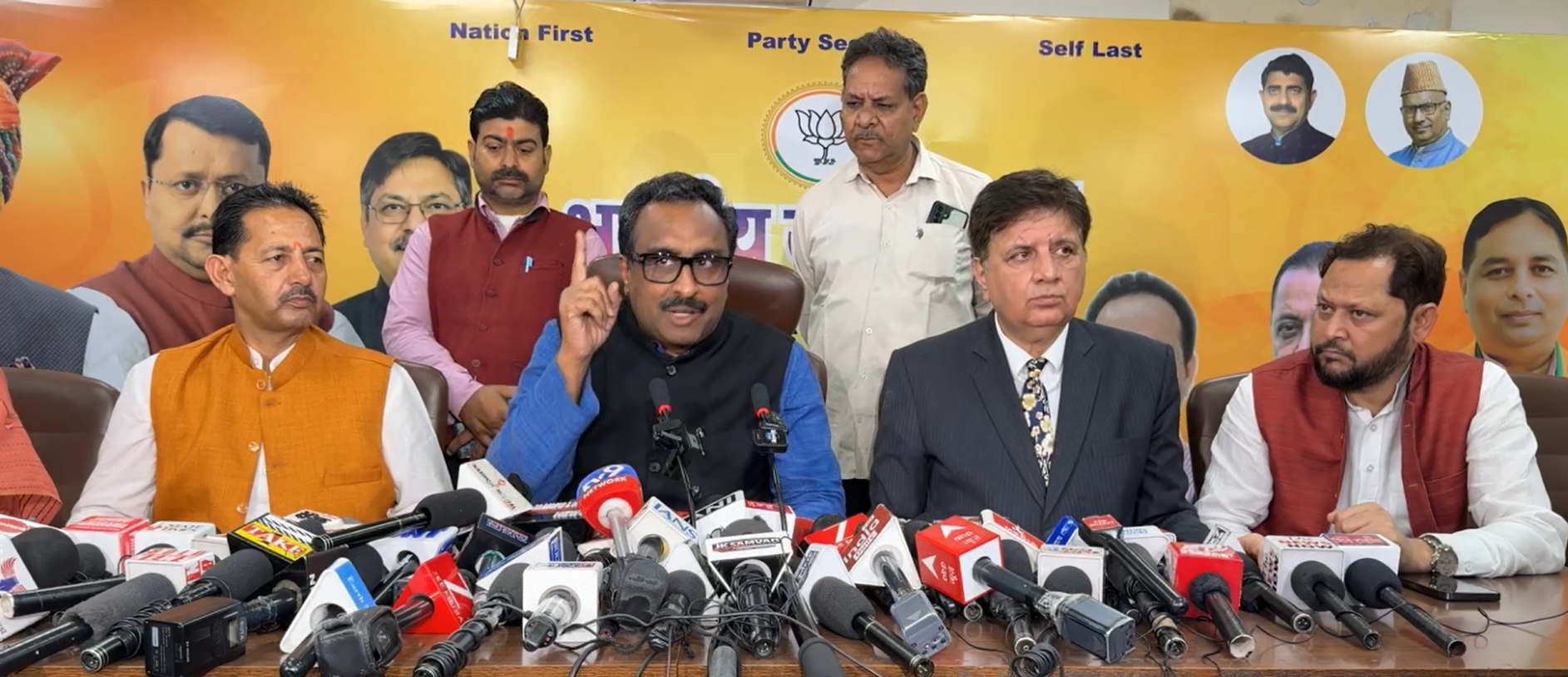
Addressing a press conference at the BJP headquarters in Trikuta Nagar, Jammu, Madhav also accused the Congress of attempting to undermine democratic institutions and engineer political instability through what he described as a campaign of misinformation over the Special Intensive Revision (SIR) of electoral rolls.
Drawing a comparison with Congress allegations of electoral fraud against the BJP, Madhav said two former prime ministers had been associated with established instances of electoral manipulation.
He cited the 1971 election of former prime minister Indira Gandhi, which was set aside by the Allahabad High Court in 1975 over electoral malpractice, and the 1987 Jammu and Kashmir Assembly elections.
“Secondly, in 1987 in J&K Assembly elections, Rahul’s father and the then Prime Minister Rajiv Gandhi, in league with Farooq Abdullah, who was then J&K Chief Minister, had resorted to large-scale irregularities in the election process, leading to emergence of terrorism here,” Madhav said.
He added that these were well-documented events.
Madhav was accompanied by J&K BJP general secretaries Gopal Mahajan and Baldev Singh Billawaria, chief spokesperson Sunil Sethi and other senior party leaders.
The BJP leader accused the Congress of seeking a change of government through unrest and violence because it could not defeat Prime Minister Narendra Modi electorally.
He cited the opposition’s rally at Ramlila Maidan, saying that despite claims of mobilising one million people, the participating parties had managed to gather only around 50,000 to 60,000 people.
He claimed the BJP could mobilise around 5,000 people even at an ordinary rally in a Jammu Assembly constituency.
Madhav declined to comment on the political developments within the National Conference following its recent internal differences and speculation about the stability of the Jammu and Kashmir government.
He said his visit was focused on addressing what he described as the Congress’s misinformation campaign against the SIR exercise.
“For the past few months, the main opposition party Congress and its leader Rahul Gandhi have been busy spreading lies that the Election Commission has manipulated the country’s electoral system,” he said.
Madhav said the Election Commission had submitted a detailed affidavit before the Supreme Court explaining the SIR process and addressing the allegations.
He alleged that the Congress was attempting to create distrust in constitutional institutions and encourage unrest to achieve political change outside the democratic process.
He also referred to developments in Bangladesh and Nepal, alleging that opposition leaders were openly calling for similar changes in India.
“The people of India will never allow the Congress to succeed in its intentions to spread anarchy in the country,” he said.
Describing the SIR as a legitimate constitutional exercise, Madhav said it was aimed at correcting electoral rolls through door-to-door verification by Booth Level Officers.
He said the exercise, being undertaken after nearly two decades, would identify discrepancies, including the names of deceased, transferred and non-existent voters, as well as illegal foreign nationals.
Madhav alleged that the Congress wanted illegal voters to remain on electoral rolls for political reasons.
Responding to the Congress claim that 13 crore voters had been deleted, he questioned why the party had not identified those affected.
“Where are those 13 crore voters whose names, according to the Congress, have been deleted?” he asked.
He said the deletions included around two to three crore deceased voters, six crore people who had shifted residence, one to two crore non-existent voters and alleged illegal immigrants.
Referring to Jammu, Madhav said Rohingya migrants had settled in several areas and that their names should not remain on electoral rolls if they were ineligible.
He said genuine voters whose names had been removed through computer-based verification could apply to have them restored through the prescribed procedure.
Madhav acknowledged that errors could occur during a computer-based revision exercise but said such mistakes could be rectified through the relevant forms and procedures.
He cited Uttarakhand, where he serves as BJP in-charge, saying that most of the names deleted there belonged to Hindu voters, adding that eligible people could seek their inclusion.
The BJP leader also rejected earlier Congress allegations of electronic voting machine manipulation, saying the party had failed to establish its claims.
He pointed out that Congress had lost 56 Assembly elections between 2014 and 2024, as well as the 2014, 2019 and 2024 parliamentary elections.
“If the Congress says the Election Commission is manipulating elections, how was it defeated before the present Chief Election Commissioner, Gyanesh Kumar, took office?” he asked.
Madhav accused the opposition of avoiding a special session of Parliament while continuing to make allegations against the electoral system.
He also mocked Congress claims that the BJP had allowed it to win elections in Karnataka, Kerala and Telangana to lend credibility to allegations of electoral manipulation elsewhere.
He described the argument as illogical, saying the opposition could not question the same electoral system through which it had secured victories.
Madhav said Congress was seeking a return to ballot papers instead of electronic voting machines but had failed to perform well in recent elections conducted through paper ballots.
He cited municipal elections held in October, in which Congress won two of 42 wards, and MLC elections, where BJP and its allies won 16 of 28 seats, the BJP secured 13 and Congress won one.
He said any genuine discrepancies in the SIR exercise could be addressed through the existing correction mechanism.