
For years, Kashmir’s winters have been treated as the awkward footnote to its solar ambitions.
The argument sounds intuitive: a region known for freezing temperatures, snow-covered roofs, short winter days and long spells of cloudiness hardly seems like natural territory for solar power.
But photovoltaic technology does not ask whether the air is warm. It asks whether there is light.
That distinction changes the conversation.
Solar panels convert sunlight into electricity, not heat into electricity. And, counterintuitively, high temperatures can reduce the performance of photovoltaic modules. Most panels have a negative temperature coefficient, meaning their power output generally declines as the temperature of the solar cells rises.
The familiar 25-degree Celsius figure associated with solar panels is therefore easily misunderstood. It refers to the cell temperature under Standard Test Conditions used to rate modules; it is not a claim that panels perform best only when the surrounding air is 25 degrees.
On a bright, cold day, panels can operate under favourable thermal conditions. A panel sitting under a strong summer sun can become substantially hotter than the surrounding air, reducing its output.
For Kashmir, then, cold itself is not the principal obstacle.
Winter sunlight is.
The Valley receives fewer daylight hours during winter. The sun travels lower across the sky, clouds can persist, and snowfall can cover panels. Each of these factors can reduce generation.
And there is a second problem: the decline in solar production arrives precisely when electricity consumption rises.
Heating loads increase. Households spend longer hours indoors. Commercial and institutional demand can climb. Solar generation, meanwhile, is at its seasonal low.
That makes one conclusion unavoidable: rooftop solar cannot be treated as a year-round replacement for the electricity grid in Kashmir.
But that is a very different proposition from saying solar does not work here.
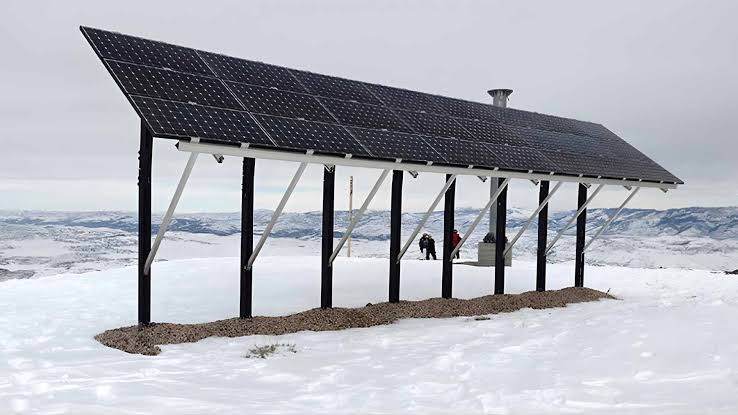
Cold regions across the world already demonstrate that photovoltaic generation is compatible with low temperatures. The question is not whether panels can survive or function in cold weather. It is whether installations are designed around the realities of that weather.
In Kashmir, that means paying attention to the roof before putting panels on it.
Panel orientation and tilt can influence how efficiently snow slides away. Mounting structures must account for local snow loads. Maintenance becomes more important after heavy snowfall. System designers must consider shading, roof strength, drainage and access.
Even snow is not entirely a one-dimensional enemy. In suitable circumstances, light reflected from snow-covered surfaces can provide additional illumination to bifacial solar modules, which generate electricity from light reaching both sides of the panel.
The point is not that snow improves solar generation overall. It does not. The point is that Kashmir’s winter conditions require engineering, not dismissal.
The economics are equally important.
A rooftop solar system is often judged by the size of its upfront cost. Electricity purchased from the grid, by contrast, tends to disappear into monthly bills. The two expenses therefore feel fundamentally different.
But solar is an asset that can produce electricity for years.
For a household with a suitable roof, the rational question is not whether its panels will generate as much power in January as they do in May. They will not.
The question is how much electricity the system can generate over its useful life, and how much of the household’s annual consumption that production can offset.
The same calculation becomes more interesting for businesses and industries.
Factories, warehouses, hotels, schools, hospitals and government buildings often have large roof surfaces exposed to sunlight. In many cases, the roof already exists. No additional land needs to be acquired simply to place generation capacity above it.
That matters in a region where land has competing demands from housing, agriculture, industry and environmental conservation.
A dispersed network of rooftop systems could also change the relationship between consumers and the power system.
For generations, the electricity system has largely operated on a simple arrangement: power stations generate electricity, and consumers use it.
Rooftop solar complicates that model in a useful way.
A house can become a small generating unit. A school can become one. So can a workshop, hotel or factory.
Thousands of such installations would not make Jammu and Kashmir energy-independent. Nor would they eliminate the need for conventional generation, transmission infrastructure or the grid.
They could, however, reduce daytime dependence on purchased electricity.
That distinction is important.
The realistic goal for Kashmir should be greater energy self-reliance, not an overnight escape from the grid.
Solar can generate electricity when the sun is available. Hydropower and other sources can provide generation when it is not. Batteries can shift some electricity from one period to another, although storage large enough to provide complete winter independence would be expensive.
The future, therefore, is likely to be a mix rather than a single technology.
Solar should not be asked to do what it cannot do.
It cannot generate electricity at night. It cannot guarantee output through prolonged snowfall. It cannot erase seasonal variations in sunlight.
But neither should it be rejected because it cannot meet those impossible conditions.
The more useful approach is to measure what it can do.
That requires better information about rooftop potential, transparent financial incentives, accessible financing and predictable policies. Distribution networks must be able to accommodate increasing amounts of distributed generation. New buildings can be designed with solar-ready roofs and electrical systems.
Government institutions could lead with systematic assessments of suitable public buildings, especially where daytime electricity consumption is substantial.
For industries, the argument can be even more direct. A factory roof exposed to sunlight is not merely a protective surface. It can also become an energy asset.
The environmental argument matters, but so does the balance sheet.
Every unit of electricity generated on-site is a unit that does not have to be purchased from elsewhere at that moment, subject to the economics and the applicable electricity rules.
The winter question, then, needs to be reframed.
Instead of asking whether Kashmir is too cold for solar, ask whether its rooftops receive enough usable sunlight across the year to justify investment.
That is an engineering and economic question. It can be measured.
Kashmir’s winter will remain difficult for solar. December and January will not suddenly resemble the bright months of spring. Snow, clouds and shorter days will continue to suppress generation.
But the existence of a seasonal weakness does not invalidate the resource.
An electricity system is built around variation. Hydropower fluctuates with water availability. Solar varies with daylight and weather. Demand rises and falls with seasons and time of day.
The challenge is to make these differences work together.
Kashmir does not need to become a place where every home produces all its own electricity.
It needs to become a place where suitable roofs are no longer automatically treated as passive spaces.
The sunlight is already arriving.
The question is how much of it we are willing, and able, to turn into electricity.
About the Author
Tabish Khan is a multimedia journalist and postgraduate in Convergent Journalism, working across text, video, social media, and digital storytelling.