
For six and a half centuries, the seasons have passed beneath its branches.
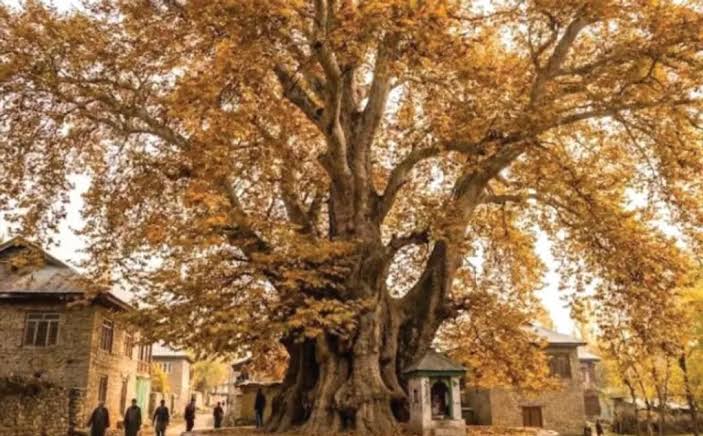
Empires have risen and disappeared. Roads have replaced old paths. Villages have expanded, fields have changed hands, and Kashmir’s landscape has been reshaped by generations of human activity. Through it all, a Chinar tree at Chattergam in Budgam has remained rooted to the same ground.
At an estimated 650 years old, the tree is described by the Jammu and Kashmir government as the oldest Chinar in Asia.
And it is still alive.
The tree has lost some of its oldest and dried branches naturally over time, but the portion that remains is green, the government has said. Protection measures have now been put in place around its roots, including iron fencing intended to keep people and vehicles away from the critical root zone.
The details emerged in the J&K Legislative Assembly in response to a question by Budgam MLA Aga Syed Muntazir Mehdi. The Forest, Ecology and Environment Department’s response offered both reassurance and a warning: the ancient tree survives, but the species that has become one of the defining symbols of Kashmir is under pressure.
The government acknowledged that Chinar numbers in Jammu and Kashmir have declined, citing several factors, including tree cutting for development activities, shrinking land and a growing population. Natural ageing, disease and pests have also contributed to the decline.
The story of the Chattergam tree is therefore larger than one remarkable tree.
It is about what happens when a living monument outlasts the landscape that once protected it.
The Chinar has long occupied a special place in Kashmir’s imagination.
Its enormous leaves provide shade through summer and turn into brilliant shades of yellow, amber and red in autumn. Its broad canopy has made it a natural gathering place, while its distinctive seasonal transformation has become part of Kashmir’s visual identity.
The tree is not native to the valley in the strict botanical sense. The species, Platanus orientalis, has a long history across parts of the Mediterranean and western and central Asia, and was introduced and cultivated widely in Kashmir centuries ago.
Over time, however, the Chinar became inseparable from the valley.
It appears in gardens, roadsides, university campuses, village commons and historic landscapes. It is associated with Mughal-era gardens and with the older cultural geography of Kashmir.
The Chattergam tree carries that history in a particularly literal form.
At 650 years, it is not simply an old tree. It is a living archive.
Its rings have recorded centuries of growth, drought, cold, disease and changing environmental conditions. Its branches have witnessed a landscape transformed around it.
Yet age also brings vulnerability.
A tree that has survived for centuries cannot be treated as an ordinary roadside tree. Its root system, soil conditions, canopy and surrounding environment all matter.
That is why the government’s decision to fence the critical root zone is significant.
The department said measures had been introduced to prevent soil compaction and root suffocation around the Chattergam Chinar.
The concern may sound technical, but it is central to the survival of an old tree.
The roots of a mature tree extend beyond the visible trunk and are dependent on adequate air and water in the soil. Repeated movement of vehicles and people over the root zone can compact the soil, reducing the spaces through which oxygen and water reach the roots.
For a young tree, damage may be reversible.
For a centuries-old giant, the margin for recovery can be much smaller.
The iron fencing installed around the critical root zone is intended to prevent traffic and other pressure in that area. It is a modest intervention, but one that recognises an important principle: protecting an ancient tree means protecting the ground beneath it, not merely the trunk above it.
The government has also said that similar protection measures are in place for Chinars across Kashmir.
That protection is increasingly necessary.
Around 30,000 Chinar trees have been surveyed across Kashmir, excluding trees located inside security campuses and installations, according to the government.
That figure offers a sense of the remaining population, but it also underscores how finite the resource is.
The government’s explanation for the decline is familiar: development, shrinking land and population growth.
As settlements expand, open spaces contract. Roads widen. Buildings replace agricultural and common land. Trees that once stood comfortably within large plots increasingly find themselves beside walls, pavements and traffic.
The pressures are not always dramatic.
A Chinar may not be cut down. Instead, its roots may be repeatedly compacted. Its branches may be trimmed improperly. Its bark may be damaged. A signboard may be nailed to its trunk. Vehicles may park beneath its canopy.
Individually, these actions can appear insignificant.
Collectively, they can change the conditions that allow a tree to survive.
The government has made clear that even a branch cannot be cut without prior permission from the local administration under the applicable rules.
Carving into the bark, hammering signboards into trees and damaging their roots are also offences.
Such rules recognise that the Chinar is not merely private vegetation where it happens to stand. It is part of a larger ecological and cultural inheritance.
The issue becomes more complicated when an old tree becomes a hazard.
In Budgam alone, the government received 161 representations over the past three years seeking permission to prune dried or hazardous Chinar branches.
Permission was granted in 130 cases.
The numbers illustrate the practical tension between conservation and safety.
Old trees inevitably develop deadwood. Large branches can become dangerous during storms or strong winds. A branch hanging over a road, building or pedestrian path cannot be protected simply because it is old.
But indiscriminate cutting is equally problematic.
The challenge is to distinguish between necessary safety interventions and unnecessary removal.
That requires expertise: assessing the health of the tree, identifying structurally weak branches and determining whether pruning can reduce the risk without damaging the tree’s long-term vitality.
For ancient trees, “do nothing” is not always conservation. Nor is aggressive pruning.
The objective is careful stewardship.
There is another encouraging element in the government’s response: planting.
The Department of Floriculture has planted 709 Chinar saplings in gardens and parks over the past three years. Another 7,134 saplings have been distributed free of cost to the public, educational institutions and security establishments across Kashmir.
The numbers are significant.
But planting a sapling is the beginning of conservation, not its conclusion.
A Chinar can take decades to develop the scale and character that makes mature trees so valuable. Replacing a centuries-old tree is therefore impossible within a human lifetime.
A sapling planted today cannot compensate for the loss of a 650-year-old Chinar tomorrow.
That is why mature-tree protection deserves equal, if not greater, attention.
The temptation in environmental policy is often to count what has been planted. It is harder to count what has been saved.
Yet for Kashmir’s Chinars, survival may be the more meaningful measure.
The Chattergam tree poses an interesting question about what societies choose to preserve.
A monument built of stone can be repaired. A historic building can sometimes be reconstructed. A manuscript can be copied.
An ancient tree cannot.
Its biological life is continuous. Once its roots die, no restoration can bring the same organism back.
That makes the Chattergam Chinar different from a conventional heritage object.
It is simultaneously a landscape, habitat, cultural symbol and living organism.
Its survival depends not only on the forest department or local administration but also on the behaviour of people around it.
Do not drive over its roots. Do not nail signs into its bark. Do not carve names into its trunk. Do not remove branches without permission. Do not treat its shade as an invitation to compact the soil beneath it.
These may seem like small rules. For an ancient tree, they are the difference between disturbance and care.
Kashmir’s relationship with the Chinar has always been emotional. Its autumn leaves have become almost shorthand for the valley itself.
But sentiment alone cannot protect a tree.
The Chattergam Chinar is still green, the government says. That is good news. Yet its naturally fallen branches are also a reminder that even the oldest trees have limits.
The larger decline in Chinar numbers adds urgency.
The question now is whether Kashmir can preserve not only its oldest Chinar but the conditions in which thousands of younger ones can grow into future giants.
That will require more than planting saplings.
It will mean protecting mature trees from unnecessary cutting, enforcing rules against damaging roots and bark, managing pruning scientifically, keeping vehicles away from critical root zones and incorporating heritage trees into development planning before roads and buildings are designed around them.
The Chattergam tree has already survived centuries of change.
Its next chapter will depend on whether the landscape around it changes with enough care.
For now, its canopy remains green.
At 650 years, that is more than a botanical fact.
It is a reminder that some of Kashmir’s oldest stories are still alive.
About the Author
Zafer Iqbal is a cinematographer with a keen interest in international politics, bringing a visual perspective to global affairs and their shifting landscapes.