
There are doctors whose careers are measured in procedures, publications and awards.
And then there are doctors whose professional lives become inseparable from the people and places they choose to serve.
Dr Upendra Kaul belongs to the second category.
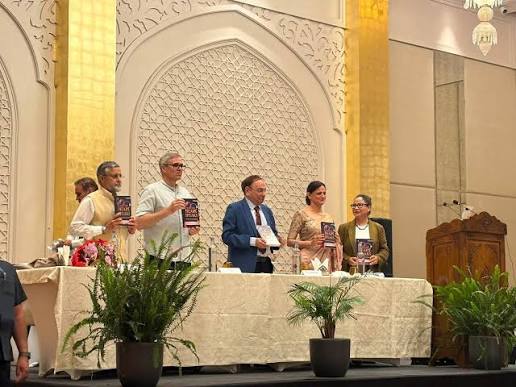
At the launch of the revised second edition of his memoir, When the Heart Speaks: A Memoir of a Cardiologist, in Srinagar on Saturday, Chief Minister Omar Abdullah described the book as a “love letter” to Kashmir.
The phrase is fitting because Kaul’s story is about more than medicine. It is about attachment, responsibility and the belief that a doctor’s obligation does not necessarily end when the consultation does.
Kaul, a Padma Shri awardee, has maintained a decades-long association with Kashmir. During the turbulent 1990s, when healthcare services in the Valley faced enormous disruption, patients from Kashmir would sometimes reach him at AIIMS late in the evening.
He says he would still see them.
There were occasions when he remained at the hospital until 11 p.m. or midnight to examine patients who had travelled from the Valley.
That may seem like a small act in the machinery of modern medicine. It was not small to the patient who had travelled hundreds of kilometres seeking specialised care.
It also reflects an idea of medicine that deserves renewed attention: the patient should remain at the centre of the system.
Kaul has recalled facing criticism for treating Kashmiri patients, including accusations that he was doing so for financial gain. He said such criticism did not deter him.
That response is important.
Medicine, at its best, should be indifferent to political identity. A doctor sees illness, not ideology. A patient’s religion, geography or background should not determine whether care is offered.
Kaul’s assistance also extended beyond medicine. During the 1990s, he helped some people who had left Kashmir find employment, placing some at his hospital and helping others secure work elsewhere.
His memoir records such experiences alongside professional anecdotes and accounts of patients who could not afford expensive cardiac procedures or devices.
Those stories point toward one of healthcare’s oldest problems: medical advances mean little if people cannot reach or afford them.
This is where Kaul’s current work becomes particularly relevant.
The Gauri Kaul Foundation is expanding its heart-health services in Jammu and Kashmir. A cardiac centre has already been established in south Kashmir, and the foundation plans to extend its work to Jammu.
But the more important idea is the decision to take healthcare to patients rather than waiting for patients to reach major hospitals.
“We felt that everybody cannot come in. We must go to them,” Kaul said.
That should be more than a slogan.
Healthcare systems are often designed around hospitals. The specialist sits in the hospital; the equipment remains there; the patient is expected to travel.
For many people, especially those living far from urban medical centres, that journey is itself a barrier.
Travel costs money. Time away from work has a cost. Families may need to accompany the patient. Weather and transport can make the journey even more difficult.
A hospital can be excellent and still be inaccessible.
Kaul’s “heart clinic on wheels” offers a different approach. Equipped with facilities including echocardiography, the mobile clinic visits Ayushman centres and schools.
The programme focuses partly on children between 5 and 15 years old and aims to identify cardiac conditions early. Kaul said thousands of people had already been screened, with the programme targeting about 6,000 beneficiaries.
This is where preventive cardiology becomes particularly important.
Modern medicine often celebrates intervention. We admire the sophisticated procedure, the emergency operation and the latest device.
Prevention is quieter.
There is no dramatic operating room, no crisis and no visible rescue.
But detecting a cardiac problem before it becomes severe can be far more valuable than treating it after the damage has been done.
The same principle should inform healthcare policy.
Instead of asking only how many advanced hospitals a region has, we should also ask how many people are being screened, how early diseases are being detected and how easily patients can access specialists.
For Jammu and Kashmir, geography makes those questions especially important.
A sophisticated medical centre in a major city is of limited value to a patient who cannot afford the journey there. A specialist cannot help someone who never reaches the consultation room.
That is why outreach matters.
It also explains why Kaul’s career in Kashmir carries significance beyond his individual achievements.
Trust in medicine is accumulated slowly.
A doctor sees a patient after hours.
A family receives help when it cannot afford treatment.
Someone is guided toward another specialist.
A patient is followed up instead of being forgotten.
Over time, these acts become a reputation. And reputation becomes trust.
Kaul’s memoir appears to document that process as much as it documents his medical career.
Abdullah said the book goes beyond cardiology, covering Kaul’s experiences, struggles, travels and relationships. He also praised the cardiologist for writing candidly about the medical profession, noting that an honest autobiography can upset people because it requires the writer to present experiences without sanitising them.
That honesty is valuable.
Doctors are often placed on pedestals, expected to be technically accomplished but emotionally invisible. Yet medicine is practised by human beings. Their choices, relationships and sense of responsibility shape the care they provide.
Kaul’s story suggests that professional success and public service need not be opposites.
He could have concentrated entirely on the financial rewards of a successful medical career. Instead, his work has included treating patients who struggled to pay, returning repeatedly to Kashmir, helping people during difficult years and developing programmes aimed at bringing cardiac screening closer to communities.
The lesson is not that every doctor must reproduce his particular journey.
It is that healthcare should be organised around the principle behind it.
Reach the patient.
If the patient cannot come to the hospital, take care closer to the patient.
If disease can be detected early, detect it early.
If treatment is unaffordable, find ways to reduce that barrier.
And if trust has been built over decades, recognise that trust itself is part of healthcare.
Kaul’s memoir looks backward, but his foundation’s work looks forward.
Together, they offer a useful picture of what medicine can become: technologically advanced but still human; capable of complex treatment but equally committed to prevention; centred on hospitals but willing to leave them when patients cannot reach them.
At the Srinagar launch, Abdullah jokingly suggested that Kaul’s third edition should contain even more stories and anecdotes.
Perhaps it should.
Because the most important story in medicine is rarely the procedure itself.
It is the person who was waiting for help.
And sometimes, the measure of a doctor is not how many people can reach him.
It is how far he is willing to go to reach them.
About the Author
Amir Yaseen is a Srinagar-based journalist interested in Kashmir, policy, progress, and the human stories shaping everyday life.