
For years, Jammu and Kashmir’s electricity problem has followed a familiar script.
Demand rises. The grid comes under pressure. Power has to be purchased at considerable cost. Curtailments follow, particularly when winter pushes electricity consumption sharply higher. Households complain about outages, businesses struggle to maintain operations, and the debate returns to the same question: Where will the additional power come from?
But a different answer is beginning to take shape on rooftops, inside government buildings and in the increasingly sophisticated meters attached to consumers’ premises.
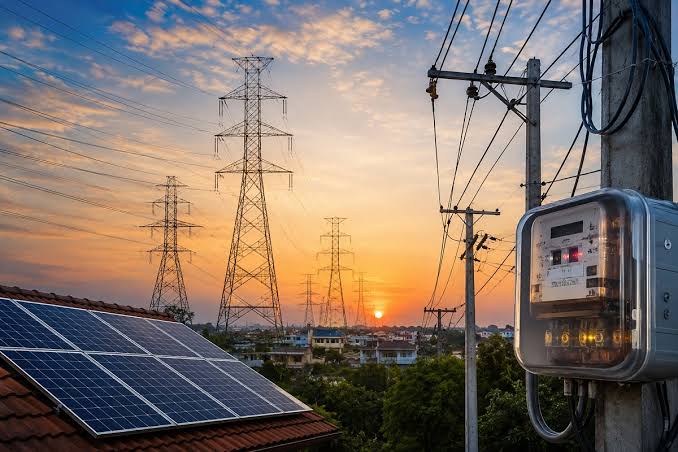
Jammu and Kashmir is entering a period in which solar panels, smart meters and time-based electricity pricing could work together to change not simply how much power the territory uses, but when it uses it.
That distinction matters.
Solar electricity is abundant during daylight hours, precisely when much of the government, institutional, commercial and industrial economy is operating. Yet the most difficult hours for the electricity system often come later, when the sun has disappeared, and households return home to switch on lights, heating appliances, water heaters, cooking equipment and other loads.
The emerging policy framework offers a way to move some of that demand into the hours when electricity is cheaper and solar generation is available.
The opportunity is substantial. But so is the challenge: J&K will have to treat rooftop solar, smart metering and electricity tariffs not as separate programmes, but as parts of one system.
The government has already begun to test that proposition on its own buildings.
A major rooftop solarisation programme covering thousands of government establishments is under implementation, with official plans extending into hundreds of megawatts. The systems are being designed around net metering and bidirectional smart meters, allowing buildings to use the electricity they generate and send surplus power back into the grid.
The significance goes beyond the solar panels themselves.
Government offices, colleges, universities and other public institutions are among the easiest consumers to move toward daytime electricity use because their working hours already broadly coincide with the solar window.
That alignment has become even more important with the introduction of the new Time-of-Day tariff by the Jammu and Kashmir Electricity Regulatory Commission.
Under the new arrangement, consumers with sanctioned load above 10 kilowatts and compatible metering can receive a 20 percent rebate during the 9 a.m. to 5 pm solar period, while specified peak-hour consumption attracts a surcharge.
In effect, the tariff is sending consumers a simple economic message: use more electricity when the system has more of it available and less when the grid is under its greatest strain.
For government establishments, that creates an unusual convergence of policy and operations.
An office can save money by shifting eligible consumption into the daytime even before its rooftop solar system is commissioned. Once solar panels are installed, the same building can replace part of the electricity it would otherwise draw from the grid with electricity produced on its own roof.
The real prize, however, would come from applying the same logic to flexible loads.
The Finance and Power Departments should therefore make electricity-use patterns across government establishments an accountability exercise, rather than leaving solarisation as a procurement or infrastructure project.
Pumping stations, irrigation systems, workshops, water-supply installations, lifts and other electricity-intensive operations should be examined individually.
Where the technology and operational requirements permit, loads that can be shifted should be moved toward daylight hours.
The reason is simple. Electricity demand is not equally expensive or equally difficult to serve at every hour of the day.
A pumping operation carried out at noon, when solar generation is plentiful, can have a very different effect on the grid from the same operation carried out during the evening peak.
Every flexible unit of demand moved away from that peak effectively frees some capacity for consumers who cannot shift their electricity use.
That matters particularly in winter, when households have little choice but to consume more electricity for heating, cooking and lighting.
Demand management cannot eliminate the need for additional generation or purchases. But it can reduce the intensity of the pressure placed on the system at the most difficult moments.
The next major opportunity lies with industry.
J&K’s existing Industrial Policy provides substantial support for diesel generator sets. But as the policy is revised, the government has emphasised green energy and reducing the carbon footprint of industry during consultations with stakeholders.
That creates an opportunity to rethink what public support for backup power should mean.
Instead of continuing to encourage diesel-based generation, the revised framework could redirect a meaningful share of that support toward rooftop solar and other forms of clean captive generation.
The change would not merely be environmental.
For businesses, electricity generated on-site can reduce dependence on the utility grid, while the combination of solar generation and a daytime tariff incentive could improve the economics further.
This is particularly relevant to Kashmir’s single-shift industries.
A factory operating predominantly between 9 am and 5 pm is naturally positioned to benefit from the hours in which solar generation is strongest. If its rooftop system is producing electricity at the same time that machinery is running, the electricity does not have to travel through the grid before reaching the consumer.
The tariff then reinforces the same behaviour by making daytime electricity more attractive.
The Jammu and Kashmir Energy Development Agency has already identified grid-connected rooftop solar across commercial and industrial sectors as a means of substantially reducing electricity drawn from the utility grid.
What is emerging, then, is less a story about solar panels than about matching generation with demand.
The household question
The biggest test, however, will be households.
Their sheer number means that even small changes in electricity generation or consumption behaviour can add up to a significant change in the overall system.
J&K already has a substantial rooftop-solar programme for domestic consumers. Official information placed before Parliament showed that 39,160 rooftop installations had been completed against 85,908 applications as of July 28, 2026.
The numbers reveal both progress and an unfinished task.
More than 39,000 households have moved from being purely consumers of grid electricity toward becoming potential generators. But the difference between applications and completed installations – more than 46,000 – represents a large pool of demand that has yet to translate into functioning rooftop systems.
The programme therefore needs not only continuation but speed.
Central assistance has already provided a substantial financial foundation. During the preceding five years, Rs 278.55 crore had been released to J&K under rooftop-solar programmes.
The question now is how quickly that investment can be converted into actual generation on household rooftops.
There is another missing piece.
The current ToD provision is aimed at consumers with sanctioned loads above 10 kW. Ordinary households, which make up the largest consumer base, therefore remain outside the tariff mechanism.
That is a significant policy gap.
If smart meters are intended to do more than simply record consumption, they should eventually become instruments for changing consumption behaviour.
J&K could consider approaching the regulator for a dedicated domestic ToD incentive for smart-metered households.
Such a scheme would not necessarily need to begin with a peak-hour surcharge. A meaningful daytime rebate could be enough to change behaviour.
Washing machines, irons, water heaters, pumps and other flexible appliances do not necessarily need to operate in the evening. Some household consumption can be shifted to the hours when solar electricity is abundant.
That may sound like a small adjustment at the level of an individual home.
Across hundreds of thousands of homes, it would be something else.
The government would also not necessarily have to wait for every household in J&K to receive a smart meter. The incentive could be expanded progressively wherever compatible metering, billing and regulatory arrangements are available.
The larger question is whether J&K can move beyond the traditional model of dealing with electricity shortages.
For decades, the dominant measure of progress has been generation capacity and the quantity of power available for purchase.
Those remain important. A growing economy and rising household demand will require more electricity.
But additional supply alone does not solve a system in which demand is heavily concentrated at particular hours.
A more resilient electricity system needs to manage both sides of the equation.
That means asking two questions alongside the old one.
How much electricity can be generated close to where it is consumed?
And when should the electricity that still comes from the grid be consumed?
The answers point toward a more decentralised system.
Government buildings can become daytime solar generators. Industries can produce part of their own electricity while operating during solar hours. Commercial establishments can align consumption with lower-cost periods. Households can gradually become both consumers and generators.
Smart meters can provide the information needed to understand consumption patterns. ToD tariffs can provide an economic reason to change them. Rooftop solar can provide an alternative source of electricity at the point of consumption.
None of this will make J&K’s electricity deficit disappear overnight.
Solar generation falls after sunset. Winter weather can reduce output. Batteries remain expensive for many consumers. The grid will continue to be essential, particularly during evenings and periods of poor solar generation. And installing tens of thousands of rooftop systems requires financing, equipment, trained personnel, and efficient implementation.
But these limitations do not diminish the strategic opportunity.
They make integration more important.
The objective should not be to replace the grid with rooftop solar. It should be to make the grid work better by reducing the amount of electricity it has to deliver at the most difficult times.
That is where the three emerging policies – solarisation, smart metering and time-based tariffs – become more powerful together than they are separately.
A rooftop solar programme without demand management can reduce a consumer’s daytime purchases without necessarily addressing the evening peak.
A smart meter without an incentive may simply provide better information about a problem.
A ToD tariff without sufficient daytime generation can shift consumption without fully reducing dependence on conventional power.
But combine the three and the logic changes.
Generate more electricity where it is consumed. Encourage consumers to use electricity when solar generation is available. Reserve the grid’s most constrained hours for loads that cannot easily be moved.
For J&K, that could mean a gradual shift away from managing electricity crises after they emerge toward managing demand before the crisis arrives.
The roofs are already being solarised. Smart meters are spreading. A daytime tariff incentive is now on the table.
The next step is coordination.
The government should measure how much load can actually be shifted. Industries should be given a strong reason to replace diesel backup with clean captive generation. Household rooftop installations should be accelerated. And the regulator should examine how smart-metered domestic consumers can eventually participate in time-based pricing.
The electricity crisis will not be solved by slogans, nor by solar panels alone.
But if Jammu and Kashmir can turn sunlight into generation, smart meters into information and tariffs into behaviour, it may begin to break a cycle that has persisted for years.
The most important change may be conceptual.
Instead of asking only how to find more electricity, J&K can begin asking where electricity should be generated – and when it should be used.
That is a smaller shift in language than in infrastructure.
It could prove to be the bigger shift in policy.
About the Author
Wajahat Iqbal Kashtwari is a filmmaker and multimedia professional with a keen interest in environment, ecology, and climate change.