
Disasters have their own clock.
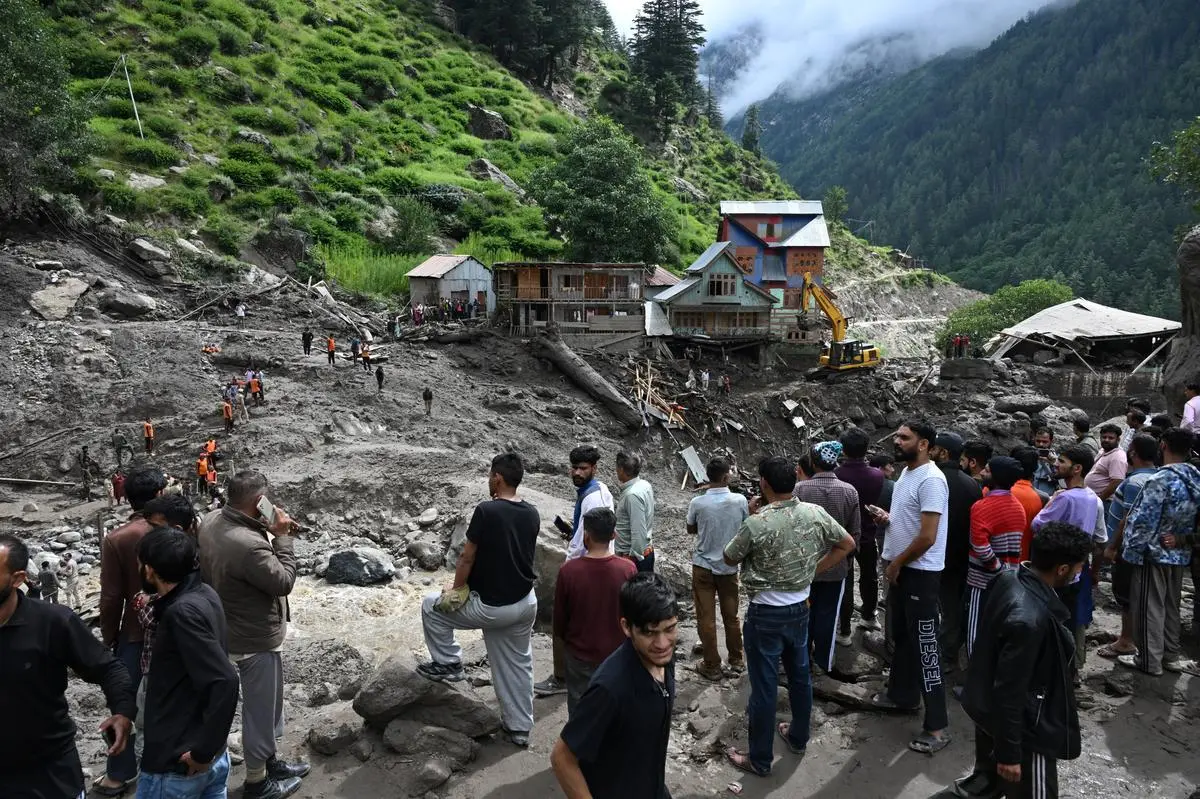
The flood arrives in hours. A cloudburst can turn a stream into a torrent in minutes. A landslide can bury a road before there is time to close it. A house that has stood for generations can disappear overnight.
Recovery moves differently.
It begins with assessments, files, estimates, sanctions, tenders, and work orders. Money is approved. Committees meet. Departments prepare plans. Contractors are identified. Projects are uploaded to digital platforms. Months can pass while families wait for roofs to be rebuilt, roads to reopen and irrigation channels to carry water again.
For people who have lost homes or livelihoods, the gap between disaster and recovery is not an administrative interval. It is part of the disaster itself.
That is why the Jammu and Kashmir government’s decision to accelerate the use of a Rs 1579.09 crore disaster recovery package carries significance beyond the expenditure figures. The money is intended not simply to repair what floods, cloudbursts, landslides and other disasters have destroyed, but to rebuild in ways that can withstand the next shock.
Chief Secretary Atal Dulloo has directed departments to speed up the formulation and execution of projects under the Recovery and Reconstruction Plan-2025, while insisting that rebuilt infrastructure should be designed with future disasters in mind.
The package includes Rs 1534.58 crore under the Post-Disaster Needs Assessment and another Rs 44.52 crore for a dedicated recovery plan for Ramban district, following the April 2025 cloudburst and flash floods.
So far, departments have prepared costed action plans worth Rs 1225.78 crore. That leaves Rs 353.31 crore still to be operationalised by the Jal Shakti and Agriculture departments.
The numbers reveal both progress and urgency.
A disaster recovery package has value only when it moves from a government ledger to a damaged household, a broken bridge, a washed-out road, a field buried under debris or a water system that has stopped functioning.
Public money delayed is not merely money unspent. In disaster-hit areas, it can mean another season without adequate shelter, another harvest lost, another community isolated, or another vulnerable structure waiting for the next rainfall.
The Chief Secretary’s instruction therefore touches on one of the least visible dimensions of disaster management: speed is itself a form of resilience.
A family that receives assistance quickly can rebuild before temporary displacement becomes permanent. A road restored before winter can reconnect a village to markets and hospitals. An irrigation system repaired before the agricultural season can prevent a natural disaster from becoming an economic disaster. A damaged school rebuilt before the academic year can prevent disruption from spreading into children’s lives.
The longer recovery takes, the more expensive the original disaster can become.
Yet speed alone is not enough.
There is a temptation after a disaster to rebuild exactly what existed before: the same road, the same bridge, the same house, the same drainage channel. It is administratively convenient. It is easy to measure. It can appear to demonstrate that normality has returned.
But if the original infrastructure was vulnerable enough to be destroyed once, rebuilding it in precisely the same way may simply prepare the ground for the next loss.
That is where the government’s “Build Back Better” approach becomes important.
Dulloo has directed implementing agencies to move beyond restoring damaged infrastructure to its pre-disaster condition and instead incorporate resilience into reconstruction. In Jammu and Kashmir, that can mean designing buildings according to Seismic Zone IV and V requirements, raising plinth levels in flood-prone areas and stabilising slopes where landslides pose a recurring threat.
The principle is straightforward: do not spend today’s recovery money to recreate tomorrow’s disaster.
This is particularly important in a region exposed to multiple hazards.
Jammu and Kashmir’s geography means that its communities can face floods, flash floods, landslides, cloudbursts, earthquakes, avalanches, and severe weather. Infrastructure built without accounting for those risks can become a liability when nature tests it.
A road is not resilient merely because it has been repaired. A bridge is not resilient merely because traffic can cross it again. A house is not resilient merely because its roof has been replaced.
Recovery should ask a harder question: Will this asset survive the next event better than it survived the last one?
The answer should determine how the money is spent.
The package covers some of the most basic pieces of everyday life.
In the social sector, departments have prepared plans worth Rs 262.11 crore against an approved allocation of Rs 289.40 crore.
Housing has achieved full commitment against its Rs 193.19 crore allocation, covering 9083 households – including 5227 houses that were fully damaged and 3856 that suffered severe damage.
Those numbers represent more than units of construction.
Each damaged house is a disruption to a family. It is a loss of privacy, security, and stability. Rebuilding a house is therefore not simply an infrastructure project. It is an attempt to restore a sense of normal life.
The decision to release household relief through a 30:40:30 progress-linked direct benefit transfer mechanism is intended to connect payments with actual reconstruction. That approach can help ensure that assistance follows the physical progress of rebuilding rather than being exhausted before a house is complete.
But the system will work only if it remains simple enough for affected families to navigate and responsive enough to resolve problems quickly.
That is why the government’s instruction to block, sub-divisional and district-level officers to resolve E-Samadhan and CPGRAMS grievances within 15 days matters. Recovery can become trapped in paperwork as easily as it can be accelerated by it.
For someone whose home has been destroyed, the difference between a grievance being acknowledged and being resolved is enormous.
The infrastructure numbers are equally substantial.
The roads and bridges sector has planned the entire Rs 461.64 crore allocation, covering restoration of approximately 1,230.7 kilometres of roads and 4,494.5 metres of bridges.
The scale explains why disaster recovery cannot be understood only through individual relief payments. A washed-out bridge can isolate an entire settlement. A damaged road can prevent ambulances from reaching patients, farmers from reaching markets and children from reaching schools.
The power sector has planned Rs 70.08 crore against Rs 72.97 crore, targeting the restoration of more than 21,000 poles, 1100 circuit kilometres of conductors and 800 transformers, with an estimated benefit to around 1.45 lakh consumers.
Water systems tell another part of the story.
The drinking water and sanitation sector has prepared plans worth Rs 59.02 crore against Rs 139.65 crore, while Irrigation and Flood Control has planned Rs 93.01 crore against Rs 199.79 crore from an allocation of Rs 199.79 crore.
These are precisely the sectors where recovery can become prevention.
A water system repaired after a flood can be rebuilt with stronger protection. A drainage channel can be redesigned. Flood-control infrastructure can be strengthened. Irrigation networks can be restored with an understanding of where water actually moves during extreme rainfall.
The objective should be to convert lessons from the disaster into physical changes on the ground.
Agriculture, meanwhile, illustrates why recovery cannot stop at bricks and concrete.
The department has prepared plans worth Rs 168.36 crore against Rs 223.67 crore, involving 45 packages covering crop inputs, land reclamation and restoration of research infrastructure at SKUAST-Jammu.
For farmers, a disaster can destroy more than the current crop. It can remove soil, damage orchards, kill livestock, disrupt irrigation and erase months or years of accumulated investment.
That is why rapid agricultural assistance can have a multiplier effect. It can prevent temporary damage from becoming a long-term loss of livelihood.
Horticulture has already fully utilised its Rs 3.87 crore allocation, supporting 3,493 farmers.
The dedicated Rs 44.52 crore Ramban recovery plan, meanwhile, offers a more concentrated test of how recovery works after a specific disaster. The plan includes Rs 23.24 crore for roads and bridges, Rs 3.34 crore for irrigation and flood control, Rs 1.78 crore for education and Rs 1.48 crore for animal husbandry and livestock, with approved and proposed allocations in these components fully reconciled.
Ramban’s experience also illustrates why recovery must be locally tailored.
A national or regional formula can provide money. It cannot by itself understand the particular vulnerability of a mountain road, a village perched below an unstable slope or a farm whose access route disappears after a flash flood.
Local knowledge has to shape implementation.
So does transparency.
Dulloo has ordered all projects to be geo-tagged and uploaded on the BEAMS digital platform, creating a unified record of physical progress, expenditure and outcomes.
That may sound like an administrative detail, but it could become one of the most important safeguards in the programme.
Disaster spending happens under pressure. Governments must move quickly, but urgency can also create opportunities for duplication, weak planning or inefficient use of public funds.
The government has therefore ordered strict cross-verification of beneficiaries and proposals against schemes including PMAY-G, Jal Jeevan Mission, AMRUT, SASCI, NABARD, PMGSY and Samagra Shiksha.
The principle is simple: disaster money should fill gaps, not pay twice for the same work.
That is especially important when public resources are limited.
The Rs 1579-crore package is large. But so is the potential cost of another disaster if reconstruction ignores the vulnerabilities exposed by the last one.
This is why the speed of expenditure matters, but so does the quality of expenditure.
The worst outcome would be to spend the money quickly on infrastructure that remains vulnerable.
The second-worst would be to spend it slowly while families wait for recovery.
The challenge is to do both things correctly at once: move faster and build stronger.
That requires departments to treat deadlines as more than bureaucratic targets. It requires engineers to think beyond restoration. It requires district administrations to listen to affected communities. It requires financial systems to release assistance without unnecessary friction. And it requires public monitoring strong enough to show where every major project stands.
There is also a larger lesson here.
Disaster recovery is often treated as the period after the emergency. In reality, it is part of disaster preparedness.
A stronger bridge is preparedness. A safer house is preparedness. A restored and reinforced drainage system is preparedness. A slope stabilised after a landslide is preparedness. A farmer returned to productive land is economic resilience. A family able to rebuild before another winter is social resilience.
The boundary between recovery and prevention is therefore thinner than it appears.
Jammu and Kashmir cannot prevent every cloudburst, flood or landslide. It cannot stop the mountains from moving or the rivers from rising.
What it can do is ensure that the next disaster finds fewer weak points.
That is what makes the Rs 1579.09-crore package more than a reconstruction programme. It is an opportunity to decide what kind of Jammu and Kashmir emerges from the damage.
If the money sits in files, it will remain an allocation.
If it is spent merely to replace what was destroyed, it will produce restoration.
But if it reaches affected communities quickly and is invested intelligently, it can produce something more valuable: resilience.
The test of disaster recovery is not how much money a government announces.
It is how quickly that money becomes a safer house, a stronger bridge, a functioning water supply, a productive field, and a family able to begin again.
After a disaster, time is not an abstract resource.
For those waiting to rebuild, time is recovery.
And the next disaster does not wait for the paperwork to finish.
About the Author
Mir Suneem is a filmmaker and postgraduate in filmmaking from Jamia Millia Islamia, with a strong interest in editing and narrative craft.