
For generations, the fields around Pampore have been measured in a crop whose value is concentrated into tiny threads: saffron.
Now another harvest is being imagined above those fields.
At the Advanced Research Station for Saffron and Seed Spices of SKUAST-K in Pampore, researchers are proposing a small experiment that asks a deceptively simple question: Can the same piece of land grow saffron and generate electricity at the same time?
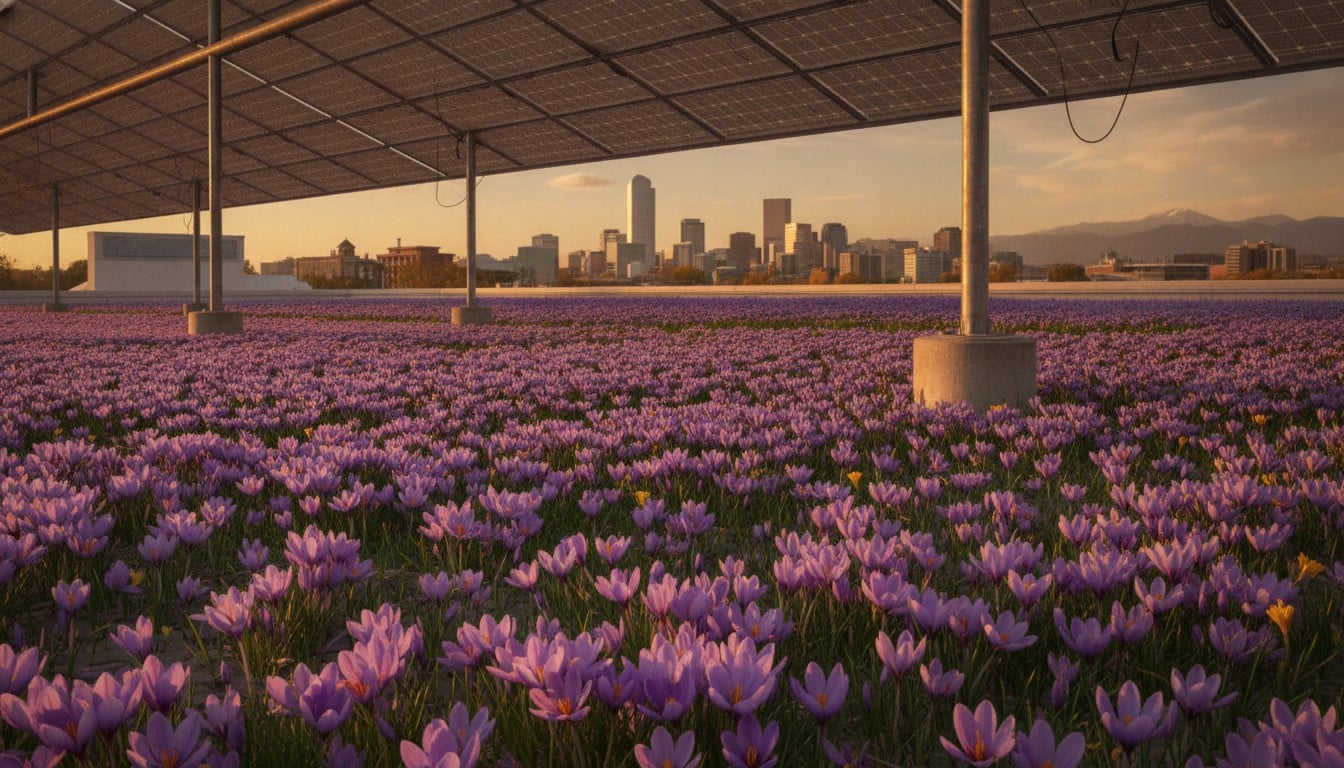
The idea is known as agrivoltaics, or Agri-PV – the practice of combining agricultural production with solar-power generation on the same land.
Instead of clearing farmland for a conventional solar park, panels can be installed above crops or arranged between planting areas. The land remains agricultural, while sunlight is divided between two purposes: feeding plants and producing electricity.
For Jammu and Kashmir, where agricultural land competes with settlements, infrastructure, horticulture and other uses, the attraction is obvious.
The challenge is equally obvious.
A solar panel does not know that beneath it is one of Kashmir’s most valuable crops.
Saffron does.
Its growth depends on a particular relationship with sunlight, moisture, soil conditions, and seasonal weather. A panel arrangement that works well for producing electricity could, in theory, alter the conditions that the crop needs.
That is why the proposed Pampore project is less a solar installation than an experiment.
The Detailed Project Report, titled “Detailed Project Report for Saffron-Based Agrivoltaics System,” has been prepared for a research project involving the Advanced Research Station for Saffron and Seed Spices, SKUAST-K, NIT Srinagar and JK Green Technologies.
The proposed pilot would have a modest capacity of about 16.74 kilowatts.
Its purpose is not to build a miniature solar farm. It is to compare different ways of putting solar panels into a saffron field and observe what happens to both sides of the equation.
Three arrangements are proposed, each involving roughly 5 kilowatts of capacity.
One would use vertically installed bifacial solar panels oriented toward the east. Another would use vertical bifacial panels facing west. The third would use conventional panels tilted 30 degrees toward the south.
The experiment is designed around a fundamental trade-off.
The panel that produces the most electricity may not necessarily be the panel arrangement that works best for saffron.
According to the project proposal, the south-facing configuration could generate about 8.1 megawatt-hours of electricity a year. Each of the east and west-facing vertical arrangements is projected to generate about 3.2 megawatt-hours.
On a conventional solar spreadsheet, that difference might appear decisive.
But the researchers are asking a different question.
They want to know which arrangement produces the best combined result – electricity plus agriculture – rather than which one produces the most electricity alone.
That distinction is at the heart of agrivoltaics.
A field converted entirely to solar generation can produce power efficiently, but the agricultural harvest disappears. A field left entirely to farming produces a crop but forgoes the possibility of using sunlight to generate electricity.
Agrivoltaics tries to occupy the space between those choices.
The panels become another layer in the agricultural landscape.
Vertical panels, for example, may produce less electricity than conventional south-facing panels, but they can occupy less horizontal space. They may allow more sunlight to reach the soil and permit rain and snow to fall more directly onto the field. Their arrangement could also leave more room for agricultural activity.
Tilted panels could behave differently.
They may cast shade over parts of the field and influence soil temperature and moisture. That could become beneficial under some conditions, neutral under others, or detrimental to saffron production.
The point of the Pampore experiment is to find out.
The answer cannot simply be imported from another crop or another region.
A panel configuration suitable for vegetables may not suit saffron. A design developed for an orchard may be unsuitable for a low-growing crop. Even within agriculture, the balance between shade, sunlight, moisture, temperature and machinery can vary sharply from one crop to another.
Saffron makes the question particularly interesting because its cultivation is closely associated with the landscape of Pampore and the wider Kashmir Valley.
The crop is already facing challenges associated with climate variability, water availability and productivity. At the same time, saffron-growing land is under pressure from changing patterns of land use.
That creates a second possibility for agrivoltaics.
If farmers could earn something from electricity without sacrificing a significant share of their saffron harvest, solar generation could become an additional source of value from land that remains in agricultural use.
The economic question, therefore, is not simply how much electricity a panel can produce.
It is how much value a field can produce altogether.
Imagine a saffron plot that continues to yield flowers and valuable stigmas while also sending electricity into the grid. The additional revenue might help improve the economics of farming. But if the panels reduce crop yields enough to offset their electricity income, the calculation changes.
The project will need to discover where that balance lies.
The DPR makes a much larger calculation, projecting the possibility of applying the concept across about 3,200 hectares of saffron land. It assumes a solar potential of 0.5 megawatts per hectare and arrives at a theoretical figure of roughly 1,600 megawatts.
That number is striking, but it is not a proven resource estimate.
The proposed pilot is only 16.74 kilowatts. It cannot establish that 1600 megawatts of solar capacity could actually be installed across saffron fields while maintaining commercially viable agriculture.
The assumed density of 0.5 megawatts per hectare would itself have to be tested against the realities of Kashmiri fields, crop requirements, panel spacing, access, sunlight and farm operations.
The small scale of the proposed experiment may therefore be its greatest virtue.
At an estimated cost of about Rs 10.42 lakh, the project is relatively modest compared with the scale of the theoretical opportunity. Its immediate product is not megawatts.
It is evidence.
A carefully designed experiment could show what happens when saffron and solar panels occupy the same ground.
That evidence could become more useful if the researchers compare the solar plots with a nearby saffron field without panels.
Such a control plot would provide a baseline against which changes in crop performance could be measured. Without one, it would be harder to determine whether a change was caused by the panels or simply reflected differences in weather, soil, or seasonal conditions.
The research could also become more revealing over several growing cycles.
Researchers could record flower production, stigma yield and quality, corm health and multiplication. They could measure soil moisture and temperature, irrigation requirements and disease incidence. They could observe how snow behaves around different panel arrangements and whether the structures alter the local microclimate.
Those measurements would turn an appealing idea into something farmers and policymakers could actually use.
The economics would require similar discipline.
The most meaningful figure may not be annual electricity generation or saffron yield considered separately. It could be the total income generated from the same piece of land after accounting for the cost of installing the panels, their maintenance, and the continuing costs of cultivation.
That is the promise of the “double harvest”: not necessarily twice as much of anything, but two streams of value emerging from one field.
The idea is receiving attention beyond Kashmir.
The Centre is exploring a wider role for agrivoltaics, and ICAR-IARI has established a 100-kilowatt Agri-PV research facility in New Delhi with the Ministry of New and Renewable Energy, the National Institute of Solar Energy and GIZ to examine different combinations of crops and solar configurations.
The Union government is also preparing PM-KUSUM 2.0 with a proposed dedicated 10-gigawatt Agri-PV component.
For Jammu and Kashmir, that broader policy direction could make a crop-specific experiment in Pampore particularly timely.
But scaling up will require caution.
There is a temptation whenever a new technology appears to measure its promise in the largest possible numbers. Thousands of hectares. Hundreds of megawatts. Gigawatts of potential.
Agriculture rarely works that way.
A field is not simply an area on a map. It is soil, crop, farmer, weather, water and years of accumulated knowledge.
Solar panels introduce another set of variables.
Their height matters. Their spacing matters. Their orientation matters. Their density matters. The amount and timing of shade matter.
A design that succeeds with saffron cannot automatically be transferred to apple orchards, vegetables, flowers or medicinal and aromatic plants.
The Pampore experiment could therefore become useful not because it proves that every agricultural field can become a solar farm, but because it may show where the boundaries are.
That may be the more important question.
Can agriculture and renewable energy share land without one quietly consuming the other?
For Jammu and Kashmir, the answer could have implications far beyond one research station.
The region needs energy, but it also needs productive agricultural land. It needs renewable power, but it must contend with the economic importance of farming. It needs to protect valuable crops while adapting to changing climate and land-use pressures.
Agrivoltaics offers a way to test whether those demands have to remain mutually exclusive.
In Pampore, the experiment begins with a few rows of panels and a small amount of generating capacity.
The electricity numbers will matter. So will the saffron harvest.
But the most important measurement may be something harder to capture: whether the field remains, in every meaningful sense, a field.
If the saffron continues to flower, the soil remains productive, farmers can continue working the land, and solar panels provide a second source of income, the experiment could point toward a different way of thinking about agricultural land.
Not as land that must choose between food and power.
But as land capable, under the right conditions, of doing both.
About the Author
Tabish Khan is a multimedia journalist and postgraduate in Convergent Journalism, working across text, video, social media, and digital storytelling.