
For years, the Achan landfill has been difficult to ignore.
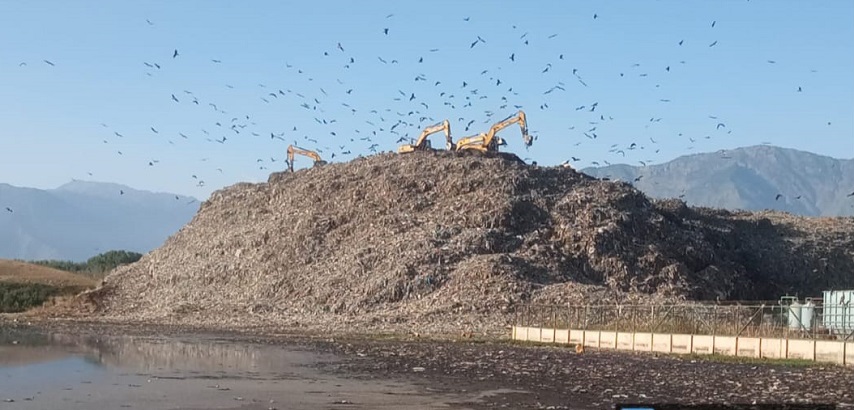
The garbage is visible from a distance, a sprawling mound built layer by layer over decades as Srinagar’s waste accumulated faster than the city’s ability to process it.
The smell travels farther.
For residents living around the landfill, the dump has become an unwanted feature of everyday life – an environmental burden they have endured because moving away is rarely an option.
Now, after years of plans, proposals and delays, the Jammu and Kashmir government says it has a new strategy for Achan.
The promise is ambitious: the garbage mountains could be gone within 18 months.
But the scale of the problem has also grown.
For years, official records put Achan’s legacy waste at around 11 lakh tonnes. Mandeep Kaur, Commissioner Secretary of the Housing and Urban Development Department, has now said another 5 to 6 lakh tonnes of waste have accumulated at the site over time.
That puts the total waste burden at roughly 16 lakh tonnes.
The government says the material is now being scientifically processed and that ground assessment has been completed. A remediation plan is being finalised, along with a new roadmap for handling fresh waste.
The long-term vision is even more striking: to turn the landfill into a bio-reserve.
“Just like we made the Waste to Wonder Park in Jammu, similarly we want to develop Achan also as a bio-reserve,” Kaur said in a recent media interview.
If the plan succeeds, one of Srinagar’s most persistent environmental scars could eventually become something very different.
But first, the garbage has to disappear.
Achan’s problem is inseparable from Srinagar’s growth.
The city has been generating hundreds of tonnes of waste every day, while its ability to process that waste has lagged far behind.
An action plan submitted by the Srinagar Municipal Corporation to the National Green Tribunal in 2024 estimated daily waste generation at about 550 to 600 tonnes.
The city’s existing processing capacity, however, was only around 150 tonnes per day.
The arithmetic was unforgiving.
Hundreds of tonnes of waste remained outside the city’s processing capacity, creating a steady flow toward disposal.
Over decades, that flow created the mountain at Achan.
By 2024, the site was estimated to contain about 11 lakh tonnes of legacy waste — material accumulated from years when waste management was dominated by dumping rather than systematic segregation, recovery and treatment.
Legacy waste is particularly difficult because it is not simply a pile of fresh household garbage.
It can contain layers of decomposed organic matter, plastics, construction debris, metals, and other material that have been compacted and altered over years.
Removing it requires more than excavation.
It requires sorting, processing, recovery, and safe disposal of the material that cannot be reused.
The environmental consequences of leaving such a site untreated are substantial.
Leachate – liquid generated as water passes through decomposing waste – can carry pollutants into the surrounding environment and groundwater. The landfill can also become a breeding ground for pests and microorganisms, while methane and other gases generated by decomposing organic waste add another layer of environmental concern.
For nearby residents, those risks are not abstract.
They are part of living beside the dump. The infrastructure that failed The landfill’s troubles have not been caused solely by the volume of waste. Infrastructure intended to manage that waste has also struggled.
A Comptroller and Auditor General audit found that the leachate treatment plant at the site remained non-functional as of January 2024.
Srinagar’s composting plant has also remained largely unused since 2020.
That meant the city was dealing with a growing stream of waste without fully functioning systems to treat some of its most problematic components.
In 2025, the Srinagar Municipal Corporation proposed a series of measures aimed at changing that equation.
They included biomining of legacy waste, construction of a new landfill cell and expansion of composting and material-recovery capacity.
Additional garbage transfer stations were also planned. But implementation moved slowly. The problem, meanwhile, did not wait. Waste continued arriving. And the old waste remained.
This year, the government approved a Rs 361-crore Integrated Solid Waste Management project with a capacity of 800 tonnes per day.
The project is intended to introduce more scientific systems for collection, segregation, processing and disposal.
Its significance lies partly in the scale. An 800-tonne-per-day system is designed to address not only the waste already sitting at Achan but also the continuing stream generated by Srinagar. That distinction is crucial.
Clearing the old mountain would accomplish little if a new one began forming behind it.
Kaur said the 11 lakh tonnes of legacy waste remains the official figure on record, but another 5 to 6 lakh tonnes have accumulated over time.
“Apart from that, another 5-6 lakh tonnes of waste have also accumulated over time, and we are processing that as well,” she said.
The government says both categories of waste are now being addressed through scientific processing.
Ground assessment has been completed, she said, while the remediation plan is being implemented and a new roadmap for waste-to-energy is being finalised.
The language marks a shift from simply managing a landfill to attempting to reclaim the site.
Achan’s future has been debated for years.
A waste-to-energy plant proposed for the site in 2016 never became operational.
According to Kaur, the proposal became entangled in litigation and was eventually found not to be viable at the scale of waste being generated in Jammu and Kashmir.
The project has now been shelved. The government is instead pursuing a different model for fresh waste.
A Compressed Biogas plant, based on a model being developed in Jammu, is planned for Srinagar.
Kaur said the detailed project report had been approved and tenders issued, with allotment expected within a month.
The idea reflects a broader shift in waste management: rather than treating all municipal waste as something to be buried or burned, organic waste can be separated and converted into usable products such as biogas.
But that approach depends on segregation.
A household’s waste must be separated before it reaches the landfill. Organic material, recyclable material and residual waste need different pathways.
The success of the system therefore depends not only on machinery at Achan but on what happens much earlier – in homes, markets, restaurants, institutions, collection vehicles and transfer stations.
Can the mountain really disappear? The government’s timetable is striking.
Kaur said the mountains of garbage could be gone within the next 12 to 18 months. For residents who have watched the landfill grow for years, the prospect is difficult to imagine. The physical scale of the task is enormous.
Sixteen lakh tonnes is not simply a statistic. It represents decades of discarded material that must be excavated, screened and processed, with recoverable material separated from material requiring disposal.
The process also carries its own technical risks.
Biomining must be carefully managed. Excavation can expose workers and nearby communities to dust, odours and hazardous materials. Recovered material needs appropriate destinations. What cannot be reused must still be disposed of safely.
And the landfill cannot simply be cleared and forgotten.
The site will require monitoring after remediation, particularly because the underlying soil and groundwater may have been exposed to years of contamination.
The promise of a bio-reserve therefore represents a much longer project than the removal of the visible garbage.
First comes excavation. Then processing. Then environmental restoration. Then, perhaps, a new landscape.
The government’s vision for Achan is unusually ambitious. Rather than leave the site as a capped landfill, authorities want to transform it into a bio-reserve.
Kaur compared the idea to Jammu’s Waste to Wonder Park, suggesting that Achan could eventually become a public and ecological asset rather than a symbol of urban waste.
It is a powerful image: a place once associated with foul odours and contaminated runoff becoming green space.
But it also raises the standard by which the project should ultimately be judged. Removing the garbage is only the beginning.
A restored site must be environmentally safe. Groundwater must be protected. Methane and other landfill gases must be managed. Contaminated areas must be remediated. Future construction must account for the site’s history.
And Srinagar must prevent the same cycle from starting again. That is perhaps the hardest part of the promise.
The landfill is a symptom of a much larger urban challenge.
Srinagar’s waste generation has grown alongside its population, commerce and consumption.
The 550 to 600 tonnes of waste generated daily, according to the municipal corporation’s 2024 submission, is a reminder that Achan is not dealing with a one-time problem.
Every day creates another day’s waste.
The new 800-TPD integrated project is therefore designed to provide capacity beyond the city’s existing processing system.
But capacity alone will not solve the problem. Waste segregation must improve. Collection must become reliable. Recycling and material recovery must be expanded. Organic waste needs separate treatment.
Landfills must become the final destination for only the material that genuinely cannot be recovered or processed.
Otherwise, Srinagar may simply exchange one garbage mountain for another.
The history of Achan offers a warning about what happens when disposal becomes easier than management.
For years, waste could be collected, transported and dumped. The costs were deferred – into the landscape, the air, the water and the lives of nearby residents.
Now those costs have accumulated into a mountain measured in lakhs of tonnes.
The government’s promise gives Achan something it has rarely had: a deadline. Within 18 months, officials say, the garbage mountains could be gone.
The claim will ultimately be tested not by presentations or project documents but by what residents can see and smell.
Is the waste actually being removed? Is the leachate being treated? Are new systems processing the city’s daily waste? Are the surrounding communities seeing a pollution reduction? And, after the old waste disappears, does Srinagar have the discipline to prevent another mountain from forming?
The answers will determine whether Achan becomes a story about a landfill finally cleaned up – or another chapter in a cycle of ambitious plans and delayed execution.
For decades, Achan has represented the point at which Srinagar’s waste problem became impossible to hide.
Now the government wants to make it disappear.
The ambition is immense: take roughly 16 lakh tonnes of accumulated waste, process it scientifically, build a system capable of handling the city’s future garbage and eventually turn the landfill into a bio-reserve.
If it happens, the transformation would be more than cosmetic.
It would mean that a site long defined by what Srinagar threw away had finally been reclaimed for what the city might become.
But for now, Achan remains a mountain of garbage.
The 18-month clock has begun.
About the Author
Moien Darial writes with the precision of an analyst and the sensitivity of a storyteller, exploring global economic shifts and emerging technologies.