
On a humid September afternoon in Anantnag, a group of young men sat beside the Arpaeth nullah, behind a playfield in the southern Kashmir town, drinking soft drinks and eating chips.
When they were done, they left their bottles and wrappers behind.
The litter joined what was already there: plastic bags snagged in the grass, food packets flattened into the mud, bottles scattered along the bank. The waterway, once part of the landscape through which people moved and children played, had become something closer to an open-air dumping ground.
The young men walked away without looking back.
For Javed Ahmad, 44, who grew up in Anantnag, the scene represents a transformation that has taken place slowly enough to become almost ordinary.
“Some three decades ago, our school used to organise picnics near this waterbody,” he said. “The area now paints a dismal picture.”
What troubles him is not simply the garbage.
It is the sense that the water itself is disappearing.
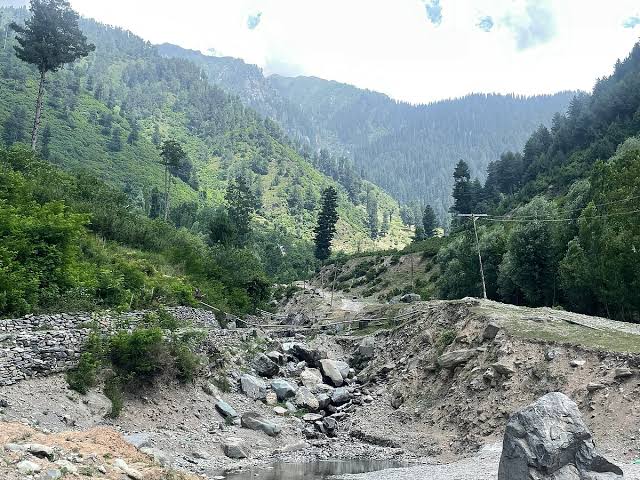
Across southern Kashmir, tributaries of the Lidder River are increasingly burdened by household waste. Springs that once supplied water to communities in places like Kokernag, Achabal and Kaipora have diminished, disappeared or come under pressure from construction and encroachment.
Anantnag is known historically as the “land of countless springs.” Its springs have long been woven into the geography and identity of the district, with Kokernag, Achabal and Verinag eventually becoming destinations for tourists drawn to their water and scenery.
But the springs are no longer guaranteed features of the landscape.
Former bureaucrat Khurshid Ahmad Ganai says hundreds of springs across what is now commonly called south Kashmir have depleted or disappeared over the past three or four decades.
The change, he argues, is not the result of a single environmental threat. It is the accumulation of neglect: garbage, encroachments, illegal mining, siltation, weak civic infrastructure and, increasingly, climate change.
The question, then, is not simply how much water Kashmir has lost.
It is why the water that remains has been allowed to deteriorate.
Ganai, a former Indian Administrative Service officer, said solid-waste management did not appear to be a priority for the Jammu and Kashmir government despite repeated appeals from environmental and community groups.
In many places, he said, the conversation elsewhere has already moved beyond simply reducing waste. Communities are experimenting with systems for reuse, recycling and recovery, while waste segregation is organised around different streams, including food waste, other biodegradable material, non-biodegradable waste and electronic waste.
Kashmir, he said, is lagging.
There is also little visible enforcement, in his view, of measures intended to curb plastic waste, including the ban on single-use plastics, extended producer responsibility and the polluter-pays principle.
“The government is following a laissez-faire approach, as though these problems will resolve themselves,” Ganai said. “They will not.”
The consequences are not confined to the banks of a single stream.
Waterways are ecological systems. Springs feed streams. Streams feed rivers. Wetlands absorb and store water. The condition of one part of that network affects the others.
When a stream becomes a receptacle for household rubbish, the damage is visible.
When a spring quietly loses its flow, the damage can be harder to see.
That invisibility may be part of the problem.
A spring that disappears does not necessarily produce the dramatic image of a flooded road or a landslide. Its absence is gradual. A flow becomes weaker. A pool becomes shallower. Water that once emerged naturally is replaced by another source, or people begin travelling farther to find it.
Eventually, the spring becomes a memory.
Ganai worries that this is already happening.
“Hundreds of springs have depleted or disappeared over the past three to four decades across Anantnag, Kulgam, Shopian, and Pulwama,” he said, referring to an area that broadly corresponds to the old Anantnag district and is now generally described as south Kashmir.
Yet, he said, the disappearance has not generated a commensurate response from either authorities or communities living around the springs.
“A few decades from now, people could be searching for the springs that are disappearing today,” he said.
The threat is becoming more complicated as the climate changes.
Even waterways that survive pollution and encroachment face an uncertain future as changing environmental conditions put additional pressure on water availability.
Ganai said streams and rivers were likely to face increasing pressure from climate change alongside waste pollution, encroachments, illegal mining and siltation.
The danger is that each problem compounds the others.
A stream narrowed by encroachment has less room to carry water. A channel filled with waste and sediment functions less effectively. A degraded catchment may be less capable of sustaining groundwater and spring flows. Development can place additional demands on an already stressed system.
And when the water disappears, restoring it is not necessarily as simple as cleaning a stream.
That is why Ganai believes the response has to move beyond occasional clean-up campaigns and public appeals.
He wants responsibility for springs to be placed closer to the communities that depend on them.
In rural areas, panchayats could take responsibility for their protection and revival; in towns and cities, municipal authorities could do the same. The government, he said, should back those institutions with dedicated funding.
The idea is straightforward: people living beside a spring or stream should have both a reason and the resources to protect it.
But the current reality often looks different.
Tourism, one of Kashmir’s major economic activities, adds another layer to the problem.
The region promotes its mountains, rivers, gardens, and springs as attractions. Visitors arrive at places whose appeal depends in large part on the natural landscape. Yet the basic infrastructure needed to protect that landscape can be inadequate.
Ganai pointed to public sanitation as one example.
“International film festivals are welcome, but where are the decent wayside public toilets for tourists?” he said.
In places without adequate facilities, visitors may have little option but to use the outdoors, adding another burden to an already fragile environment.
Hotels and tourism establishments could be enlisted to help provide such facilities, including through corporate social responsibility programmes where appropriate, he said.
The broader problem, Ganai argues, is not that Kashmir lacks solutions.
It is that the solutions are not being implemented with sufficient urgency.
“The government is not short of ideas,” he said. “It knows what needs to be done, but there appears to be a reluctance to act.”
That reluctance has a cost.
Environmental degradation is often easier to prevent than reverse. Once a spring has disappeared, restoring the conditions that sustained it may require understanding groundwater flows, protecting its catchment, controlling construction and ensuring that the surrounding landscape remains capable of absorbing and storing water.
Once a riverbank becomes a dumping site, removing the garbage is only the beginning.
The culture of disposal has to change.
Back in Anantnag, the scene beside the Arpaeth nullah offers a small illustration of the larger problem.
The bottles and wrappers left behind by the young men are not, by themselves, responsible for the decline of Kashmir’s springs. Nor can the fate of the region’s waterways be attributed to ordinary residents alone.
But the litter is part of a chain.
Waste enters a waterway because someone discards it, because someone else fails to collect it, because infrastructure does not keep pace with the population using it, and because enforcement and accountability are weak enough for the practice to continue.
What begins as a bottle on a riverbank can become part of a much larger story about how a society treats the natural systems on which it depends.
For people like Ahmad, that change is already visible.
The place where schoolchildren once went for picnics has become a place where plastic accumulates.
The springs that once seemed permanent are no longer so.
And the rivers and streams that once carried Kashmir’s water through its landscape increasingly carry something else as well.
Garbage.
The environmental groups and media organisations trying to draw attention to the problem are, Ganai says, increasingly left with the task of warning people about a water crisis that could emerge if corrective measures are delayed.
But awareness alone cannot restore a spring.
Nor can nostalgia.
The task now is to protect the water that remains before the landscape has to remember too much of what it has lost.
“Failure to give adequate attention to springs, lakes and rivers will have serious consequences for Jammu and Kashmir’s water resources, wetlands and ecology,” Ganai said.
The warning is simple.
The harder question is whether Kashmir will act while its springs are still flowing.
About the Author
Wajahat Iqbal Kashtwari is a filmmaker and multimedia professional with a keen interest in environment, ecology, and climate change.