
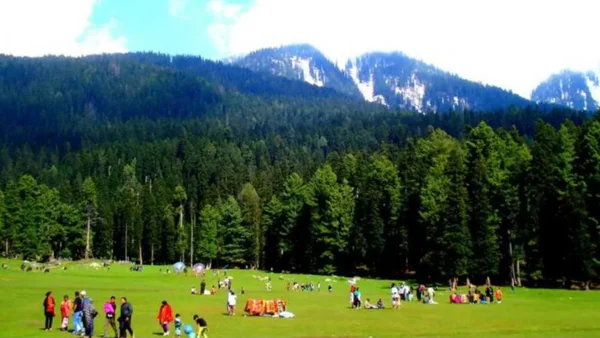
For generations, the journey to Baisaran was part of the attraction.
Visitors leaving Pahalgam would set out on foot or climb onto ponies, travelling roughly 3.5 kilometres across rugged mountain terrain before the trees opened into the broad green meadow often described as “mini-Switzerland.” The journey was not simply a means of reaching the destination. It was an experience – slow, physical and closely tied to the local economy.
Ponnywalas earned from the ride. Porters carried luggage. Small businesses along the tourist circuit benefited from the movement of visitors. The meadow itself was reached at a pace dictated by the landscape.
Now, that journey is set to change.
A more than four-kilometre motorable road connecting Baisaran with the Circuit Road is being built at an estimated cost of Rs 6.09 crore, offering a new form of access to one of Kashmir’s best-known tourist destinations.
The foundation stone was laid by Pahalgam MLA Altaf Ahmad Wani, popularly known as Kaloo. The project will be executed by the Public Works Department’s Roads and Buildings Division in Pahalgam under the National Bank for Agriculture and Rural Development, or NABARD. Officials expect construction to take two to three years.
The road comes at a moment when access to Baisaran carries a meaning far beyond tourism.
On April 22, 2025, the meadow became the scene of one of the darkest attacks in Kashmir’s recent tourism history. Twenty-five tourists and pony operator Syed Adil Shah were killed. Shah was killed while attempting to save visitors.
Baisaran has remained closed since then.
The proposed road therefore raises an obvious question: Could easier physical access make the meadow safer?
The answer will depend on much more than the road itself. But the project has reopened a discussion about something that became painfully visible during the attack — how difficult it is to reach an isolated tourist destination when an emergency unfolds.
During the attack, there was no conventional road connecting the meadow to the wider transport network. The injured and those killed had to be moved using horses, all-terrain vehicles and human carriers before they could be taken toward the Pahalgam health facility.
For tourists, the distance between a scenic destination and a medical facility can feel insignificant on an ordinary afternoon.
During a crisis, it can become the difference between minutes and hours.
The road is intended to change that equation.
Wani said the decision to construct it was taken after the attack and described the incident as a national tragedy. He said the absence of connectivity had also made it difficult for security forces to reach the area and suggested that road access could have made a difference during the attack.
Officials have similarly said the project is intended not only to improve tourist access but also to strengthen the ability of security agencies to reach and secure the destination.
That does not make the road a substitute for security.
A road cannot determine what happens inside a meadow. It cannot prevent an attack by itself, and it cannot eliminate the need for intelligence, surveillance, policing, emergency preparedness or coordination among agencies.
But it changes the physical conditions under which all of those systems operate.
That distinction matters.
For a tourist destination, security is not only about preventing violence. It is also about the ability to respond when something goes wrong – whether the emergency is an attack, a medical crisis, a fire, a landslide, a sudden weather event, or an accident.
Road access can shorten the distance between an incident and assistance.
It can allow ambulances to reach closer to the site. It can provide a more direct route for rescue teams. It can make evacuation more predictable. It can allow essential supplies and emergency equipment to be transported more quickly.
And it can make it easier for authorities to establish and maintain a visible presence.
But Baisaran is not simply a security problem.
It is also a livelihood landscape.
For years, the journey to the meadow has supported an ecosystem of work built around the absence of a road.
Ponnywalas have taken visitors uphill. Porters have carried bags. Guides have helped tourists navigate the terrain. Local transporters have moved people to and from Pahalgam. Shops and service providers have benefited from the steady movement of visitors.
For many families, tourism is not an occasional source of income. It is the economic foundation of the year.
That is why the road’s impact on livelihoods may be as important as its impact on access.
Wani has said the traditional trek will remain and that pony operators will be able to continue their services after the road is completed. Tourists, he said, will still have the option of using ponies.
Whether that promise translates into sustained income will depend on what happens on the ground.
A road introduces choice.
Some tourists who once had to hire a pony may choose a taxi or other vehicle. Families with children or older travellers may welcome the convenience. Tourists carrying luggage may prefer direct transport. Emergency services will benefit from the same access.
But the continued existence of the pony route could preserve another kind of tourism — one that values the journey itself.
There may be room for both.
The question is whether the local economy can adapt quickly enough to a destination that becomes easier to reach.
A new road could create work for taxi and cab operators, as the MLA has suggested. It could also increase demand for local accommodation, food, guides, and other services if tourist numbers recover.
The project could extend the tourism season, particularly if winter connectivity makes Baisaran more accessible beyond the traditional summer months.
That possibility is significant for Pahalgam, where tourism is deeply seasonal.
A destination that can receive visitors for more months of the year can spread income across a longer period. Transporters can work more days. Hospitality businesses can operate longer. Local suppliers can sell more. Young people may find more opportunities within the local tourism economy.
The road could also make Baisaran part of a larger circuit rather than an isolated excursion.
Pahalgam already draws visitors to Aru Valley, Betaab Valley and Chandanwari. Better connectivity could allow Baisaran to be integrated more easily into that circuit, potentially changing how visitors spend their time in the area.
Wani has also said that a cable car linking the Circuit Road with Baisaran is being planned and that its survey has already been completed.
Taken together, the road and possible cable car suggest a future in which Baisaran becomes substantially more accessible than it has been.
That future carries opportunity.
It also carries responsibilities.
The more accessible the meadow becomes, the greater the need for authorities to plan its carrying capacity, waste management, traffic, parking, emergency services and environmental protection.
Baisaran’s appeal comes precisely from its landscape. If access grows without corresponding management, the qualities that attract visitors could themselves come under pressure.
Security planning will also have to evolve alongside tourism.
A safer destination is not simply one that can be reached quickly. It is one where visitors know what to do during an emergency, where communication systems work, where medical assistance is available, where evacuation routes are clearly established and where different agencies can coordinate.
The road can become one component of that system.
Its most tangible benefit may therefore be measured not in the number of vehicles it carries but in the time it saves during an emergency.
That time matters especially in places where terrain has historically been a barrier.
The April 2025 attack demonstrated the difficulty starkly. Victims could not simply be loaded into ambulances waiting outside the meadow. People had to improvise with whatever means were available – horses, all-terrain vehicles, and human effort.
A road would change that.
It could allow emergency vehicles to move closer to the destination and reduce the physical burden on those carrying injured people. It could provide a more direct evacuation corridor. It could allow medical teams and equipment to reach the site more quickly.
But its value will ultimately depend on whether emergency infrastructure develops alongside it.
A road without ambulances nearby is limited.
An ambulance without a functioning communication network is limited.
Emergency access without trained personnel and a coordinated response system is limited.
The infrastructure must therefore be viewed as a chain, not a single project.
The same is true for the local economy.
If ponnywalas are expected to remain part of the tourism experience, they need a defined role in the new system. If the road changes visitor behaviour, the traditional trek may need to be promoted as an experience rather than treated simply as an old mode of transport.
The local workforce should not be seen as an obstacle to modernisation.
It is part of the destination.
The pony operators who have carried visitors into Baisaran for years know the terrain in a way that no new road can erase. Porters, guides and other local workers are part of the human infrastructure of tourism.
Their livelihoods deserve to be considered as carefully as the engineering of the road.
There is also a symbolic dimension to reopening Baisaran.
After the attack, the meadow became associated with grief rather than the landscape that had made it famous. Its closure was a reminder that tourism depends on something more fragile than hotels and roads: the visitor’s confidence that a place is safe enough to enjoy.
Restoring that confidence will take time.
A road may help by making Baisaran more connected, more reachable, and easier to evacuate. But tourists will ultimately return when they believe that the broader security and emergency-response environment has become dependable.
The project, then, is not simply about bringing vehicles to a meadow.
It is about shortening distances – between tourists and help, between remote places and public services, and perhaps between a community recovering from a tragedy and a tourism economy trying to rebuild itself.
There will be changes.
The old journey may become less exclusive. The pony economy may have to adjust. Traffic and construction may alter the landscape. The meadow will require careful management if greater access brings greater numbers.
But access can also mean opportunity.
For tourists, it can mean another way to experience Baisaran. For emergency teams, it can mean precious minutes. For local businesses, it can mean new customers. For ponnywalas and porters, it can mean a need to redefine rather than necessarily abandon the services they have traditionally provided. And for a destination marked by a terrible attack, it can become part of a broader effort to make tourism more connected and better prepared.
The road will not answer every security question. It does not need to.
Its importance may lie in something more practical: making an isolated destination less isolated.
The next chapter of Baisaran will therefore be written not only by the machines that build its road, but by the systems, businesses, workers and visitors that use it.
The meadow became famous because of the journey into it.
The challenge now is to ensure that the journey out – in ordinary times and, especially, in an emergency – is never again harder than it needs to be.
About the Author
Tabish Khan is a multimedia journalist and postgraduate in Convergent Journalism, working across text, video, social media, and digital storytelling.