
There is a particular silence that comes before a forest disappears.
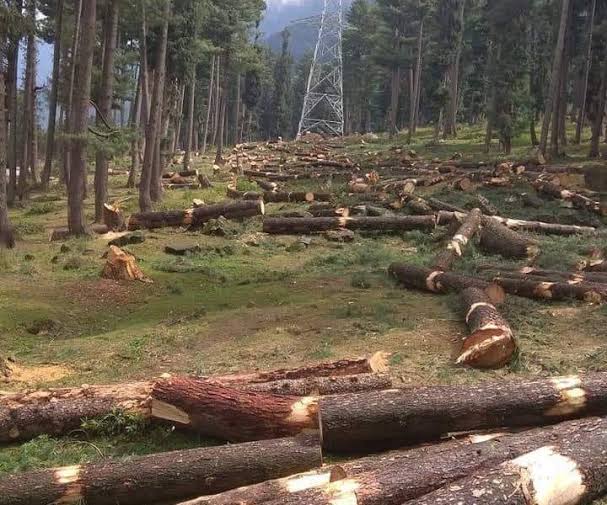
First come the surveyors, marking boundaries through the trees. Then the machinery arrives. A road is widened, a transmission line is laid, a building rises, a tunnel is drilled, or a project takes shape where, not long ago, there was only the slow economy of a forest: trees growing, water filtering through soil, animals moving under a canopy and people drawing from a landscape that had taken decades or centuries to form.
By the time the last tree falls, the decision has often been made somewhere else, in a file.
In Jammu and Kashmir, that decision has now acquired a number.
The Centre has told the Rajya Sabha that 1,086.01 hectares of forest land in Jammu and Kashmir has been approved for diversion for non-forestry purposes over the past three years and the current financial year through Aug. 6, 2026. That is about 10.86 sq km of forest land – an area large enough to make the issue more than an abstract environmental statistic.
Across India, the corresponding figure was 82,817.92 hectares, putting Jammu and Kashmir’s share at about 1.31 percent.
The number is particularly striking because forests occupy nearly half of Jammu and Kashmir’s geographical area.
J&K’s Economic Survey for 2025-26 describes its forests as covering about 20,194 square kilometres, or 48 per cent of its geographical area, and notes that they provide timber and forest products, grazing grounds, water supplies and tourism benefits.
The government says forest diversion is not a free-for-all. Environment officials told Parliament that proposals are considered individually and that forest land may be diverted only when it is considered “unavoidable and site-specific.” The area, the Centre says, is restricted to the bare minimum required for a project. Approvals come with conditions such as compensatory afforestation, payment of Net Present Value and measures for soil and moisture conservation and wildlife and catchment-area treatment.
That is the logic of the system.
But the deeper question is whether a forest can actually be replaced.
A forest is not simply a collection of trees standing on a piece of government-owned land. It is an ecosystem: soil, roots, fungi, insects, birds, mammals, streams, fallen leaves, microorganisms and an intricate web of relationships built over generations.
A plantation can put trees back on the ground. It cannot necessarily put the forest back.
That distinction matters enormously in the Himalayas.
A road through a forest may occupy only a narrow strip on a map. Its consequences can be much wider. Construction fragments habitat, changes drainage patterns, opens previously inaccessible areas and increases human pressure. In steep terrain, the removal of vegetation can interact with rainfall, erosion and landslides. A transmission line may require a corridor. A hydropower project may require roads, tunnels and ancillary infrastructure. A building may occupy a small footprint but create a much larger zone of disturbance.
The forest does not end where the bulldozer stops.
Research from the Western Himalayas has illustrated the problem. A study of hydropower development and compensatory afforestation in Himachal Pradesh’s Kinnaur region found that development projects altered land use, fragmented forests and affected biodiversity. It also found serious problems with compensatory plantations, including poor survival of saplings and damage from wildfires and landslides.
The lesson for Jammu and Kashmir is not that every road, power project or public facility must be rejected.
It is that the presumption should change.
Development should have to demonstrate why a forest must be sacrificed, rather than the forest having to demonstrate why it should survive.
For decades, India’s environmental governance has tried to strike a compromise between development and conservation. The forest-clearance system is designed precisely for that purpose. Forest land is not supposed to be diverted casually. A project must pass through scrutiny, and the loss is supposed to be compensated.
But compensation has a conceptual weakness: it can turn a living ecosystem into an accounting exercise.
A hectare of mature Himalayan forest is measured. A payment is calculated. Another piece of land is identified. Saplings are planted. The paperwork is completed.
But the original forest may have contained mature trees that took generations to grow. It may have supported wildlife that cannot simply relocate to a plantation. It may have protected a spring or watershed. It may have connected two habitats. It may have held soil on a mountain slope.
None of these functions can be reproduced instantly by planting an equivalent number of saplings elsewhere.
The Comptroller and Auditor General has previously examined serious weaknesses in India’s compensatory-afforestation regime, including the diversion of forest land and the collection and use of compensatory-afforestation funds. More recent academic research has continued to question whether compensatory afforestation adequately replaces the biodiversity and ecological quality lost when natural forests are diverted.
There is another problem: what appears as a gain in forest cover nationally does not necessarily mean that natural forests are being preserved.
The Forest Survey of India uses satellite-based remote sensing, supplemented by ground verification, to conduct its biennial assessment of forest cover. The India State of Forest Report 2023 put India’s forest cover at 715,342.61 sq km, or 21.76 percent of the country’s geographical area, an increase of 156.41 sq km from the 2021 assessment.
Those figures are important. But they do not answer every ecological question.
A forest map can tell us how much canopy exists. It does not, by itself, tell us whether a continuous wildlife corridor has been broken into fragments, whether an old-growth ecosystem has been replaced by young plantations or whether a watershed has been disturbed.
Research from IIT Bombay has highlighted this distinction. Large, connected forests provide ecological benefits that fragmented patches cannot fully reproduce. Forest fragmentation can disrupt the movement and survival of wildlife and weaken the ecological resilience of landscapes.
This is why the debate in Jammu and Kashmir should not be reduced to the number of hectares cleared.
The real question is what those hectares contain.
Jammu and Kashmir’s forests include Western Himalayan coniferous and broad-leaved ecosystems, as well as subtropical pine, Himalayan moist temperate, dry temperate and alpine forest types. The government’s own Economic Survey describes the forests as an important source of water, livelihood and economic activity.
For a mountainous region, that makes forests infrastructure of another kind.
They are natural infrastructure.
They slow water. They stabilise slopes. They hold soil. They store carbon. They regulate local climates. They provide habitat. They feed streams. They make landscapes more resilient to extreme weather.
Unlike a road or a building, much of that infrastructure was never built with a budget allocation. It was built by nature.
And once destroyed, it can be extraordinarily expensive – sometimes impossible – to reconstruct.
There is also a political dimension to the issue.
When governments approve forest diversion, the decision is often presented as a choice between conservation and development, as if opposing a project means opposing progress. That is a false binary.
The choice should instead be between better development and careless development.
A new road can be aligned differently. A transmission corridor can be designed to reduce fragmentation. Infrastructure can be concentrated rather than scattered. Existing roads can be upgraded instead of opening new corridors through intact forests. Buildings can be planned around ecological constraints. Sensitive areas can be identified before project designs become politically and financially irreversible.
The most important environmental decision may therefore be the one made before a project reaches the forest-clearance table.
The government has said that forest diversion must be “unavoidable and site-specific.” If that principle is taken seriously, every proposal should have to answer a simple question: What alternatives were examined before this forest was chosen?
And the answer should be public.
Maps should be public. Tree-felling plans should be public. Compensatory-afforestation sites should be public. Survival rates of plantations should be public. The number and type of trees lost should be public. The wildlife and watershed implications should be independently assessed.
Most importantly, approval should not be treated as the end of environmental scrutiny.
It should be the beginning of accountability.
Jammu and Kashmir has already witnessed the consequences of treating its mountains as an unlimited construction site. Roads, tourism infrastructure, hydropower, power transmission, defence infrastructure and urban expansion all compete for limited space. The pressure will only increase as the region seeks economic growth and better connectivity.
That makes the 1086 hectares more than a statistic from a parliamentary answer.
It is a warning about the direction of travel.
India’s development ambitions are legitimate. Jammu and Kashmir needs better roads, reliable electricity, modern hospitals, schools, telecommunications and employment. Its people should not be asked to remain economically backward in the name of conservation.
But development that destroys the ecological systems on which communities depend is not development without cost. It is development that sends part of its bill to the future.
The easiest tree to save is the one that has not yet been marked for felling.
Once the forest is gone, governments can plant saplings. They can spend money. They can issue reports. They can count hectares. They can count surviving trees.
What they cannot easily recreate is time.
A mature forest is time made visible.
That is why Jammu and Kashmir needs a stronger principle than simply “minimum diversion.” It needs a presumption in favour of intact forests, independent scrutiny of alternatives, cumulative assessment of projects in the same landscape and transparent monitoring long after environmental approval has been granted.
The goal should not be to stop development.
It should be to stop pretending that every forest cleared in the name of development is replaceable.
The Centre’s figures show how much forest land has already entered the system of diversion. They should also prompt a more uncomfortable question: how much more can the mountains afford to lose before the ecological cost becomes greater than the economic gain?
For Jammu and Kashmir, that question is no longer theoretical.
The chainsaw may be authorised.
The consequences are not.
About the Author
Amir Yaseen is a Srinagar-based journalist interested in Kashmir, policy, progress, and the human stories shaping everyday life.