
Kashmir Impulse Desk
New Delhi, July 17
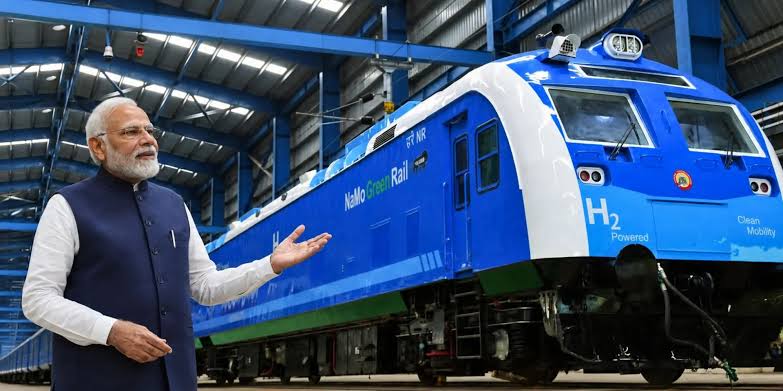
Prime Minister Narendra Modi on Friday inaugurated India’s first hydrogen-powered passenger train, marking a milestone in the country’s efforts to reduce carbon emissions from its vast railway network and position itself among a handful of nations deploying hydrogen-powered rail transport.
The train, which will operate between Jind and Sonipat in the northern state of Haryana, was flagged off at Jind railway station in the presence of Railway Minister Ashwini Vaishnaw, Haryana Governor Ashim Kumar Ghosh and Chief Minister Nayab Singh Saini.
The 89-km journey will take about two hours, with the train stopping at 12 intermediate stations.
The launch comes as India accelerates investments in clean-energy technologies under its broader strategy to reduce dependence on fossil fuels and achieve net-zero carbon emissions by 2070.
Hydrogen has emerged as a key pillar of that strategy, with the government promoting its use across industries including transport, steel production and fertilisers.
Unlike diesel-powered locomotives, hydrogen trains generate electricity onboard through fuel cells that combine hydrogen and oxygen, producing only water vapour as a by-product. The technology eliminates direct carbon emissions while reducing noise and lowering dependence on imported fossil fuels.
Railway officials said the train was designed, engineered and integrated in India using indigenous technology, underscoring the country’s growing capability in advanced railway engineering.
India’s hydrogen-powered train has a 10-coach configuration, making it among the longest passenger trains of its kind in the world.
Equipped with a 3200-horsepower propulsion system, it is also among the most powerful hydrogen-powered trainsets currently in operation, according to the Railways.
Hydrogen-powered trains are increasingly being viewed as an alternative to diesel services on non-electrified railway routes, where installing overhead electric infrastructure can be costly or impractical.
Because electricity is generated onboard through fuel cells, the trains do not require continuous overhead electrification, offering a lower-emission option for regional rail services.
India has one of the world’s largest railway networks, carrying millions of passengers every day, and has been steadily expanding electrification while exploring alternative fuels to reduce emissions.
The introduction of hydrogen-powered trains complements those efforts and forms part of the government’s National Green Hydrogen Mission, which aims to position India as a major producer and user of green hydrogen over the coming decades.
Officials said the project would also serve as a technology demonstrator for future deployment of hydrogen-powered rolling stock on suitable routes across the country, although no timeline has yet been announced for wider commercial expansion.
As the sky-blue and white train departed Jind carrying passengers, including schoolchildren invited for the inaugural journey, the launch marked India’s formal entry into a small group of countries that have introduced hydrogen-powered passenger rail services as part of their transition to cleaner transport systems.