
Kashmir Impulse Desk
Srinagar, July 17
Two students from Jammu and Kashmir secured places among India’s highest-ranked candidates in the National Eligibility-cum-Entrance Test (NEET-UG) 2026, marking a strong performance for J&K in a year when the country’s biggest medical entrance examination was re-conducted following a paper leak that disrupted the admission process for millions of aspirants.
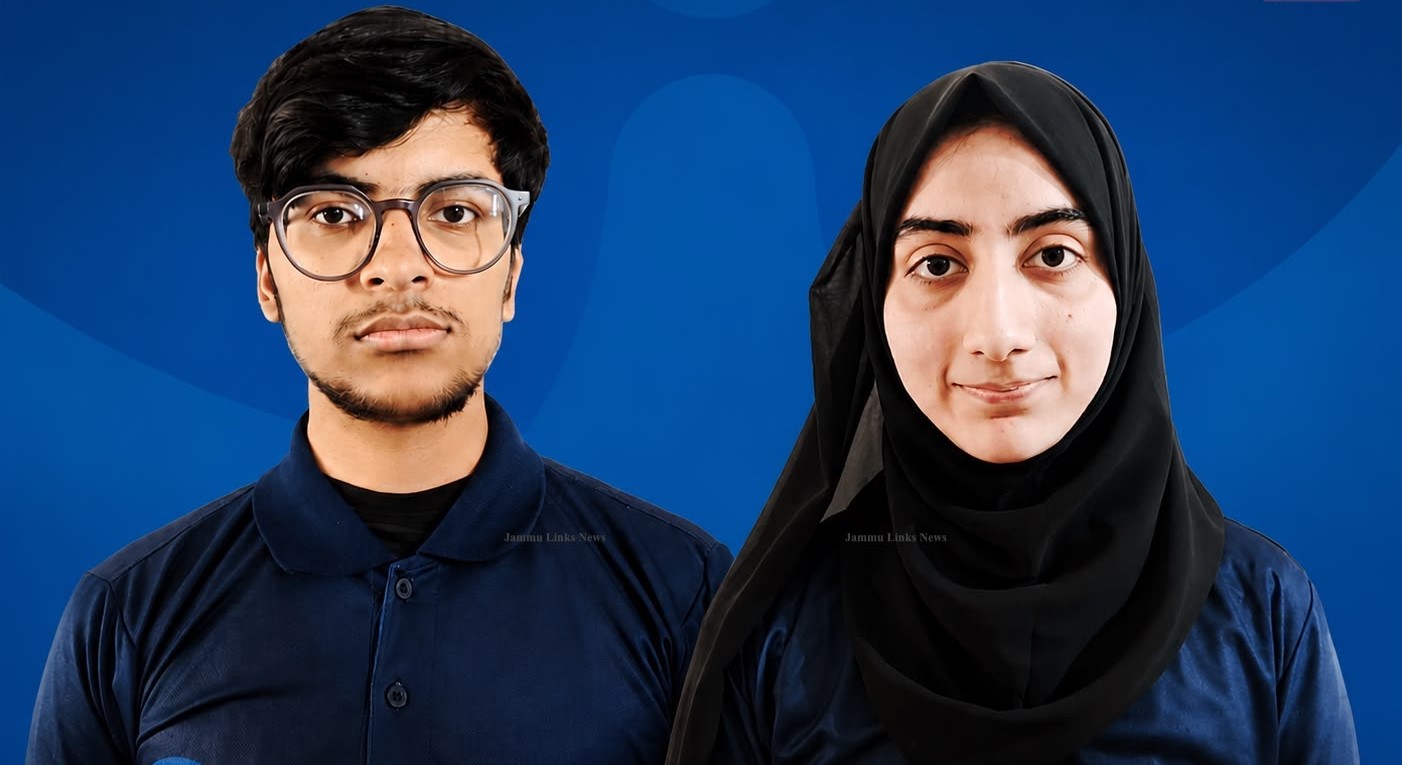
Hadiya Nissar secured All India Rank (AIR) 99, while Zaidan Wani finished at AIR 124, placing both among the country’s top performers after scoring 690 marks in the examination, results released by the National Testing Agency (NTA) showed.
Their achievement comes after one of the most turbulent admission cycles in the history of the examination.
The original NEET-UG test, conducted in May, was cancelled following allegations of a paper leak, forcing more than 2.2 million candidates across India to prepare for a fresh examination in June. The unprecedented decision triggered weeks of uncertainty, legal challenges and anxiety among students awaiting admissions to medical colleges.
For J&K, the results reflected both growing academic competitiveness and the continuing pressure on medical admissions despite a substantial expansion in government medical education over the past decade.
J&K now has around 1,675 MBBS seats across government medical colleges, including AIIMS Jammu, following the establishment of seven new Government Medical Colleges. Yet demand continues to far outstrip supply, with registrations for NEET in Jammu and Kashmir crossing 50,000 in recent years, leaving thousands of qualified candidates competing for a limited number of seats.
Nationally, nearly 2 million candidates appeared for the examination this year, of whom about 1.12 million qualified. Only 19 candidates scored above 700 marks, underlining the intense competition at the top end of the merit list. Hadiya and Zaidan were among the 138 candidates nationwide to score 690 marks.
The strongest performance within Jammu and Kashmir came from south Kashmir’s Anantnag district, which produced both the Union Territory’s top-ranked candidates and eight of its top 20 qualifiers.
Hadiya, a first-time candidate from Bon-Dialgam village, said the cancellation of the original examination briefly disrupted her preparation but ultimately worked in her favour.
“I had secured 705 marks in the cancelled examination. That doesn’t necessarily mean my rank would have been better. The re-test proved to be a blessing in disguise,” she said.
She attributed her success to consistent preparation, family support and guidance from teachers, advising future aspirants to focus on conceptual clarity rather than comparing themselves with others.
Zaidan Wani, from Shangus in Anantnag district, said consistency mattered more than the number of hours spent studying each day.
“I mostly studied for three to four hours a day and sometimes up to six. The key is consistency,” he said, adding that self-study formed the backbone of his preparation while coaching served mainly as academic guidance.
Other candidates from J&K also reflected the increasingly diverse pathways to success.
Faizan Bashir Bhat from Kupwara qualified after preparing almost entirely through self-study and free online educational resources because his family could not afford private coaching. The son of a labourer, he said support from relatives, including an uncle who bought an inverter to help him study during winter power outages, proved crucial.
In Bandipora, Aiman Showkat secured 622 marks after relying largely on online learning platforms instead of full-time coaching. She said conceptual understanding and disciplined study were becoming increasingly important as the examination evolved towards more application-based questions.
Admissions to medical colleges will now move to the counselling stage, where candidates’ prospects will depend not only on their national rankings but also on the Jammu and Kashmir merit list, reservation categories and individual college preferences.
For thousands of successful candidates across J&K, Friday’s result marked the end of months of uncertainty – but only the beginning of another intensely competitive phase in the race for an MBBS seat.