

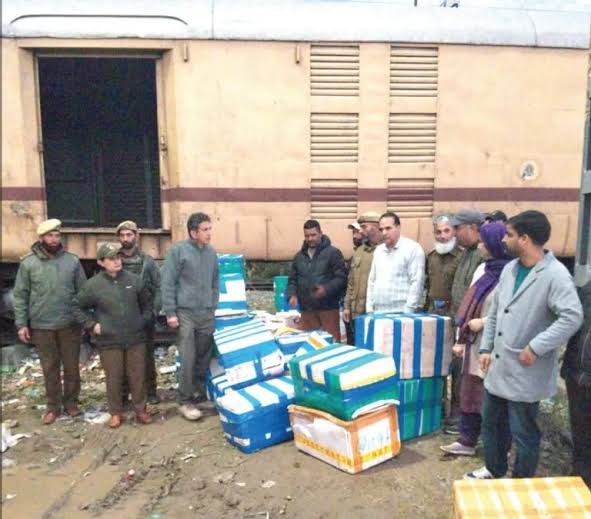
The seizure of nearly 2000 kg of rotten meat in Budgam has brought renewed attention to a part of Jammu and Kashmir’s food supply chain that consumers rarely see: the checks, or the absence of them, between the arrival of a consignment and its appearance in a market, restaurant or household kitchen.
The seizure has raised questions about how food brought into J&K is monitored, how its condition is verified during transport and who is responsible for ensuring that it remains safe before it reaches consumers.
Jammu and Kashmir has food-testing laboratories equipped with sophisticated instruments. It also has departments tasked with regulating food and monitoring animal health. But the enforcement network has acknowledged shortages of personnel and essential supplies, while questions remain about surveillance at entry points and in rural areas.
The gap begins at Lakhanpur, the principal road entry point into J&K. In principle, it should serve as an early screening point for food consignments entering J&K. In practice, the extent and regularity of checks have been questioned, particularly because of the shortage of trained personnel and the absence of clearly defined procedures covering the movement and handling of some products.
Poultry and livestock illustrate the problem. The Animal Husbandry Department is responsible for checking poultry for disease and mortality at the point of entry. But its monitoring largely ends once a consignment is cleared. Beyond that stage, the source material identifies no clearly defined departmental responsibility or enforceable standard operating procedure governing the movement, storage and handling of livestock until slaughter.
Important aspects of poultry transportation – including transit duration, transport conditions, feeding, temperature control and cage hygiene – remain outside a clearly defined regulatory framework. The Food Safety Department’s jurisdiction primarily begins after slaughter, leaving the period between entry into Jammu and Kashmir and slaughter with an institutional gap.
The division of responsibilities has raised questions in the past about the possibility of sick or diseased birds entering the food chain. An official said that the Animal Husbandry Department did not have adequate personnel deployed at the entry point. Consignments could consequently not be checked properly around the clock.
The Food Safety Department faces a separate manpower problem. Its chronic staff shortage limits the reach of inspections, and, apart from periodic drives, there is no departmental checkpoint to examine the large quantities of food entering J&K.
The need for a dedicated checking facility and laboratory at Lakhanpur is not new. In February 2013, the then Minister of State for Animal and Sheep Husbandry, Nazir Ahmad Gurezi, directed officials to establish a laboratory at the Veterinary Assistant Surgeon Centre to facilitate clinical examination of live animals entering the region. The proposal was reiterated in April 2017 by the then Minister of State Mir Zahoor Ahmad, who asked the Animal Husbandry Department to initiate the process of setting up a laboratory for examining incoming livestock.
The repeated proposals underline the long-standing recognition of the need for stronger surveillance at the entry point. The issue is not simply whether Jammu and Kashmir has laboratories. It is whether consignments can be screened at the stage when problems can be identified before distribution.
A food laboratory in Srinagar has advanced analytical equipment, but a facility located hundreds of kilometres from an entry point cannot by itself prevent an unsafe consignment from entering the local supply chain. Testing infrastructure and field surveillance perform different functions. One can analyse a sample; the other must identify which consignments need to be examined, ensure that they are handled correctly and act when irregularities are found.
A workable system would not require every vehicle carrying food to undergo laboratory testing. The proposed approach in the source material is risk-based inspection: checking documents, supplier details, packaging, storage conditions and temperature records, and identifying consignments that warrant closer examination.
Frozen meat, poultry, dairy products and other temperature-sensitive foods require an uninterrupted cold chain. A consignment that leaves its source in safe condition can become hazardous if the required temperature is not maintained during transportation and storage. Where irregularities are detected, the load should be detained, sampled and sent for appropriate laboratory examination.
The Budgam seizure has also raised questions about food entering through railway networks. Screening arrangements that focus only on road entry points would leave other routes outside the same level of scrutiny.
The question of what happens after food enters J&K is only one part of the challenge. The capacity to test samples and identify violations is equally important. On that front, the Food and Drug Testing Administration has announced an ambitious expansion of the testing scope of its two government laboratories, while acknowledging that shortages of staff and supplies have affected their functioning.
The administration has said it intends to increase the number of notified testing parameters from 381 to 3500 by March 2027. Its stated target is to raise the NABL-accredited testing scope to 2500 parameters by January 2027 and 3500 by March.
The proposed increase would represent a more than eightfold expansion in the notified testing parameters. But the announcement comes with a significant qualification: the department has acknowledged shortages of laboratory analysts, microbiologists, chemicals, certified reference materials, glassware and other essential supplies.
In a statement, the administration said funding-related issues had affected the recruitment of technical and non-technical staff and the procurement of consumables required for food testing. It said the Food Safety and Standards Authority of India had approved a three-year action plan covering 2026-27, 2027-28 and 2028-29.
The department said recruitment of laboratory analysts, microbiologists and other personnel through the Government e-Marketplace portal had reached its final stage. Procurement of certified reference materials, chemicals and glassware was under way and was expected to be completed within two weeks. It also said annual maintenance contracts for high-end equipment had been executed with the respective original equipment manufacturers.
The figures for the two laboratories show the gap between the proposed expansion and the existing scope. The Srinagar laboratory currently has 354 NABL-accredited parameters, while the Jammu laboratory has 27 notified parameters.
The administration has also said that contracts for hiring drivers and laboratory analysts for its Food Testing on Wheels initiative had been finalised. The mobile testing programme had stalled, according to the earlier report that prompted the department’s response.
The expansion targets could strengthen the laboratory network if the promised recruitment, procurement and maintenance arrangements are completed. But a larger list of testing parameters does not automatically translate into more effective surveillance. Laboratories need trained staff and supplies, and their work must be linked to a system that regularly collects representative samples from markets, supply chains and food establishments.
The same concern applies to pesticide residues in fruits and vegetables. A government response in the Lok Sabha, based on the Ministry of Agriculture’s Monitoring of Pesticide Residues at National Level project, showed that 58 of 1489 fruit and vegetable samples tested in Jammu and Kashmir between 2023 and 2026 had exceeded the prescribed Maximum Residue Limits.
The proportion of samples found in violation was 3.9 percent, above the national average of 3.1 percent. The figures were presented by Union Agriculture Minister Shivraj Singh Chouhan.
But the government’s response did not identify the fruits or vegetables involved. It also did not specify which pesticides had been detected or how far the residues exceeded the permissible limits.
That absence of detail makes it difficult for consumers to understand the nature of the violations or identify whether particular products or supply chains require closer attention. Unlike visible spoilage, pesticide residues cannot be identified by looking at produce, smelling it or tasting it.
The health implications of pesticide exposure depend on the chemical involved, the concentration, the duration of exposure and the route through which it enters the body. The World Health Organisation says toxicity depends on the level of exposure. Maximum Residue Limits are intended to ensure that dietary exposure remains within prescribed safety levels.
Some pesticides have raised particular health concerns. Malathion is classified by the International Agency for Research on Cancer as probably carcinogenic to humans, in Group 2A. Mancozeb and captan have also raised concerns in toxicological research. Other pesticides used in agriculture and horticulture in Kashmir include chlorpyrifos and carbendazim.
The available figures do not establish a direct link between pesticide residues in food and Jammu and Kashmir’s cancer burden. Such a conclusion would require epidemiological evidence. Nor do the findings mean that every fruit or vegetable carrying a residue is unsafe. The concern is whether consumers may be repeatedly exposed to mixtures of chemicals over extended periods without adequate surveillance or public information about what is present in the food supply.
J&K has a specialised facility capable of testing pesticide residues. The Research Centre for Residue and Quality Analysis at Sher-e-Kashmir University of Agricultural Sciences and Technology of Kashmir, Shalimar, has been functioning since 2012. The NABL-accredited laboratory tests food items routinely and also conducts tests on the demand of various departments.
It is not, however, a regulatory laboratory for the food chain. Its existence demonstrates that testing expertise is available, but routine regulatory surveillance remains a separate responsibility. The Food and Drug Administration has been urged to move beyond occasional checks and conduct more systematic analysis of food products reaching consumers.
The problem extends beyond entry points and laboratory capacity to the distribution of food within Kashmir itself. Rural and remote areas, in particular, remain a concern because inspections are less frequent and many small establishments operate outside regular monitoring networks.
Municipal towns and larger urban centres may receive periodic inspections, but thousands of villages have limited access to routine food-safety oversight. Small restaurants, roadside eateries and vendors selling raw or cooked meat may operate without consumers having a reliable way to verify the source, quality or storage conditions of the products they sell.
The movement of packaged meat into parts of north Kashmir has raised questions about whether such supplies undergo mandatory inspections and quality checks. Establishing the origin of these products, verifying their storage conditions and ensuring compliance with food-safety standards require a system that follows consignments beyond the point at which they enter the region.
Meat is not the only product requiring attention. Milk and dairy products, edible oils, sweets and other frequently consumed food items also need sustained surveillance to prevent adulteration and the sale of substandard goods.
Maharashtra’s Food and Drug Administration offers one example of a more enforcement-oriented approach. Since Tukaram Mundhe took over as commissioner in May 2026, the department has stepped up surprise inspections, raids, licence suspensions and surveillance. Its operations have covered spurious milk, adulterated paneer, unsafe edible oils and unhygienic food establishments.
By July, the Maharashtra FDA had conducted more than 1,100 raids and seized over 1.5 lakh litres of spurious milk and 35 tonnes of adulterated paneer. Subsequent inspections also resulted in improvement notices and licence suspensions against establishments found violating food-safety norms.
The model cannot simply be transferred to Kashmir without considering the region’s own staffing, geography and logistical constraints. But it illustrates the scale of sustained enforcement required when inspections are intended to be more than occasional responses to complaints or isolated incidents.
For J&K, the challenge runs through the entire food chain. It begins with the screening of consignments at Lakhanpur and other entry points, continues through transport and storage, and extends to laboratories, markets, restaurants and village-level vendors.
The announced laboratory expansion could improve the ability to detect violations. But it will need to be matched by trained personnel, regular sampling, adequate supplies, functioning mobile laboratories and an enforcement network capable of acting on test results.
The seizure in Budgam has drawn attention to one consignment. The larger question is whether the system can identify risks before unsafe food reaches consumers, and whether it can do so consistently across urban and rural areas.
Without regular inspections, clear departmental responsibilities and publicly accessible findings, consumers remain largely dependent on assurances about the food they buy. A functioning food-safety system must do more than test samples after a problem emerges. It must make surveillance part of the ordinary journey from supplier to plate.
About the Author
Tarique Bhat is a filmmaker and CEO of a multimedia production house, with extensive experience and a keen understanding of politics, policymaking, and governance.