
The fire at a cement plant in Khonmoh is a reminder that industrial growth cannot come at the expense of worker safety. Kashmir needs stronger inspections, stricter enforcement, and a culture that treats every workplace accident as preventable. Bisma Rafiq writes.
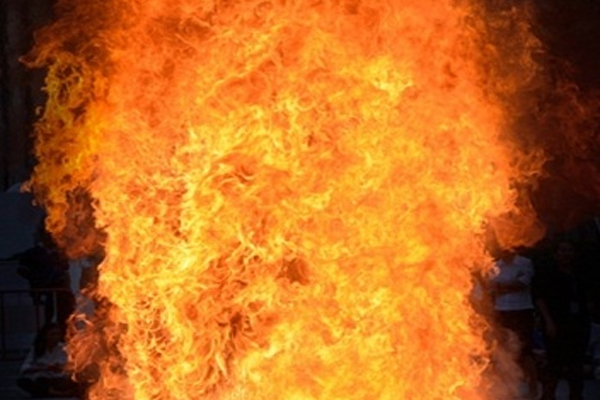
The fire that injured seven workers at a cement factory in Khonmoh on the outskirts of Srinagar is, first and foremost, a human tragedy.
Behind every injury is a family waiting anxiously outside a hospital ward. Behind every industrial accident is a worker who left home expecting to return safely at the end of a shift. For one employee who reportedly suffered critical burn injuries, that expectation has been shattered. For six others, recovery may take weeks or months. For their families, the emotional and financial consequences could last much longer.
As authorities investigate the cause of the fire and examine whether safety protocols were followed, the incident should prompt a larger conversation about industrial safety in Jammu and Kashmir.
The question is not merely what caused the fire in Khonmoh. The question is whether enough is being done to prevent the next one.
Industrial accidents often generate headlines for a day or two before disappearing from public attention. Investigations are ordered. Committees are formed. Reports are prepared. Then the news cycle moves on.
Yet for workers employed in factories, industrial units, cement plants, brick kilns and manufacturing facilities across Kashmir, safety remains a daily concern.
The region is undergoing gradual industrial expansion. New infrastructure projects are emerging. Manufacturing activity is increasing. Construction demand continues to grow. Cement plants, in particular, occupy a critical place in the economy, supplying material for roads, bridges, tunnels, housing projects and public infrastructure. But industrial growth brings responsibility.
Economic development cannot be measured solely by production figures, investment numbers or construction targets. It must also be measured by the safety of the people who make that growth possible.
A factory that produces thousands of tonnes of cement but fails to adequately protect its workforce cannot be considered a success.
The modern industrial world has learned this lesson repeatedly, often through tragedy.
Cement manufacturing is inherently hazardous. The industry involves high-temperature kilns, combustible materials, heavy machinery, conveyor systems, electrical equipment, dust exposure and elevated structures. Workers routinely operate in environments where a small lapse in safety can produce serious consequences. That is precisely why safety systems are supposed to be multilayered.
Modern industrial facilities should not depend on a single precaution. They require multiple safeguards designed to prevent accidents, detect risks early and minimise harm when incidents occur.
The first area that deserves scrutiny is inspection and compliance. Government agencies responsible for labour, industry and occupational safety must conduct regular and unannounced inspections of industrial facilities. Too often, inspections become routine paperwork exercises rather than rigorous evaluations of workplace conditions. A checklist completed in an office cannot substitute for a thorough physical inspection. Authorities should examine fire suppression systems, emergency exits, electrical infrastructure, worker training records, protective equipment availability, machinery maintenance schedules and compliance with national safety regulations. Facilities found violating safety norms should face meaningful penalties. In many parts of the world, companies sometimes treat fines as a cost of doing business because penalties remain too low to influence behaviour. Enforcement mechanisms must be strong enough to ensure compliance is cheaper than negligence.
Second, worker training requires far greater attention. Safety equipment is valuable only when workers know how to use it. Every employee in a high-risk industrial environment should receive regular training in fire safety, emergency evacuation procedures, equipment operation and first aid. These sessions should not occur only when a factory opens or when an accident happens. They should be continuous. Emergency drills should become mandatory. Factories routinely conduct production exercises and efficiency reviews. They should conduct safety drills with equal seriousness. Workers must know exactly what to do when alarms sound, smoke appears or equipment malfunctions. Panic thrives where preparation is absent.
Third, the government should consider mandatory third-party safety audits for large industrial facilities. Internal assessments are important but often insufficient. Independent experts can identify vulnerabilities that may be overlooked by management or regulators. Such audits should evaluate not only compliance with regulations but also broader risk-management practices.
How quickly can emergency services reach the facility? Are fire hydrants functional? Are evacuation routes clearly marked? Are workers equipped with adequate protective gear? Are safety records being maintained accurately? These questions can mean the difference between a contained incident and a major disaster.
The Khonmoh fire also highlights the importance of emergency medical preparedness. Industrial accidents involving burns require specialised treatment. Every minute matters. Delays can significantly worsen outcomes. Large industrial facilities should therefore be required to maintain on-site emergency response systems capable of providing immediate assistance until specialised medical care becomes available. Coordination between factories, hospitals and emergency services should be regularly tested through mock exercises.
Another area demanding attention is transparency. Too often, details about industrial accidents emerge slowly and incompletely. Public confidence depends on openness. Whenever a serious workplace accident occurs, investigation findings should be made public. If safety violations are identified, corrective measures should be disclosed. Lessons learned from one incident should be shared across the industrial sector. Transparency helps create accountability. Accountability encourages improvement. Improvement saves lives.
There is also a cultural dimension to industrial safety that regulations alone cannot address. Many workplaces continue to view safety as an administrative obligation rather than a core value. Production targets frequently receive more attention than risk management. Efficiency often receives more recognition than prevention. This mindset must change. The most successful industrial organisations in the world treat safety as part of operational excellence. They understand that worker welfare and productivity are not competing goals. They are complementary ones.
A worker who feels protected is more likely to perform effectively. A workplace with strong safety standards is more likely to avoid costly disruptions. A company that prioritises employee well-being is more likely to earn public trust.
Safety is not an obstacle to growth. It is a prerequisite for sustainable growth. The government should also establish a comprehensive database documenting industrial accidents across Jammu and Kashmir. Reliable data remains essential for effective policymaking.
Authorities need to know where accidents occur most frequently, what hazards are most common and which sectors require greater oversight. Without data, prevention becomes reactive rather than proactive. Most importantly, industrial accidents must never be accepted as inevitable.
There is a tendency to describe such incidents as unfortunate but unavoidable consequences of industrial activity. That assumption is dangerous. While no system can eliminate risk entirely, the overwhelming majority of workplace accidents can be prevented or mitigated through proper planning, maintenance, training and oversight.
Every accident should therefore be approached with a simple question: what could have been done differently?
The answer may involve equipment upgrades. It may involve better inspections. It may involve stronger enforcement. It may involve improved training.
Whatever the answer, the objective should be prevention rather than merely response. As the investigation into the Khonmoh fire proceeds, authorities must focus not only on determining responsibility but also on identifying lessons. Those lessons should shape future policy.
Kashmir’s industrial ambitions are growing. Infrastructure projects are expanding. Manufacturing activity is increasing. These developments are important for economic progress. But growth must be accompanied by safeguards. No worker should have to choose between earning a livelihood and risking life or limb. The measure of an industrial economy is not only what it builds. It is also how well it protects the people doing the building.
The fire in Khonmoh should serve as a warning. The appropriate response is not sympathy alone. It is action.
About the Author
Bisma Rafiq is interested in human resources and wants to improve journalism from the human resources point of view. She is also a passionate story teller.