
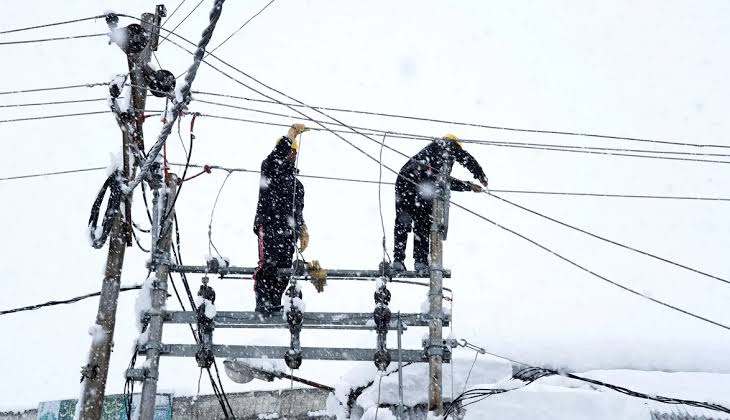
As temperatures begin to fall across Kashmir, electricity cuts have returned to disrupt daily life, renewing questions about the government’s ability to provide a reliable power supply through the winter months, even as consumers face higher tariffs.
The Kashmir Power Distribution Corporation Limited (KPDCL), under a revised curtailment schedule that took effect on October 17, has prescribed up to eight hours of daily outages in several areas. Other feeders have been assigned six or three hours of scheduled cuts, while essential feeders have been exempted.
The schedule offers a familiar sign of the pressures that accompany Kashmir’s transition into winter, when households increasingly depend on electricity for heating, lighting and other essential needs. It also exposes a persistent contradiction in the region’s power sector: consumers are paying more for electricity, but the reliability of supply remains a concern.
The latest curtailment plan divides feeders according to their aggregate technical and commercial (AT&C) losses, a measure that captures electricity lost through technical inefficiencies, theft and gaps in billing and revenue collection.
Feeders with AT&C losses exceeding 65 percent have been assigned eight hours of daily curtailment. Those with losses between 40.5 and 65 percent face six hours, while feeders with losses between 15 and 40.5 percent have been allotted three hours.
Feeders designated for round-the-clock supply and those with low losses have generally been assigned 30 minutes of curtailment in a single daytime slot. Essential feeders have been excluded from scheduled outages.
The schedule does not provide the current peak demand, the amount of electricity available to KPDCL or the size of any supply deficit. But the duration of the prescribed cuts illustrates the pressure facing the distribution network as demand rises ahead of the coldest months.
The immediate challenge is seasonal. The deeper problem is structural: limited growth in locally controlled generation capacity, substantial dependence on purchased electricity, high distribution losses and the continuing need to modernise the network.
The return of scheduled outages comes less than two months after a revised electricity tariff structure took effect on September 1.
The Joint Electricity Regulatory Commission approved an average tariff increase of 6.83 percent for the period through March 31, 2027, adding to the pressure on the National Conference government to demonstrate progress on its electoral assurances concerning electricity supply.
For households, the combination of higher tariffs and scheduled power cuts raises a straightforward question: what improvement in service can consumers expect in return for paying more?
The tariff revision and the curtailment schedule are not, by themselves, evidence that one caused the other. Electricity prices and supply arrangements are shaped by different considerations, including procurement costs, demand, available generation and the condition of the distribution system.
Still, the timing has made reliability a more immediate public concern. As temperatures fall, electricity becomes increasingly important not only for household comfort but also for basic domestic routines, particularly during the mornings and evenings.
For families that rely heavily on electric heating, scheduled outages can require changes to daily routines and alternative arrangements to keep homes warm. The burden can be especially difficult for households with limited options for backup power.
Businesses face a related problem. Shops, workshops, hotels, restaurants and small manufacturing units depend on electricity to operate equipment, maintain working hours, preserve goods and serve customers.
Long outages can interrupt production, reduce trading hours and force establishments to spend more on generators or other backup arrangements. Smaller businesses, which may not be able to afford those alternatives, are particularly exposed.
The effects extend beyond the duration of an individual outage. Uncertainty over when electricity will be available can make it harder for businesses to plan work, manage staffing and meet customer requirements.
One of the central challenges facing Jammu and Kashmir is the gap between electricity consumption and the expansion of generation capacity reflected in official installed-capacity figures.
The Digest of Statistics 2024-25, published by the Directorate of Economics and Statistics, records installed power capacity at 1372.40 megawatts from 2019-20 through 2024-25. The figure was 1414.17 MW in 2018-19.
The data show that reported installed capacity remained broadly unchanged over six consecutive years, even as the region continued to face growing electricity requirements.
Installed capacity, however, is not the same as the amount of electricity available to consumers at any given time. It represents the capacity of generating facilities, not their actual output or the share of electricity that can be delivered to households and businesses.
Hydropower production varies with water availability and seasonal conditions. Electricity generated locally must also be considered alongside purchases from other sources, transmission constraints and the capacity of the distribution network.
Consequently, the installed-capacity figures alone do not establish the precise contribution of local generation to the current curtailments.
J&K has substantial hydropower potential, and several major projects have been under development. But planned capacity cannot relieve a shortage until projects are commissioned and begin supplying electricity.
In the meantime, J&K continues to rely heavily on electricity purchased from central generating stations and other sources to meet its requirements, particularly during winter.
That dependence exposes the power system to the cost and availability of electricity procured from outside. It also makes the timely completion of generation projects, alongside better use of existing resources, important to any longer-term effort to improve supply.
Yet even an increase in available generation would not automatically eliminate outages. Electricity must also be transmitted and distributed through a network capable of handling peak demand, while utilities must recover sufficient revenue to maintain infrastructure and pay for the power they supply.
The winter shortage, therefore, cannot be understood solely as a question of how much electricity J&K generates.
The other major weakness is the amount of electricity that is lost or goes unaccounted for before it can be billed and revenue collected.
Figures reported in July 2026 put J&K’s AT&C losses at 33.54 percent in 2024-25, compared with a national average of 15.04 percent.
The gap places J&K well above the national benchmark and highlights the difficulties facing its distribution system.
AT&C losses are broader than physical electricity losses alone. They include technical losses in the network, as well as commercial losses associated with unmetered consumption, inaccurate billing, theft and the failure to collect revenue from electricity supplied.
High losses weaken the finances of distribution utilities. When a significant share of the electricity supplied cannot be converted into billed and collected revenue, utilities have fewer resources to cover procurement costs, maintain equipment and invest in improvements.
They can also complicate efforts to provide a dependable supply. A network with substantial technical losses may require upgrades, while weak metering and collection systems can undermine the financial sustainability of the sector.
KPDCL’s latest curtailment schedule makes the connection between distribution performance and electricity access particularly visible. Feeders with the highest recorded losses have been assigned the longest scheduled outages.
That does not mean every outage is caused by losses on the relevant feeder. Seasonal demand, the availability and cost of purchased power, and other operational constraints also influence supply decisions. The schedule itself does not quantify the contribution of each factor.
But the allocation underscores the importance of reducing losses if the utility is to improve both its finances and the reliability of electricity delivery.
Reducing AT&C losses requires more than publishing targets. It can involve improving metering and billing, strengthening revenue collection, addressing electricity theft, upgrading ageing infrastructure and ensuring that consumers are charged accurately for the power they use.
Such changes can be difficult to implement consistently, particularly across a large distribution network. Their benefits also take time to translate into a more reliable service.
The latest curtailment schedule puts the government’s electricity commitments under renewed scrutiny just as seasonal demand begins to rise.
The immediate task is to manage available electricity while maintaining supply to essential services and limiting disruption to consumers. The longer-term challenge is to address the weaknesses that make winter curtailments a recurring feature of the region’s power sector.
Those tasks are related but distinct. Managing a seasonal shortage requires decisions about available power, demand and distribution. Preventing the same pressures from returning year after year requires investment in generation, transmission and distribution, as well as improvements in billing, collection and operational efficiency.
The government’s ability to demonstrate progress will depend partly on the availability of reliable, current data. Peak demand, local generation, electricity purchases, feeder-level losses and the duration of actual outages would help establish how much of the problem stems from insufficient supply and how much from constraints within the network.
The revised schedule does not provide those figures, making it difficult to assess the precise scale of the current deficit or measure how conditions compare with previous winters.
Nor does the schedule establish whether the prescribed curtailments will remain unchanged as temperatures fall and demand increases further.
For consumers, however, the distinction between the immediate shortage and the structural causes offers little comfort when electricity is unavailable for hours at a time.
Households need dependable power to heat their homes and manage daily life. Businesses need it to operate without interruptions that erode productivity and increase costs. The higher tariff has sharpened expectations that the service should become more reliable, even though the relationship between tariff revisions and supply improvements is neither immediate nor automatic.
The government faces the challenge of meeting those expectations while dealing with a system marked by dependence on purchased electricity and distribution losses well above the national average.
The return of winter curtailments does not, on its own, establish that the power sector has made no progress. It does, however, demonstrate that the underlying pressures remain significant.
New generation capacity can improve the availability of electricity, but it must be commissioned on time and supported by an effective transmission and distribution network. Reducing losses can strengthen utility finances, but it requires sustained improvements in infrastructure, metering, billing and collection. Better planning must also account for the seasonal nature of demand.
The latest schedule offers a measure of how the utility is responding to those pressures: the longest cuts have been assigned to feeders with the highest AT&C losses, while essential and selected low-loss feeders receive more favourable treatment.
Whether that approach can protect consumers from prolonged interruptions through the winter remains to be seen.
For now, the familiar pattern has returned. Temperatures are falling, demand is rising and scheduled outages are once again part of daily life across parts of Kashmir.
The challenge for the government is no longer simply to manage the winter shortage. It is to show that higher tariffs, generation projects and efforts to improve distribution can produce a more dependable electricity system – one in which the arrival of cold weather does not automatically bring the return of long power cuts.
About the Author
Tabish Khan is a multimedia journalist and postgraduate in Convergent Journalism, working across text, video, social media, and digital storytelling.