
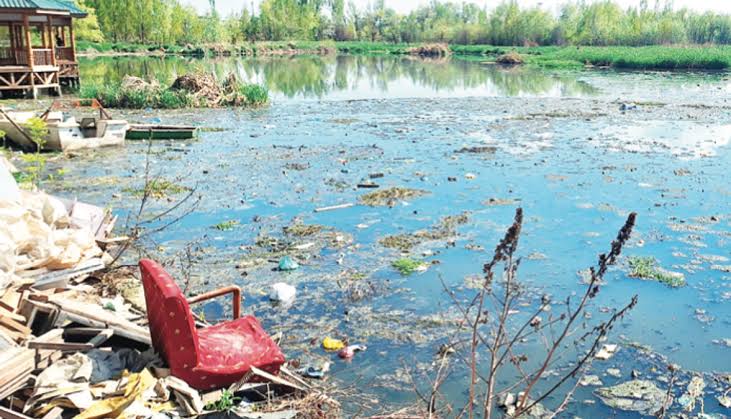
The water of Brari Nambal was once clear enough for residents of Srinagar’s old quarters to drink. Today, the historic lagoon is more likely to be associated with stagnant pools, floating waste and a pungent smell that hangs over its banks.
In the heart of the city, where the water body once formed part of Srinagar’s intricate network of lakes and waterways, garbage mounds and thick weeds have replaced much of its former splendour. Shops, automobile workshops and trading yards have spread into sections of the lagoon, narrowing the space available to water and wildlife.
The deterioration has unfolded over decades, through pollution, encroachment and repeated delays in conservation. Governments have announced restoration plans, funds have been earmarked and officials have outlined projects. Yet the lagoon continues to shrink under pressure from the expanding city, while disputes over land ownership have become a major obstacle to work on the ground.
Brari Nambal is not merely another urban water body. It is ecologically linked to Dal Lake and plays a role in regulating its hydrology. Its decline therefore threatens more than a historic landscape: it places further pressure on an already vulnerable aquatic ecosystem.
For residents who remember its earlier condition, the transformation is a measure of how much has been lost – and how little of the promised revival they have seen.
“We used to drink Brari Nambal water till a few decades ago. It has lost its glory and turned into a septic tank. The water body is emanating a pungent smell and is literally dying,” said Ghulam Rasool, a downtown resident.
His recollection captures the distance between the lagoon’s past and its present. But the causes of that distance are visible along its banks, where waste, invasive vegetation and construction have steadily altered the character of the water body.
Brari Nambal’s decline can be traced in part to changes in the waterways that once sustained it.
The deterioration began in earnest in the 1970s, after its outflow channel, Nalla Mar, was filled in. The channel had wound through downtown Srinagar, connecting the lagoon to the city’s wider network of watercourses. Its closure severely disrupted the water body’s hydrology.
A 468-metre conduit was subsequently constructed to connect Brari Nambal with the River Jhelum at Fateh Kadal. But restoring a hydraulic connection did not, by itself, restore the lagoon’s ecological health.
Over the past two decades, the absence of sustained conservation measures has left it exposed to encroachment, pollution and excessive weed growth. As the city grew around it, portions of the water body were occupied and used for activities that further burdened its fragile environment.
One of the most visible changes has occurred on the Baba Demb side, where a large expanse has been encroached upon for shops and automobile workshops. Scavengers dump plastic and other non-biodegradable waste in occupied portions of the lagoon and use the area as a loading point for trucks. Another section has been taken over by dealers in second-hand goods.
These activities have transformed sections of the lagoon’s edge into a mixture of commercial space and dumping ground. Solid waste enters the water, while encroachments restrict its spread and complicate efforts to restore its original boundaries.
The result is an ecological problem that cannot be solved by cleaning the water alone. The lagoon’s physical footprint, its connections with other water bodies and the land surrounding it are all part of the same challenge.
Brari Nambal’s history gives its decline a particular poignancy.
The 14th-century Kashmiri ruler Zain-ul-Abidin, widely remembered as Budshah, was said to have been so captivated by the lagoon’s beauty that he built steam baths, known as hamams, along its banks. Tradition holds that he also ensured the water body was cleaned regularly.
The story survives as a reminder that Brari Nambal was once valued as an integral part of the city’s landscape rather than as vacant land awaiting development.
Its present condition stands in sharp contrast to that memory. The water body that attracted royal attention now struggles with untreated waste, encroachment and neglected vegetation. The historical association with Budshah is not merely a nostalgic detail; it underscores how long the lagoon has formed part of Srinagar’s urban and cultural identity.
Yet heritage alone has not secured its protection.
After a sustained campaign by Greater Kashmir pressing for the restoration of Brari Nambal, the government in 2015 formulated a conservation project. The proposed restoration was described at the time as a “litmus test” for the authorities.
The test remains unfinished.
Despite the plan, no sustained set of scientific conservation measures has restored the lagoon to its former condition. The water body continues to be burdened by waste and weeds, while sections of its banks remain occupied. What was presented as a chance to revive a historic urban ecosystem has instead become another example of the gap between official plans and visible results.
The problem is not a lack of recognition that Brari Nambal needs protection. Successive governments have acknowledged its importance. The difficulty has been translating that recognition into a coordinated programme that can withstand encroachment, address pollution and restore the lagoon’s ecological functions.
For hydraulic engineering expert and environmentalist Ajaz Rasool, the lagoon’s condition demands a comprehensive response rather than isolated interventions.
“Brari Nambal, one of Srinagar’s historic urban lagoons, continues to face serious ecological pressures from pollution, encroachment, excessive weed growth, solid-waste dumping, and shrinking water spread,” he said.
Rasool welcomed the proposed augmentation of the Brari Nambal Sewage Treatment Plant, which has a capacity of 17.08 million litres per day, at an estimated cost of Rs 12 crore. But he cautioned that sewage treatment, on its own, would not be enough to revive the water body.
“Brari Nambal requires a comprehensive restoration programme involving strict protection of its boundaries, prevention of landfilling, removal of waste and invasive vegetation, regular water-quality monitoring and restoration of its lost water spread,” he said.
His prescription points to the interconnected nature of the problem. Treating sewage can help reduce one source of pollution, but it cannot reclaim land already occupied, remove every source of solid waste or restore the water body’s lost area. Nor can it replace regular monitoring and enforcement.
A functioning sewage treatment plant is an important part of conservation, but the lagoon also needs protection from activities that continue to diminish its ecological value.
“Brari Nambal is not vacant urban land — it is part of Srinagar’s natural and ecological heritage,” Rasool said. “Its protection must therefore be treated as a priority, not as an occasional response to encroachment.”
The warning is particularly relevant in a densely built urban environment, where the loss of a water body can be difficult to reverse once commercial and other uses become entrenched along its banks.
The government has outlined several initiatives aimed at preserving and improving Brari Nambal.
In a reply to the Legislative Assembly, it said the Jammu and Kashmir Lake Conservation and Management Authority had formulated projects under the Atal Mission for Rejuvenation and Urban Transformation, or AMRUT, and the Prime Minister’s Development Package, or PMDP. The projects were intended to support preservation, conservation, beautification and the development of tourist facilities around the lagoon.
Under AMRUT, officials said Rs 8.76 crore was being spent on the water body’s rejuvenation and revival.
The proposed work includes dredging the main lagoon and its connected Rainawari and Nowpora channels, constructing a one-kilometre walkway, stabilising slopes, improving a temple, removing solid waste, restoring damaged electric poles, repairing existing grill fencing and installing aerators.
On paper, the programme addresses several visible shortcomings. Dredging could help improve the water body and its connected channels, while waste removal and aeration could support efforts to improve water quality. Fencing repairs and slope stabilisation could contribute to protecting sections of the shoreline.
But the projects face a practical obstacle that has repeatedly delayed conservation: uncertainty over land ownership and boundaries.
Officials have acknowledged that land acquisition and demarcation issues have hindered implementation. A senior officer of the Lake Conservation and Management Authority said a substantial portion of the lagoon consisted of proprietary land, creating disputes with owners who did not want work to proceed before the acquisition process was completed.
“There is a large chunk of proprietary land in Brari Nambal, due to which a dispute has arisen. Proprietary land owners don’t allow us to work in the water body before land acquisition. This is a major bottleneck,” the officer told Greater Kashmir.
The authority had sought revenue records, the officer said, adding that the demarcation process would begin soon. It had also approached higher authorities for approval to acquire the land.
“We will start conservation work in the areas of Brari Nambal, which is outside proprietary land,” the officer said.
The explanation identifies a genuine administrative challenge, but it also reveals why years of conservation planning have not produced a decisive turnaround.
Where ownership is disputed, officials must establish boundaries and determine what land can legally be acquired or accessed. Without that process, construction and restoration work may be contested or blocked. Yet while departments pursue revenue records and approvals, the lagoon remains exposed to the pressures that have already damaged it.
The distinction between announcing a project and implementing it is especially consequential for a shrinking water body. Delay allows encroachments and waste accumulation to become more difficult to address. The longer commercial uses occupy the lagoon’s edges, the more complicated the task of protecting its boundaries may become.
The authority’s decision to begin work on areas outside proprietary land could allow some activities to proceed without waiting for every dispute to be resolved. But the scale and impact of such work will depend on which areas are accessible, what measures are completed and whether they form part of a broader restoration strategy.
A walkway or beautification project may improve selected stretches, but neither can substitute for protecting the lagoon’s water spread and restoring its ecological functions. The test of conservation will be whether the water body becomes cleaner, its boundaries are secured, waste dumping is controlled and its links with the surrounding waterways are maintained.
Another concern lies in the lagoon’s connection to Dal Lake. When the water level in the River Jhelum rises, Brari Nambal’s outflow gate is closed. This can cause polluted water from the lagoon to flow back into Dal Lake, transferring part of the problem to another vulnerable water body.
That hydraulic relationship makes effective management of Brari Nambal important beyond its immediate surroundings. Its deterioration is not contained within the lagoon’s banks; under certain conditions, its polluted water can affect the wider lake system.
Brari Nambal’s decline has accumulated over generations: a lost outflow channel, disrupted hydrology, encroachment, waste dumping and conservation plans delayed by administrative and land disputes. No single intervention can undo that history.
The proposed sewage treatment plant augmentation, the AMRUT allocation and the planned dredging and waste-removal work offer potential starting points. But their value will depend on implementation, enforcement and a sustained commitment to protecting the water body from further damage.
The immediate tasks are clear: complete the necessary land demarcation, resolve acquisition issues, prevent additional encroachment, remove solid waste and invasive vegetation, monitor water quality and restore the lagoon’s lost spread. The authority will also need to demonstrate what work has been completed, what remains pending and how the different projects fit into a single conservation plan.
For Srinagar, Brari Nambal is both a piece of living heritage and part of the city’s environmental infrastructure. Its history cannot be recovered through a plaque or a beautified walkway if the water itself continues to stagnate.
The lagoon’s future will be determined less by the number of plans announced than by whether officials can protect its boundaries, restore its water and prevent further degradation.
For now, the water body that once drew a king to its banks remains trapped between its remembered beauty and its neglected present. The question is no longer whether Brari Nambal deserves restoration. It is whether the authorities can move quickly enough to make restoration more than another promise.
About the Author
Wajahat Iqbal Kashtwari is a filmmaker and multimedia professional with a keen interest in environment, ecology, and climate change.