
Jammu and Kashmir has set a deadline of the end of the current financial year to finalise geographic information system-based master plans for 25 cities and towns, an ambitious timetable for an exercise that remains at markedly different stages of preparation across the Union Territory.
Only one plan, covering Anantnag, Bijbehara and Mattan, has reached the draft stage and been placed in the public domain. Bandipora’s preliminary draft has been submitted and is under scrutiny, while several other towns remain at the stage of preparing or reviewing maps, analysing existing land use or examining development requirements.
The plans, being prepared or reviewed under the Atal Mission for Rejuvenation and Urban Transformation 2.0, are intended to provide a framework for urban expansion, land use and future infrastructure development. The Housing and Urban Development Department has indicated that the exercise is expected to be completed during the current financial year, which ends on March 31.
The gap between that deadline and the progress recorded so far raises questions about how quickly the remaining plans can move through technical scrutiny, public consultation and the formal approval process.
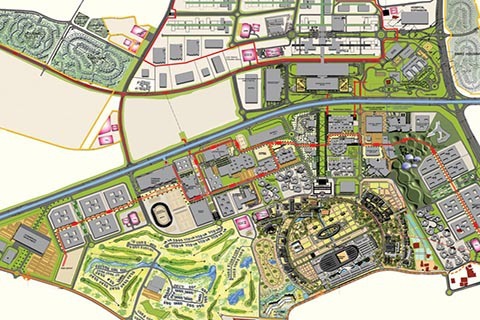
Master plans are among the principal instruments through which urban authorities determine how cities and towns should grow. They can guide the allocation of land for housing, commercial activity, public facilities, transport and other infrastructure, while providing a framework for regulating development.
For Jammu and Kashmir, where expanding settlements must accommodate growing demands on roads, drainage, water supply and public services, the plans are intended to establish a more systematic basis for managing urban growth.
But the progress reported by the department suggests that the process is still largely concerned with establishing the groundwork in many locations, rather than completing plans ready for implementation.
The Anantnag-Bijbehara-Mattan Master Plan-2044 is the most advanced among the plans listed in the departmental statement.
The plan has moved through several preparatory stages, including approval of the inception report, vetting of the base map, data analysis and pre-draft proposals. The draft has since been placed in the public domain, and objections and suggestions are now being scrutinised.
That stage is important because a master plan must reconcile technical assessments with the concerns and requirements of the people and institutions affected by proposed land-use decisions. Public objections can identify local problems, challenge proposed designations or seek changes before the plan is finalised.
The statement does not specify how many objections have been received, how long their scrutiny is expected to take or when the final document will be notified.
Bandipora’s Master Plan-2046 is the next most advanced in the reported process, though it remains behind Anantnag-Bijbehara-Mattan.
Its approach and methodology, revised work plan, base map and field-vetted existing land-use plan have been cleared. A preliminary draft has been submitted and is under scrutiny.
The distinction between the two plans is significant. Anantnag-Bijbehara-Mattan has reached public consultation, while Bandipora’s preliminary draft remains under departmental examination. Both have moved beyond the initial mapping and data-gathering stages, but neither has been reported as finalised.
Pulwama-2046 and Kupwara-2046 have completed their base maps and existing land-use plans. These documents were examined and returned to the consultants with remarks. The departmental statement does not list either town as having reached the draft stage.
The next steps in those cases will depend on how the consultants address the observations and how quickly the revised material can be examined and approved.
A number of towns have progressed through data analysis and the preparation of proposals, but have yet to reach the preliminary-draft stage.
Kulgam, Baramulla, Sopore and Pattan, all with a planning horizon of 2047, have had their data-analysis reports approved, along with proposals examining projected requirements, existing issues and development potential.
These assessments are intended to establish the basis for future land-use decisions by identifying how settlements may expand and what facilities and infrastructure they are likely to require.
Budgam-2047 remains at an earlier stage, with its inception report and base maps approved.
In Ganderbal and Awantipora, data-analysis reports have been examined and remarks sent to the consultants. Shopian’s approved work, according to the statement, is limited to the inception report and base maps.
The differences in progress across the towns point to a workload involving several distinct stages of technical preparation and review. Each plan must move from an initial understanding of the settlement and its boundaries to a more detailed assessment of existing land use, development pressures and future requirements.
The process also involves repeated exchanges between the department and consultants. Maps and reports are examined, observations are communicated, and documents may have to be revised before the next stage can begin.
The departmental statement does not provide individual completion dates for the plans still under preparation. Nor does it set out a town-by-town schedule for moving the remaining documents through scrutiny, consultation and final approval.
Without such milestones, the overall financial-year deadline offers a broad target but little indication of how the department intends to sequence the work in the months ahead.
In Jammu division, several towns are still at the beginning of the planning process.
The inception reports for Akhnoor, Reasi, Ramban, Banihal, Kathua, Samba, R S Pura and Doda have been approved. The reviews of the Katra Master Plan-2031 and Udhampur Master Plan-2032 are also at the inception-report stage.
An inception report generally establishes the scope and methodology of the assignment, along with the proposed approach to collecting and analysing information. Its approval is an early milestone, not an indication that the substantive planning work has been completed.
The position is different in Jammu, where the review of the Jammu Master Plan-2032 is at its final stage.
The department’s statement does not specify the remaining steps in that review or provide a date for its completion. Still, Jammu’s progress contrasts with the early stages recorded for much of the rest of the division.
The review of an existing master plan also differs from the preparation of a new plan. While both require technical scrutiny and decisions about urban development, the review begins with an established planning framework rather than an entirely new document.
The timetable for the 25 plans therefore encompasses assignments that are not directly comparable in terms of their starting points or the work remaining.
Four master plans have already been notified, according to the departmental statement: Srinagar Master Plan-2035 under SRO 160 of 2019; Jammu Master Plan-2032 under SRO 90 of 2017; Udhampur Master Plan-2032 under SRO 91 of 2017; and Katra Master Plan-2031 under SRO 125 of 2016.
These notified plans provide an existing statutory planning framework for the respective areas. The current exercise includes the review of some of those documents, as well as the preparation of plans for other urban settlements.
The distinction matters because preparing a master plan is only one part of urban planning. Once a plan is notified, its practical value depends on how consistently its provisions are applied, how development is regulated and whether the infrastructure required to support projected growth is provided.
The departmental statement focuses on the preparation and review process and does not provide an assessment of how effectively the four notified plans have been implemented.
Nor does it detail the extent to which the proposed plans for other towns will be accompanied by investment schedules or mechanisms for monitoring compliance.
The government has assigned the planning work to a range of academic and technical institutions, with different consultants responsible for different towns.
The Kanwar Surjit Singh Institute for Spatial Planning and Environment Research is listed as the consultant for Anantnag-Bijbehara-Mattan, Bandipora, Pulwama and Kupwara.
The School of Planning and Architecture in Bhopal is listed for Budgam, Kulgam, Sopore, Akhnoor and Reasi. The School of Planning and Architecture in Delhi is listed for Ganderbal and Awantipora, while SPA New Delhi is responsible for the review of the Katra master plan.
Guru Nanak Dev University in Amritsar is listed for Ramban, Banihal, Udhampur, Kathua, Samba, R S Pura and Doda.
The statement does not identify a consultant for every town in the exercise.
The involvement of multiple institutions creates a need for consistent technical standards, particularly where plans are intended to serve the same broader objective of managing urban expansion across J&K.
Differences in methodology, data quality or the pace of submissions could complicate the task of reviewing the plans within a common timeframe. The departmental statement does not describe how such differences are being managed or whether consultants have been given separate deadlines linked to the overall target.
A separate arrangement applies to Rajouri, Poonch and Kishtwar. Their plans are being handled through the Tourism Department because the relevant Development Authorities fall under its jurisdiction. The department is expected to float tenders shortly.
The government has also established an oversight structure for tourism-related planning. Government Order No. 1152-JK(GAD) of 2026, dated July 1, constituted high-level vetting, steering and implementation committees to oversee master plans for 10 Tourism Development Authorities in the first phase.
The arrangement places those authorities within a separate administrative process, rather than the main group of assignments described by the Housing and Urban Development Department.
The expected tendering for Rajouri, Poonch and Kishtwar adds another timetable to an exercise already involving several consultants and different levels of progress.
The financial-year-end target gives the department a clear deadline, but the reported status of the plans shows that reaching it will require substantial movement across several stages of preparation.
Anantnag-Bijbehara-Mattan must complete scrutiny of public objections and suggestions. Bandipora’s preliminary draft remains under review. Pulwama and Kupwara must progress beyond their examined base maps and existing land-use plans, while several other towns are still working through data analysis or earlier preparatory stages.
In Jammu division, most of the listed assignments remain at the inception-report stage, although the review of Jammu’s master plan is nearing completion. Rajouri, Poonch and Kishtwar face a separate process in which tenders are still expected to be issued.
These differences mean that the deadline is not simply a matter of completing the same remaining tasks in 25 locations. Each assignment has its own sequence of technical work, departmental review and, where applicable, public consultation.
The available statement does not indicate whether the government has adopted a detailed schedule to bring all the plans to completion by March 31, or how delays will be addressed if consultants fail to meet the required milestones.
For residents and local authorities, the eventual significance of the exercise will lie in the decisions the plans enable: where development can take place, how infrastructure needs are anticipated and how competing demands on urban land are reconciled.
A completed plan can establish a framework for those decisions, but its effectiveness will depend on implementation and the ability of civic institutions to enforce its provisions.
For now, J&K has set an ambitious target for a planning exercise that remains unevenly advanced. Whether the government can meet it will depend on how quickly the unfinished plans move from preliminary studies and technical scrutiny to final approval — and whether the deadline can be matched by the institutional capacity needed to put them into effect.
About the Author
Mir Suneem is a filmmaker and postgraduate in filmmaking from Jamia Millia Islamia, with a strong interest in editing and narrative craft.