
The boundary between a forest and a neighbourhood can be little more than a line on a map. For a wild animal, it may be a road, a field, a stream, or simply a place where the trees give way to houses.
For the people living nearby, that invisible boundary can become a source of fear.
The Jammu and Kashmir government is now placing greater emphasis on preventing such encounters before they become emergencies, with the minister overseeing forests and wildlife calling for a strategy that protects people without turning wildlife into the casualty of human expansion.
At a review of the Wildlife Department, Javed Ahmed Rana, the minister for Jal Shakti, Forest, Ecology and Environment, and Tribal Affairs, directed officials to introduce safe, non-lethal deterrents to keep wild animals out of residential areas.
The instruction reflects a basic but increasingly consequential question in wildlife management: how can people and animals occupy the same landscape without either being forced to pay the price?
Rana asked the department to identify locations vulnerable to human-wildlife conflict, train local communities in safe responses and strengthen rapid-response teams capable of dealing with wildlife emergencies.
His message was that conflict should be managed before it becomes a confrontation.
“Protecting human lives and conserving wildlife must go hand in hand,” was the principle he laid down, with prevention and community participation at the centre of the approach.
The shift matters because a wildlife encounter is rarely just an encounter between an animal and a person. It is often the final moment in a chain of events: habitat and settlements existing side by side, animals moving through familiar corridors, food or water drawing them toward inhabited areas, and residents suddenly finding themselves confronted with a species they are neither equipped nor trained to handle.
In such moments, instinct can become dangerous.
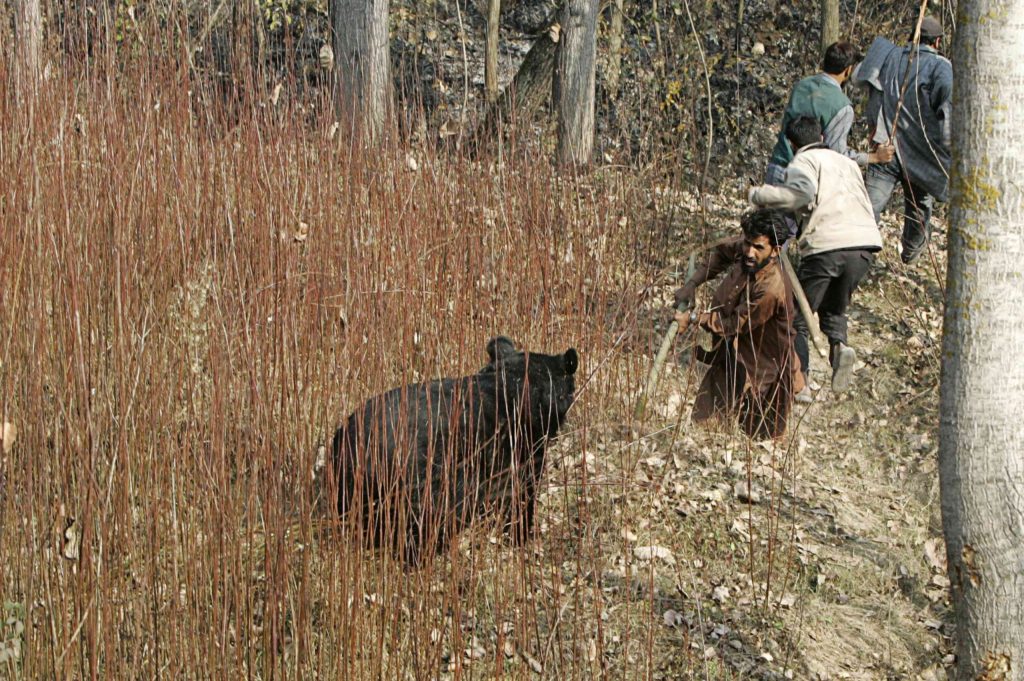
An animal that enters a residential area may be frightened, disoriented, or searching for food. People gathering around it can intensify the situation. Attempts to chase it away can provoke an unpredictable response. For the animal, a journey into a settlement can end with injury, capture or death.
The government’s emphasis on non-lethal deterrence therefore places prevention ahead of confrontation.
The precise measures to be adopted were not specified at Friday’s review. But the minister’s direction makes clear that the department is expected to look beyond emergency rescue operations and develop measures that reduce the likelihood of wildlife entering inhabited spaces in the first place.
That requires another resource besides equipment: local knowledge.
Residents living near vulnerable forest areas are often the first people to notice changes in animal movement. Training communities in how to respond safely can reduce panic, prevent people from approaching or cornering animals, and give wildlife officials valuable time to intervene.
Rana’s call for stronger rapid-response teams is aimed at the other side of that equation — ensuring that when prevention fails, trained personnel can respond quickly.
The review was broader than human-wildlife conflict. Rana examined the functioning of the Wildlife Department and progress on conservation and development projects in the Pir Panjal and Chenab regions, as well as work at Jambu Zoo.
There, the government is pursuing a different kind of relationship between people and wildlife: one based not on avoiding animals but on understanding them.
The minister reviewed plans for new and upgraded animal enclosures, specialised habitats and facilities for rescued wildlife. He directed that the projects be guided by animal welfare, scientific management and conservation.
Plans also include walk-through aviaries, a butterfly park and landscaped green spaces as part of the zoo’s development and master-planning framework.
The ambition is to make the zoo more than a collection of enclosures.
Rana said the facilities should strengthen conservation while encouraging public engagement, suggesting a role for the zoo as a place where children, students, families and visitors can encounter wildlife in a controlled setting and learn about biodiversity.
The government is also looking at the practical experience of reaching the zoo. Walking tracks and battery-operated vehicles are among the visitor facilities under review, while officials have been asked to examine Smart City bus connectivity to improve public transport access.
The objective is partly recreational and partly educational: a more accessible zoo, officials said, could attract more families, students and tourists while giving conservation a wider public audience.
But the contrast between a zoo and a residential neighbourhood is instructive.
Inside a zoo, the relationship between humans and animals is deliberately structured. Boundaries are visible. Habitats are designed. Movement is managed. The risks are understood.
Outside, in the forests, fields and settlements of Jammu and Kashmir, those boundaries are far less certain.
There, conservation has to contend with the ordinary rhythms of human life: homes, farms, roads and expanding communities existing alongside landscapes that wildlife has occupied for generations.
That search for non-lethal deterrents more than a technical exercise. It is an attempt to redraw the boundary without erecting a wall.
The challenge is also cultural. Conservation cannot succeed solely through instructions issued from government offices. It depends on whether people living closest to wildlife understand what to do when an animal appears — and whether they trust authorities to respond.
That is why community participation, rapid response and prevention form a connected strategy.
The minister also praised frontline wildlife staff for their work and urged them to continue strengthening conservation efforts and the department’s broader green mission.
For those officials, the task can be difficult: protecting an animal while managing frightened crowds, securing homes and roads, and sometimes working against the clock.
The government’s latest approach suggests that the measure of success should not simply be how effectively an animal is removed after entering a settlement.
It should also be how often such encounters can be prevented.
That may ultimately require a different understanding of coexistence. Wildlife conservation is often imagined as protecting animals inside forests and sanctuaries. Human-wildlife conflict begins where that protection meets the places where people live.
The space between those two worlds is where the hardest decisions are made.
Jammu and Kashmir’s latest policy direction emphasises making that space safer – for the resident behind the door, for the wildlife moving through the landscape and for the frontline workers asked to manage the fragile boundary between them.
The goal is not to choose between people and animals.
It is to make sure that, when their paths cross, neither has to lose.
About the Author
Syed Sameer Ahmad Nazki is a filmmaker skilled in editing and videography, with an interest in visual storytelling and sports.