
Kashmir Impulse Desk
Leh, July 17
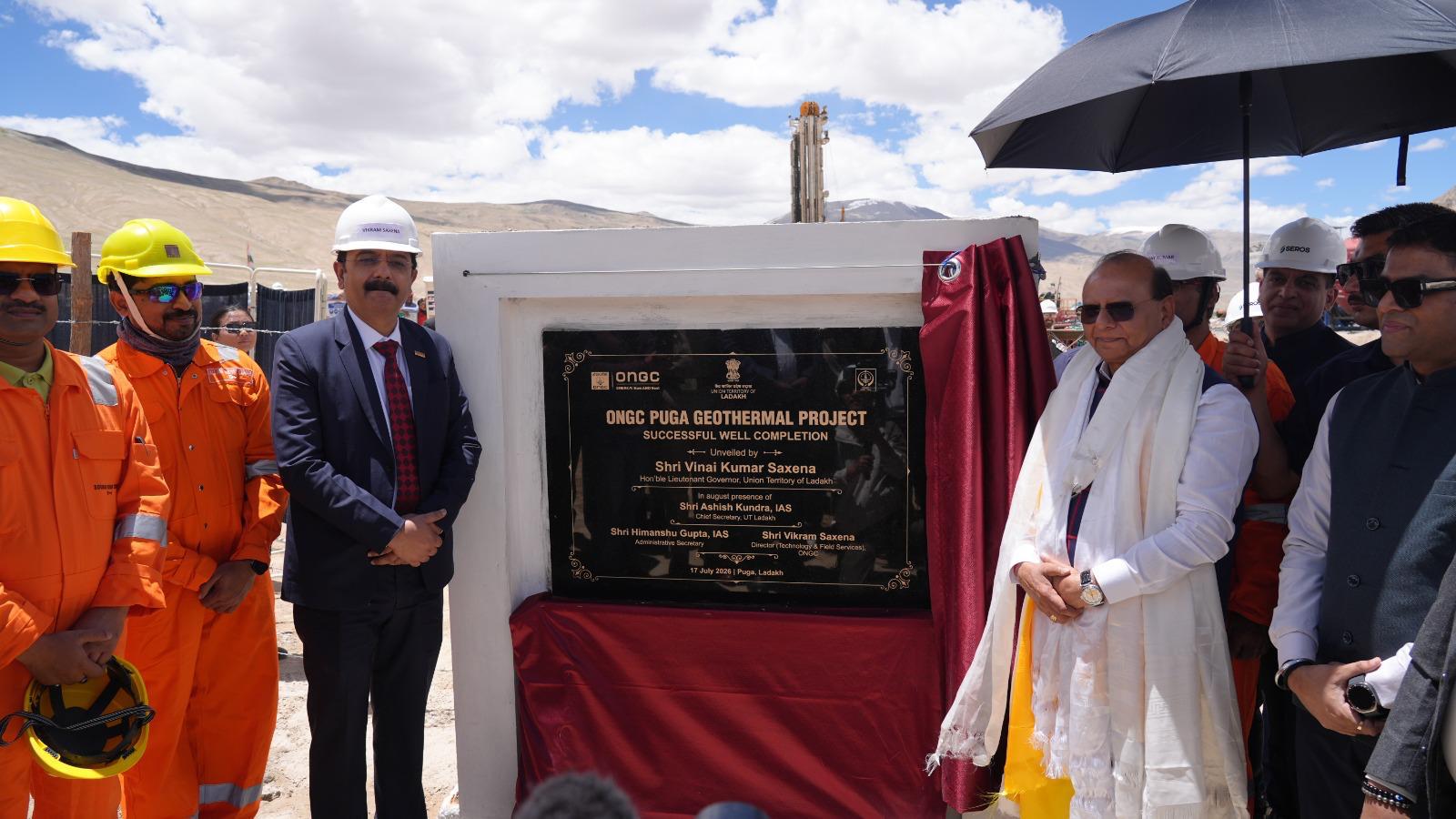
Lieutenant Governor of Ladakh V K Saxena on Friday commissioned India’s first two geothermal production wells in the high-altitude Puga Valley, marking a milestone in the country’s efforts to diversify its renewable energy mix and develop geothermal power as a source of clean electricity.
The two wells, each drilled to a depth of 3281 feet at an altitude of more than 14,000 feet, will support a planned 1-megawatt pilot geothermal power plant that is expected to become India’s first demonstration-scale geothermal electricity project.
The wells were developed by ONGC Energy Centre, the research and development arm of state-run Oil and Natural Gas Corporation.
The project represents a significant step in India’s search for alternative renewable energy sources as the country seeks to expand non-fossil fuel generation and achieve its long-term climate goals.
While India has made rapid progress in solar and wind energy, geothermal power has remained largely untapped despite the presence of geothermal fields in Ladakh, Himachal Pradesh and parts of the Himalayan belt.
Officials said the completion of the wells would enable detailed evaluation of underground geothermal reservoirs and provide the technical data required for designing and operating the proposed pilot power plant.
The project is expected to serve as a proof of concept for future commercial geothermal development in the region.
Engineers involved in the project said temperatures of up to 135 degrees Celsius had already been recorded at a depth of about 400 metres during drilling operations.
Further testing is underway to determine whether higher temperatures exist deeper underground, which could improve the viability and efficiency of geothermal power generation.
The project had faced months of uncertainty after the expiry of a tripartite agreement involving the Ladakh administration, the Ladakh Autonomous Hill Development Council (Leh) and ONGC Energy Centre, delaying work on the pilot plant.
Progress resumed after the agreement was renewed for another five years in June following intervention by the Lieutenant Governor’s office.
Drilling in Puga Valley posed significant engineering challenges because of the region’s extreme weather, rugged terrain, short construction season and active geothermal conditions beneath the surface.
The first well reached its target depth in May, while the second was completed earlier this month in just over a month of drilling.
Addressing the commissioning ceremony, Lieutenant Governor Saxena described the project as a landmark in India’s clean energy transition, saying it would strengthen Ladakh’s energy security while supporting the government’s objective of developing the region as a carbon-neutral territory.
The geothermal initiative is expected to reduce reliance on diesel-based electricity generation in remote Himalayan areas, where transporting conventional fuels is both costly and environmentally challenging.
If the pilot project proves successful, it could pave the way for larger geothermal power developments capable of supplying reliable, round-the-clock renewable electricity to high-altitude settlements that face unique energy constraints.
Unlike solar and wind power, geothermal energy provides continuous baseload electricity regardless of weather conditions, making it an attractive complement to other renewable sources in regions with suitable underground heat resources.
For India, where geothermal energy has remained largely at the exploration stage for decades, Friday’s commissioning marks the country’s most significant step yet towards commercial utilisation of one of its least-developed renewable energy resources.