
There are moments in cricket that belong to a player.
And then some moments seem to belong to an entire place.
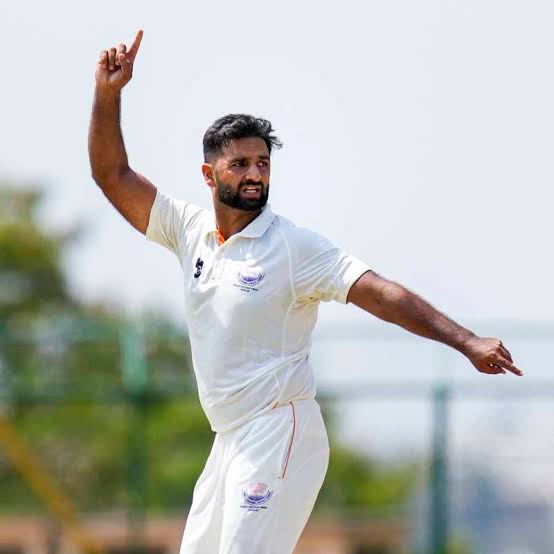
For Auqib Nabi, the phone call that took him into India’s Test squad is both.
The 29-year-old fast bowler from Baramulla has been called into India’s squad for the two-Test series against Sri Lanka after Jasprit Bumrah was ruled out with a knee injury. The first Test begins in Galle on Aug. 15, followed by the second in Colombo from Aug. 23.
Nabi’s selection is historic for Jammu and Kashmir. He is the first cricketer from the region to be included in India’s senior Test squad through the modern domestic pathway.
Now comes the possibility that could make the moment even bigger.
If Nabi is named in the playing XI, he could become the first cricketer developed through Jammu and Kashmir’s contemporary cricket system to make a Test debut for India.
There is a piece of history worth clarifying here. Vivek Razdan, who played two Tests for India beginning in 1989, was born in New Delhi. Nabi’s potential debut would therefore represent a landmark for Jammu and Kashmir’s own cricketing system.
And his selection has not arrived out of nowhere.
The numbers from the Ranji Trophy make a powerful case.
In the 2025-26 Ranji Trophy, Nabi took 60 wickets in 10 matches, finishing as the tournament’s leading wicket-taker. He averaged 12.56, with a strike rate of 28.43 and an economy rate of 2.65. His best figures were 7 for 24.
The season before, he had taken 44 wickets at an average of 13.93, finishing second among the tournament’s wicket-takers.
Across the two seasons, Nabi collected 104 wickets, establishing himself as one of the most prolific red-ball bowlers in Indian domestic cricket.
But the numbers tell only part of the story.
Nabi was central to Jammu and Kashmir’s historic Ranji Trophy triumph in 2025-26 — the state’s first title.
In the semifinal against Bengal, he produced a match-defining performance, taking five wickets for 87 in the first innings and four for 36 in the second. He also contributed 42 runs with the bat.
J&K reached its first Ranji final and went on to win the championship, with Nabi finishing as the tournament’s leading wicket-taker and being named Player of the Tournament.
That achievement transformed his reputation from promising domestic cricketer to serious national prospect.
His rise has been particularly striking because his journey was not built around instant visibility.
Born in Baramulla and raised in a modest family, Nabi has spoken of the hardships of his early cricketing years. Reports have described him borrowing equipment before establishing himself professionally. His father, Ghulam Nabi Dar, is a government-school English teacher.
Nabi grew up admiring South African fast-bowling great Dale Steyn, but his own game has been built around control, movement and consistency rather than spectacle.
He is a right-arm medium-fast bowler capable of swinging the ball both ways and extracting movement from surfaces that do not always offer much assistance.
That skill set has now taken him to the edge of Test cricket.
The IPL has also accelerated his rise.
Delhi Capitals bought Nabi for ₹8.40 crore at the 2026 auction, after an intense bidding contest. He had entered the auction as an uncapped player with a base price of ₹30 lakh and subsequently made his IPL debut.
Yet his path to India has been built primarily on red-ball cricket.
That is significant.
At a time when the IPL dominates the cricketing landscape, Nabi’s selection is a reminder that sustained Ranji Trophy performances can still open the door to the national side.
His success has also become a source of inspiration in Jammu and Kashmir.
The region has produced talented cricketers before, but few have travelled as far as Nabi has in the traditional format.
Parvez Rasool was the pioneer of the modern era.
The Bijbehara-born all-rounder became Jammu and Kashmir’s first major international cricketer, making his India ODI debut against Bangladesh in 2014 and later playing a T20 international against England. He was also the first J&K player to appear in the IPL.
Then came a new generation.
Umran Malik became the most spectacular symbol of Kashmir’s fast-bowling potential, bursting onto the IPL scene with extreme pace and earning an India call-up.
Abdul Samad established himself as a powerful middle-order batter in the IPL, while fast bowlers such as Rasikh Salam and Yudhvir Charak also brought Kashmiri representation to the league.
Nabi represents another stage in that evolution.
His reputation has been forged primarily through first-class cricket, where wickets rather than highlight reels have been his currency.
That makes his potential Test debut especially meaningful.
Test cricket remains the most demanding examination of a cricketer’s temperament and technique. A fast bowler must endure long spells, changing conditions and the physical demands of bowling repeatedly over five days.
Sri Lanka will provide its own challenge.
The heat and humidity can be punishing, while pitches may offer less immediate assistance to fast bowlers than conditions in the subcontinent’s more seam-friendly venues.
But Nabi arrives with something valuable: the confidence of a domestic season in which almost nothing went wrong.
He waited through years of Ranji cricket.
He followed 44 wickets with 60.
He helped Jammu and Kashmir win its first championship.
He entered the IPL auction as an uncapped player and emerged with an ₹8.40 crore contract.
And now India has called.
The final decision will belong to the selectors and team management.
A place in the squad is not the same as a Test cap.
But for Jammu and Kashmir, the significance of the selection is already unmistakable.
Rasool showed that a player from Kashmir could represent India.
Umran demonstrated that the Valley could produce elite pace.
Nabi has taken the next step by turning sustained first-class excellence into a national selection.
The question now is no longer whether Jammu and Kashmir can produce a Test cricketer.
It is whether Auqib Nabi will become the man who walks out in the whites and makes that possibility real.
For a region that has waited decades for its cricketing breakthrough, Galle could become more than the venue of an India-Sri Lanka Test.
It could become the place where Kashmir’s Test story begins.
About the Author
Syed Sameer Ahmad Nazki is a filmmaker skilled in editing and videography, with an interest in visual storytelling and sports.