
In the remote reaches of the Kishtwar Himalayas, where rugged mountains rise above alpine meadows, and wildlife can pass through vast stretches of terrain without being seen, the snow leopard remains one of the region’s most elusive residents.
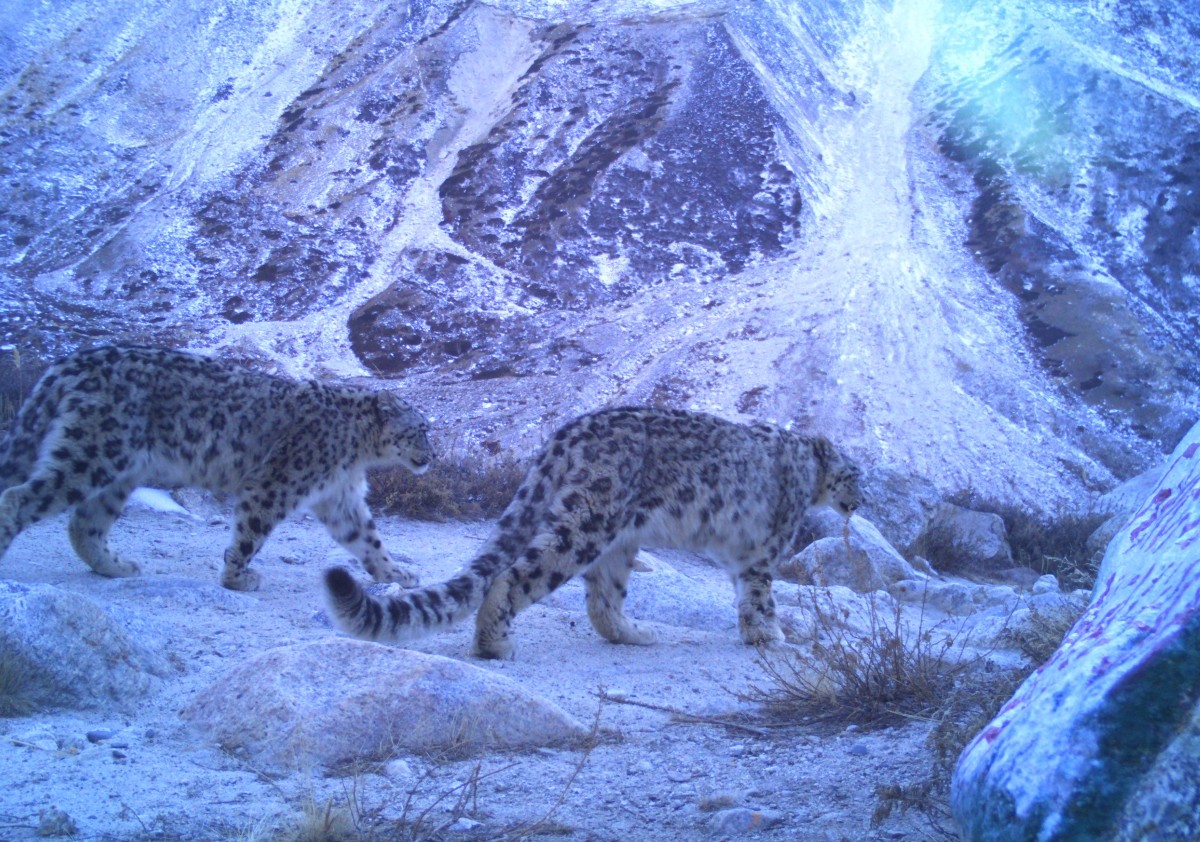
Its presence is often inferred from tracks, scat, occasional sightings and images captured by cameras hidden along mountain trails. Counting the animal is difficult; understanding how it moves through its habitat, how populations are connected and how they respond to human activity is harder still.
Now, a renewed push for scientific monitoring could help close some of those gaps in Jammu and Kashmir, where research has suggested that the snow leopard population may be larger than an earlier nationwide assessment indicated.
India is moving towards a more intensive framework for studying the Himalayan cat, combining population estimation with tools such as camera trapping, radio telemetry and genetic analysis. The approach was highlighted at a Russia-India roundtable on snow leopard study and conservation held in Moscow last month, where officials from the Ministry of Environment, Forest and Climate Change and the Wildlife Institute of India presented advances in scientific monitoring.
For Jammu and Kashmir, whose high-altitude landscapes form part of the snow leopard’s western Himalayan range, the initiative offers an opportunity to improve understanding of a species that is difficult to observe and increasingly exposed to environmental and human pressures.
The challenge is not simply to establish how many snow leopards remain. Conservationists also need to know where the animals live, how far they travel, whether populations are connected across mountain ranges and how their habitat is changing.
Those answers could shape decisions on habitat protection, livestock grazing and the management of encounters between people and wildlife.
The first nationwide Snow Leopard Population Assessment in India, known as SPAI, estimated nine snow leopards in Jammu and Kashmir. Subsequent camera-trap research, however, has pointed to the possibility of a larger population.
Studies covering around 12,000 square kilometres of the Union Territory identified potential snow leopard habitat and estimated the presence of up to 20 individuals. The landscape includes the Kishtwar Himalayas, particularly Paddar, Warwan and Kishtwar High Altitude National Park.
The difference between the estimates underscores the difficulty of studying a species spread across remote, rugged terrain. A population estimate is not a simple count of animals encountered during fieldwork. It depends on the geographical area surveyed, the methods used, the period of observation and the ability to account for animals that remain undetected.
Camera traps can provide photographic evidence of individual animals and help researchers identify patterns of distribution. But cameras cover only selected locations, and a photograph from one mountain trail offers a limited view of a much larger landscape.
The emerging picture in Jammu and Kashmir therefore remains incomplete. The estimate of up to 20 animals from subsequent research suggests that the earlier figure may not capture the full extent of the population, but the estimates should not be treated as directly interchangeable without accounting for differences in survey design and methodology.
A second phase of the Snow Leopard Population Assessment, SPAI 2.0, is now being initiated by the government. The exercise is expected to improve the understanding of the species’ status and distribution across the Union Territory’s high-altitude habitats.
A more detailed assessment could help establish a stronger baseline against which future changes can be measured. It could also identify areas where monitoring needs to be intensified and where conservation resources may have the greatest impact.
Snow leopards are notoriously difficult to study. They inhabit high-altitude environments where steep slopes, harsh weather and limited access make fieldwork expensive and logistically demanding. Their elusive behaviour compounds the problem.
Scientific tools can help researchers move beyond isolated sightings towards a more systematic account of the animals and the landscapes they use.
Camera trapping remains one of the most practical methods. Cameras placed along routes used by wildlife can capture images without requiring researchers to be present. Repeated observations can help establish where snow leopards occur and, when individual animals can be distinguished, contribute to estimates of population size and movement.
Radio telemetry can provide a different kind of information. By fitting an animal with a tracking device, researchers can follow its movements and investigate how it uses habitat over time. Such information can reveal the extent of its range, identify important movement corridors and show whether animals regularly approach settlements or grazing areas.
Genetic analysis offers another layer of evidence. Samples collected from sources such as scat or hair can help identify individuals, assess genetic diversity and investigate relationships between populations. In landscapes divided by mountain barriers or human activity, that information can be important in understanding whether animals remain connected or are becoming isolated.
Each technique has limitations. Camera traps do not record every animal, tracking requires specialised equipment and careful handling, and genetic studies depend on collecting and analysing suitable samples. Together, however, these methods can provide a more comprehensive picture than any one approach alone.
For Jammu and Kashmir, where large areas of potential habitat are remote and conventional monitoring is difficult, combining methods could be especially valuable.
The objective is to move from knowing that snow leopards inhabit particular mountain ranges to understanding how the population is distributed across them, what it needs to survive and how those needs may be changing.
Better information is arriving at a time when snow leopard habitats face several pressures.
Livestock grazing can bring domestic animals into direct contact with wildlife and intensify competition over available pasture. Habitat disturbance can reduce the suitability of important areas, while encounters between snow leopards and livestock may create conflict for communities whose livelihoods depend on their animals.
Wild prey is central to the snow leopard’s survival. Changes in prey availability can affect where the predator hunts and how it moves through a landscape. Where livestock and wild herbivores use the same grazing areas, understanding these relationships becomes an important part of conservation planning.
The pressures are not confined to the animals themselves. Communities living in high-altitude areas rely on the same landscapes for grazing and other livelihood activities. Conservation measures that fail to account for those needs may be difficult to sustain.
Scientific monitoring could help authorities identify where snow leopards and livestock are most likely to overlap, which areas are especially important for wild prey and where conflict-prevention measures may be needed.
That could support more targeted interventions rather than treating the entire landscape as if it faced the same risks.
Climate change presents a further concern. Changes in temperature, snow cover and vegetation can alter the distribution of suitable high-altitude habitat. As ecological conditions shift, snow leopards may face changes in prey availability and in the areas where they can survive.
There are also concerns that common leopards, which can adapt to a wider range of environments, may move into areas previously dominated by snow leopards as conditions change. Such shifts could alter interactions between the two predators and add to the uncertainty surrounding the future distribution of the snow leopard.
The scale and effects of these changes in Jammu and Kashmir will require careful study. Improved monitoring could help researchers distinguish established patterns from emerging trends and identify areas where further investigation is necessary.
The Moscow roundtable brought an international dimension to India’s efforts.
Organised through a partnership between the Interregional Association ‘Irbis’ and the International Big Cat Alliance, the meeting sought to strengthen cooperation in snow leopard research and conservation. Discussions focused on scientific study, monitoring methods and collaborative approaches to protecting the threatened species.
International cooperation matters because the snow leopard’s range extends across national boundaries and includes some of the most difficult terrain in the world to survey. Research methods developed in one landscape may offer useful lessons for another, while collaboration can help improve the consistency of monitoring and the exchange of scientific knowledge.
For India, the discussions also provided an opportunity to present its efforts to use more advanced tools in wildlife assessment.
But the value of international meetings will ultimately depend on what follows in the field. Monitoring frameworks require trained personnel, sustained funding, equipment, reliable data collection and the ability to turn research findings into conservation decisions.
In J&K, the immediate priority is to establish a clearer understanding of the population and its distribution. Over time, repeated assessments could help reveal whether the species is maintaining its range, shifting into new areas or becoming more restricted.
The data could also guide the identification of important habitat corridors and areas where human activity needs to be managed more carefully.
A population estimate is an essential starting point, but it is not a conservation strategy in itself.
Even a more accurate count will have limited value unless authorities use the findings to protect habitat, monitor changes in prey populations and address the sources of conflict between wildlife and people.
For areas such as Paddar, Warwan and Kishtwar High Altitude National Park, scientific evidence could help establish which locations are most important to the snow leopard and how those areas connect with surrounding high-altitude landscapes.
Monitoring could also provide a basis for assessing the effects of grazing pressure and other disturbances. If researchers can identify recurring conflict areas, authorities may be better placed to work with local communities on practical measures to protect livestock and reduce retaliatory responses to wildlife attacks.
Such measures would need to reflect local conditions rather than rely on a uniform approach across the region. The needs of pastoral communities, the availability of wild prey and the character of individual habitats can vary considerably between mountain valleys.
Genetic information could add another dimension by helping scientists assess whether populations are sufficiently connected to maintain diversity. Movement data could reveal whether seemingly separate groups use overlapping ranges or depend on corridors that may be vulnerable to disruption.
These are questions that a single survey cannot answer. They require repeated observations and long-term scientific monitoring.
SPAI 2.0 could provide an important step towards that broader understanding, although the scale of its contribution will depend on the methods deployed and the coverage achieved across the Union Territory.
J&K’s snow leopards remain difficult to count, but the scientific effort to understand them is becoming more systematic.
The first nationwide assessment offered an initial estimate of nine animals in the Union Territory. Subsequent research suggested that the number could be higher, with up to 20 individuals estimated across identified habitat. The new assessment phase is expected to refine that picture and strengthen knowledge of the species’ distribution.
For researchers, the task extends beyond resolving a numerical discrepancy. They must establish where the animals live, how they move through the mountains, whether their populations remain connected and how their habitats are responding to environmental change.
For authorities, the challenge will be to translate that evidence into action: protecting high-altitude habitat, limiting avoidable disturbance and working with communities whose livelihoods intersect with the snow leopard’s range.
The cat’s elusive nature has long made it difficult to observe. Its future, however, will depend on more than the occasional image captured by a camera in the mountains.
The emerging scientific framework offers a way to replace scattered glimpses with a more complete understanding of the species. Whether that knowledge can secure its future in Jammu and Kashmir will depend on what happens after the cameras are retrieved, the samples analysed and the estimates published.
About the Author
Zafer Iqbal is a cinematographer with a keen interest in international politics, bringing a visual perspective to global affairs and their shifting landscapes.