
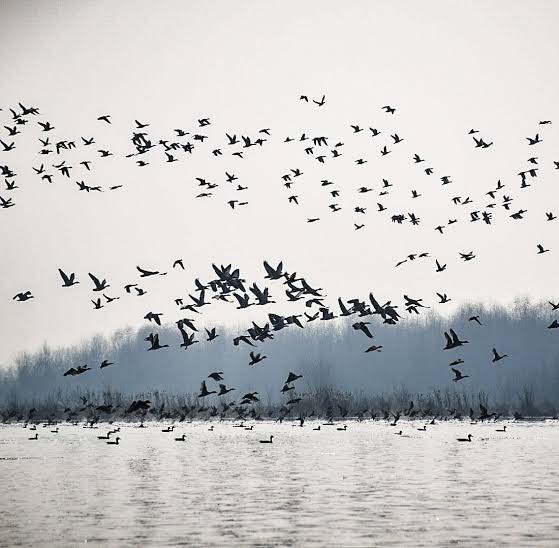
Four wetlands dominate Kashmir’s winter bird landscape, hosting nearly 96 percent of the 1.34 million birds recorded during the Asian Water Bird Census 2025, according to data disclosed by the Department of Wildlife Protection in response to a Right to Information (RTI) application.
The census recorded 1,343,506 birds belonging to 87 species across the wetlands covered in Kashmir. Hokersar, Shallabugh, Wular Lake and Hygam accounted for the overwhelming majority of the birds, underscoring their importance as winter habitats for migratory waterbirds.
Hokersar recorded approximately 403,000 birds, followed by Shallabugh with 396,000, Wular Lake with 296,000 and Hygam with 199,000. An analysis of the Wetlands Division’s site-wise figures, published by Greater Kashmir, found that the four sites together held about 96 per cent of the total recorded population.
The figures were supplied in response to an RTI questionnaire filed by activist M.M. Shuja.
The concentration of birds at a handful of wetlands highlights their central role in sustaining Kashmir’s winter avian population. It also raises questions about the condition of smaller wetlands, where bird counts were substantially lower.
Mirgund recorded approximately 23,000 birds, while Dal Lake had around 13,400. Chatlam recorded about 3,600 and Anchar Lake, which has been struggling with encroachment and pollution, registered only around 1,160.
Counts at Kranchoo, Freshkhoori and Manibugh were smaller still, with only a few hundred birds at each site.
The figures offer a snapshot of a winter landscape shaped by the availability of suitable habitat, food and water. They also reveal how heavily the region’s recorded waterbird population depends on a small number of wetlands.
Among the 87 species recorded, the Eurasian Teal, locally known as Keos, was the most numerous.
The census counted approximately 292,000 Eurasian Teals, representing about 22 per cent of the total bird population. In other words, roughly one in every five birds recorded belonged to this species.
One of the smallest shallow-water ducks, the Eurasian Teal breeds across northern Eurasia and arrives in Kashmir during winter, often in large flocks. The region’s wetlands provide important feeding and resting grounds during its seasonal migration.
Hokersar alone accounted for approximately 136,000 of the teals recorded, making it a particularly significant site for the species.
The Mallard was the second most numerous bird, with about 226,000 counted. It was followed by the Northern Shoveler, at approximately 210,000; the Northern Pintail, at 167,000; and the Gadwall, at 139,000.
Together, these five species accounted for roughly 1.03 million birds, or about 77 per cent of the total recorded population.
The dominance of these ducks illustrates the importance of Kashmir’s wetlands as wintering grounds for waterfowl that migrate across large parts of Eurasia. Their numbers also mean that changes in habitat conditions at major sites could affect a substantial share of the birds counted in the region.
Other species were present in significant numbers. The census recorded approximately 101,000 Eurasian Moorhens, 93,400 Eurasian Coots and 72,400 Eurasian Wigeons.
Hokersar alone hosted around 63,700 Eurasian Coots, again demonstrating the concentration of particular species at individual wetlands.
The count also included approximately 17,500 Grey-headed Swamphens, a marsh-dwelling bird associated with wetland vegetation.
Common Pochards, Greylag Geese and Red-crested Pochards were recorded in the thousands, while several other species appeared only in small numbers.
The census table listed just two Common Mergansers and two Baillon’s Crakes. It also recorded a single Pallas’s Fish-Eagle, 16 Bar-headed Geese, 239 Marbled Teals and 90 Ferruginous Pochards.
The list extended beyond waterfowl. Birds of prey and other species associated with wetland and riverside habitats included the Peregrine Falcon, Western Marsh Harrier, Black Kite, White-capped Water Redstart, Brown Dipper, kingfishers and wagtails.
Their presence reflects the varied habitats encompassed by Kashmir’s wetland ecosystems, which support not only ducks and geese but also predators and other birds dependent on aquatic environments.
In its RTI response, the Wetlands Division said official censuses had consistently recorded between 1.2 million and 1.3 million migratory waterbirds annually.
The department cited these recurring counts as an indicator of what it described as the “ecological recovery” of the wetlands. It attributed the improvement, in part, to management and restoration work, including the removal of approximately 120,000 cubic metres of silt through auction-based desilting.
Other interventions, the department said, included the clearance of weeds and reeds, construction of new embankments and sluice gates, and restoration of peripheral channels at Hokersar.
Such measures can influence the availability and distribution of water, open-water areas and feeding grounds – factors that help determine whether wetlands can support migratory birds through the winter.
The census, however, provides a count of birds recorded at the surveyed sites. By itself, it does not establish how much of the reported population reflects long-term ecological improvement, changes in the distribution of birds between wetlands or other factors affecting annual counts.
Nor do the totals alone provide a complete picture of the health of each wetland. Bird numbers are one indicator of ecological conditions, but a fuller assessment would also require information on habitat quality, water levels, pollution, vegetation, disturbance and the availability of food.
The difference between the four major sites and the smaller wetlands is particularly striking. While Hokersar and Shallabugh each recorded close to 400,000 birds, Anchar Lake had just over a thousand.
The disparity does not, on its own, explain why bird numbers vary so widely. Wetland size, habitat characteristics, seasonal water conditions and the suitability of feeding and roosting areas can all influence how birds use individual sites. Establishing the reasons for the differences would require site-specific ecological assessments and comparisons across multiple years.
Still, the figures underline the importance of the largest wetlands in sustaining the region’s recorded winter bird population.
Anchar Lake’s count of approximately 1,160 birds stands out against the hundreds of thousands recorded at Hokersar, Shallabugh, Wular and Hygam.
The lake has faced pressure from encroachment and pollution, problems that can degrade wetland habitat and restrict the space available to wildlife. Its low count in the 2025 census adds to the questions surrounding the condition of smaller and more vulnerable wetland ecosystems.
But a single census figure cannot determine whether the lake’s bird population has declined over time. That would require comparable historical counts, together with information on survey coverage, water conditions and seasonal bird movements.
The same caution applies to wetlands such as Kranchoo, Freshkhoori and Manibugh, where only a few hundred birds were recorded. Low counts can reflect differences in habitat and the timing or distribution of migrating flocks, as well as ecological pressures.
The site-wise data nevertheless provide a useful baseline for identifying wetlands that may warrant closer monitoring and conservation attention.
For wildlife managers, the challenge is not simply to maintain high bird counts at the four dominant sites, but also to understand the conditions that make those wetlands attractive to migratory species and whether similar habitat functions can be protected elsewhere.
The scale of the recorded population makes the stakes considerable. More than a million birds were counted across the surveyed wetlands, with most concentrated in four locations. The health of those sites is therefore central to the region’s capacity to support wintering waterbirds.
The figures also offer a way to measure future changes. Repeated surveys using consistent methods can help establish whether populations are stable, whether particular species are becoming more or less common, and whether restoration measures are associated with changes in bird use.
The Eurasian Teal’s position at the top of the 2025 count is one clear feature of this year’s snapshot. Its approximately 292,000 birds accounted for more than a fifth of the total, while the five most numerous species together represented about three-quarters of all birds recorded.
Behind those totals lies a more uneven picture of Kashmir’s wetlands: a handful of sites supporting the vast majority of the birds, and several others registering much smaller numbers.
The Department of Wildlife Protection says desilting, vegetation clearance and improvements to water-control infrastructure have contributed to ecological recovery. The census provides evidence of a large and recurring winter bird presence. Determining the extent of that recovery, however, will depend on whether the numbers are accompanied by sustained improvements in habitat quality across the wider wetland network.
For now, the 2025 count offers both a measure of abundance and a reminder of concentration. Kashmir’s winter bird spectacle remains substantial, but its recorded numbers depend overwhelmingly on four wetlands – places whose ability to hold water, sustain food supplies and provide undisturbed habitat will be critical to the seasons still to come.
About the Author
Syed Sameer Ahmad Nazki is a filmmaker skilled in editing and videography, with an interest in visual storytelling and sports.