
A patient should not have to reach the billing counter to discover the price of a medical test. Yet for many families in Jammu and Kashmir, the cost of an MRI scan, blood investigation or pathological examination remains an uncertainty added to the anxiety of illness.
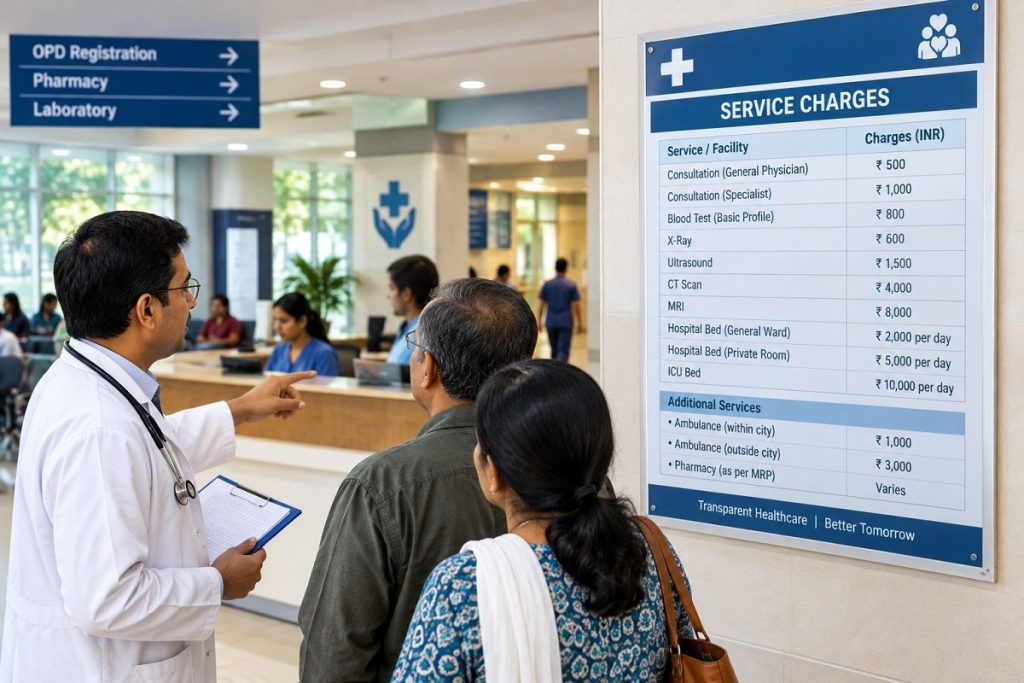
The Centre has now directed states and Union Territories to ensure that hospitals and clinical establishments prominently display their charges. The principle is simple: patients deserve to know what healthcare will cost before they pay for it.
But transparency is not affordability. A price displayed on a hospital wall may eliminate an unpleasant surprise without making treatment any cheaper. For Jammu and Kashmir, where a government initiative to standardise diagnostic rates remains unfinished, the distinction is critical.
The directive should be welcomed, but it must not be mistaken for a solution to the larger problem.
The Union Health Ministry has asked authorities to review compliance with the Clinical Establishments (Registration and Regulation) Act, 2010, and the accompanying rules. In jurisdictions covered by the law, establishments must display rates prominently in English and the local language.
The objective is to help patients understand the likely cost of services, plan their expenditure and reduce disputes over bills. Implementation and enforcement rest with the respective states and Union Territories.
These are reasonable expectations. Patients should not have to negotiate for basic information about charges, nor should families discover unexpected costs after a medically necessary procedure has been completed.
Yet a disclosure requirement is only as effective as its enforcement. A rate list hidden behind a counter, written in inaccessible language or left outdated would satisfy neither the spirit nor the purpose of the directive. Authorities must ensure that prices are visible, current, comprehensible and available before services are provided.
Visibility is not affordability.
The distinction becomes especially important in Jammu and Kashmir, where the Health and Medical Education Department constituted a committee in January 2025 to regulate and standardise rates for diagnostic tests and pathological examinations at private laboratories.
The committee was tasked with considering costs, including medical equipment, instruments and procurement, while developing a framework intended to make diagnostic services more affordable and accessible. Yet a rate list has still not been issued, according to the information available about the initiative.
That delay deserves an explanation.
Reports have cited MRI charges ranging from Rs 6000 to Rs 13,000 at some private diagnostic centres. Such variation can impose a substantial burden on families already paying for consultations, medicines, transport and follow-up treatment.
The difference alone does not prove that providers are charging unfairly. Equipment, technology, service quality and the precise examination being offered can influence costs. But patients cannot assess those differences if prices remain difficult to obtain or compare.
The government must therefore distinguish between two responsibilities: requiring providers to disclose their existing prices and determining whether those prices need further regulation.
The Centre’s directive addresses the first. It does not impose a uniform rate for every investigation, nor does it establish that any particular charge is reasonable.
That limitation should not diminish the measure’s value. Clear pricing can give patients a basis for comparing facilities where alternatives are available, asking doctors about clinically appropriate options and questioning unexplained differences. It can also help regulators identify discrepancies between advertised charges and final bills.
But the ability to compare prices is not the same as the freedom to choose. A patient needing an urgent scan may have little time to visit multiple centres. Someone living far from a well-equipped facility may have no realistic alternative. A lower-priced test is of little use if the provider cannot offer the required service.
Transparency can improve decisions only where meaningful choices exist.
Regulation needs evidence.
Private diagnostic centre associations have opposed uniform rates, arguing that laboratories differ in equipment, maintenance costs and the expertise needed to operate their facilities. These concerns warrant examination rather than dismissal.
A poorly designed price cap could fail to account for legitimate differences in technology and service provision. Conversely, invoking cost differences without transparent information makes it difficult to assess whether price variations are justified.
The answer is neither automatic uniformity nor unrestricted opacity. The government needs a credible process based on evidence, consultation and clearly defined criteria. It should examine the costs of comparable investigations, the services included in quoted prices and the extent to which differences reflect genuine variations in quality or operating expenses.
The committee formed in January 2025 should publish its progress, explain the outstanding issues and provide a timetable for completing its work. If further data or consultations are needed, the government should say so. An exercise intended to improve affordability cannot remain indefinitely without a public outcome.
Meanwhile, authorities should enforce existing disclosure requirements without waiting for the standardisation process to conclude. These are complementary measures, not competing choices.
Hospitals and diagnostic centres must display charges where patients can readily see them. They should clearly identify what each price covers and disclose relevant additional costs. Regulators should provide an accessible mechanism for complaints and investigate cases in which bills differ from advertised rates without adequate explanation.
The government, too, must be accountable for the implementation it demands. Issuing instructions is the beginning of regulation, not proof that regulation is working.
For patients, the immediate benefit of transparent pricing is predictability. Knowing the cost in advance can help families plan expenditure and ask informed questions. But the larger test is whether healthcare becomes more accessible without compromising quality.
Jammu and Kashmir now has an opportunity to address both concerns: make existing charges visible immediately and complete the harder examination of diagnostic rates.
A price list cannot guarantee affordable healthcare. But patients should never be left guessing what care will cost, and governments should not confuse informing people about high prices with making those prices reasonable.
The bill must be visible. The burden it places on patients must also be examined.
About the Author
Bisma Rafiq is interested in human resources and its role in improving journalism and media organisations. She is also a passionate storyteller.