
When Mushk Budji rice was fetching Rs 20,000 to Rs 25,000 a quintal, Jalaludin Sheikh thought he had found a crop worth betting on.
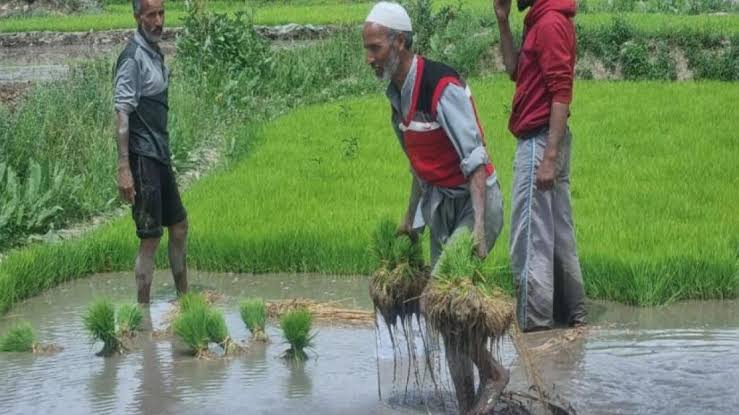
The 59-year-old farmer from Danwethpora, in south Kashmir’s Kokernag area, began cultivating the aromatic rice on two kanals in 2017. Over the next seven years, he steadily expanded his fields, reaching seven kanals by 2024.
This year, he planted something else.
“I am unable to sell even last year’s stock, so I decided not to cultivate Mushk Budji this year. I will stick to conventional rice instead,” Sheikh said.
His decision is more than an individual calculation. Across Sagam, Danwethpora and Tangpawa, the traditional heartland of Mushk Budji, farmers are beginning to make the same choice.
A rice once associated with premium prices and hopes of a revival is now confronting a very different reality: prices have fallen to between Rs 8000 and Rs 10,000 a quintal, farmers say, while large quantities of the previous harvest remain in storage.
For a crop whose revival was supposed to turn a fading agricultural tradition into a valuable specialty product, the reversal has been sharp.
Nearly 800 quintals of last year’s Mushk Budji crop remain unsold, according to Haji Ghulam Qadir Wani, chairman of the Sagam Mushk Budji Farmer Producer Company Limited.
“Prolonged storage could affect the quality of the rice,” said Wani, 60, who has himself reduced cultivation from 10 kanals to seven.
The number of families cultivating Mushk Budji in the traditional belt has fallen, too. From roughly 750 families previously, Wani estimates that only about 450 are growing it this year. Many have also reduced the acreage devoted to the crop.
The economics have become difficult to ignore.
Manzoor Ahmad Mir, 65, cultivates Mushk Budji on four kanals. He also sells his own produce and rice purchased from other growers at his shop in Sagam. Once, he could sell the rice for Rs 250 to Rs 275 a kg. Now, he said, even Rs 160 is difficult to obtain.
“I used to sell it for Rs 250 to Rs 275 a kilogram. Now I struggle to get even Rs 160. My stock is still unsold and may get spoiled,” Mir said.
For farmers, the problem is not simply a falling price. It is the collapse of the premium that once justified growing a crop that requires a market willing to recognise its distinct qualities.
Mushk Budji is prized for its distinctive aroma, subtle sweetness and smooth texture. In Kashmiri tradition, it has a ceremonial place, often served to the groom and the baraatis during Wazwan.
Yet in the villages where it has been grown for generations, that cultural value is proving harder to translate into commercial value.
The current downturn comes after nearly two decades of attempts to revive Mushk Budji.
Cultivation of the traditional variety had declined dramatically after rice blast affected the crop in Kashmir in the 1960s. By the early 2000s, Mushk Budji was no longer the force it had once been.
In 2007, the Agriculture Department, together with Sher-e-Kashmir University of Agricultural Sciences and Technology of Kashmir, began a revival programme. Farmers received seed, crop-protection inputs and technical guidance.
Cultivation began picking up again in Sagam around 2010.
By 2017, roughly 500 farmers were growing the variety. Local farmers say the number across Anantnag district had climbed to around 2000 by 2024, with much of the expansion concentrated around Kokernag.
Then came a moment that appeared to promise an even brighter future.
Mushk Budji received a Geographical Indication tag in July 2023.
For growers, the GI tag was supposed to provide something the crop had lacked: a recognisable identity that could distinguish the authentic rice from cheaper substitutes, strengthen its brand and open new markets.
Instead, farmers say, the expected transformation has yet to arrive.
Mushk Budji was traditionally cultivated in Sagam, Danwethpora and Tangpawa. By 2020, cultivation had spread to Nagam, Chawalgam, Lisser, Booch, Hilad Bahi and Peer Taiya in Kokernag.
More recently, under government agricultural programmes, including the Holistic Agriculture Development Programme and the Jammu and Kashmir Competitiveness Improvement in Agriculture and Allied Sectors project, cultivation has expanded beyond Kokernag to areas including Dooru, Chattergul-Shangus, Kulgam and Budgam.
That expansion was intended to increase production and bring more farmers into the value chain.
But farmers in Sagam see a different consequence.
They argue that rice grown outside the traditional belt does not necessarily possess the same aroma, taste or quality as the original crop.
“The climatic conditions of Kokernag, particularly the Sagam belt, are ideal for Mushk Budji. Conditions outside this area are different. The crop there is not of the same quality, aroma and taste,” Wani said.
That distinction matters in a market where the GI tag is supposed to protect geographic identity.
Farmers also allege that cheaper rice from outside the traditional production area is sometimes sold as Mushk Budji, making it difficult for consumers to tell what they are buying.
“If customers in Srinagar are getting it from Budgam at Rs 8,000, why would they purchase it from here for Rs 20,000?” asked Muhammad Shafi Wani, 55, who grows Mushk Budji on four kanals.
“Only people who know the aroma and taste can understand the quality,” he said.
For growers, the result is a peculiar contradiction: the crop has acquired a formal identity through a GI tag at precisely the moment when its informal identity in the marketplace is becoming harder to defend.
They want Sagam, Danwethpora and Tangpawa recognised and protected as the core production belt. They also want the GI designation to be used in a way that clearly distinguishes authentic Mushk Budji from rice grown elsewhere.
There is another, more practical obstacle.
Sagam does not have a dedicated rice mill for Mushk Budji.
Farmers say the absence of local processing infrastructure makes it harder to maintain quality, package the rice professionally and build a recognisable product.
“We need a dedicated rice mill in Sagam. It would help us process and package the rice here and maintain its quality,” Wani said.
The Sagam Mushk Budji Farmer Producer Company Limited was established with precisely these ambitions: production, processing, branding and marketing.
But farmers say Rs 10 lakh earmarked for the organisation has not yet been released. They want the money used to establish a dedicated milling facility.
For a crop whose marketability depends partly on preserving its distinctive characteristics, the lack of a local processing chain is a problem that extends beyond convenience.
The farmer producer company also tried to look beyond India.
Zafar Ahmad, its 38-year-old chief executive officer, said the organisation pursued a memorandum of understanding to export about 20 tonnes of Mushk Budji annually to Japan.
The proposal did not materialise.
“We increased cultivation expecting better markets, but that support has not come,” Ahmad said.
Ahmad cultivates Mushk Budji on 13 kanals in Tangpawa. If the situation does not improve, he said, he too may switch entirely to conventional rice.
The irony is difficult to miss. The farmers who increased cultivation in anticipation of a larger market are now among those contemplating abandoning the crop because that market has failed to materialise.
The Agriculture Department says it recognises the marketing problem.
Chief Agriculture Officer Anantnag Shahnawaz Hussain Shah said the issue had been discussed with Agriculture Minister Javed Ahmed Dar. The department, he said, is trying to make the crop more commercially viable and eventually export-oriented.
“We are trying to streamline the marketing of this aromatic crop. We are exploring options to make this variety export-oriented and global,” Shah said.
The department has been showcasing Mushk Budji at exhibitions across India and connecting farmers with traders, he said.
It also plans to expand cultivation to additional areas, with the stated aim of increasing production and benefiting more farmers.
Shah said a dedicated rice mill would also be constructed in Sagam to support local processing and marketing.
The challenge is that expansion may solve one problem while worsening another.
If more land is brought under Mushk Budji without a corresponding increase in demand, the supply problem could become more acute. And if production spreads into areas where farmers believe the crop does not acquire the same qualities as the traditional variety, the very premium that gives Mushk Budji its value could become harder to sustain.
For farmers in Sagam, the priority is therefore not simply producing more rice. It is producing, identifying, processing and selling the right rice at a price that makes cultivation worthwhile.
Mushk Budji’s public profile has grown in recent years.
In May 2023, ahead of the third G20 Tourism Working Group meeting in Srinagar, the rice was showcased alongside Kashmir’s saffron, honey and exotic vegetables — a presentation of the region’s agricultural heritage to an international audience.
The GI tag followed soon after.
But branding alone cannot keep a crop in the field.
In Sagam, the story is being measured in kanals abandoned, quintals left in storage, and farmers calculating whether the next harvest is worth planting.
For Sheikh, the calculation has already been made.
The fields where he once grew seven kanals of Mushk Budji will instead carry conventional rice.
That decision captures the central problem confronting the variety. The revival succeeded in persuading farmers to plant again. It encouraged expansion, created new cultivation areas and gave Mushk Budji a formal geographical identity.
But the market did not keep pace.
A GI tag can tell consumers where a product comes from. It cannot, by itself, guarantee that consumers will pay a premium for it. A government programme can increase cultivation. It cannot ensure that a farmer will find a buyer at harvest.
And a celebrated agricultural tradition can survive culturally while becoming increasingly difficult to sustain economically.
For now, Mushk Budji remains a symbol of Kashmir’s distinctive food culture – aromatic, ceremonial and deeply rooted in the landscape around Kokernag.
But in the villages where its future is being decided, farmers are asking a more immediate question.
If last year’s rice is still sitting unsold, why plant this year’s crop?
Until that question has a convincing answer, the story of Mushk Budji’s revival may become a story of retreat instead.
The crop that once drew farmers toward larger fields is now pushing some of them back toward conventional rice – not because they have forgotten its value, but because the market has.
About the Author
Tabish Khan is a multimedia journalist and postgraduate in Convergent Journalism, working across text, video, social media, and digital storytelling.