
Every morning, Srinagar wakes to a familiar choreography.
Garbage is collected from neighbourhoods, carried through the city and moved toward dumping grounds. Plastic, food waste, packaging and household refuse accumulate somewhere outside the immediate view of most residents.
But the city’s waste problem does not end when the garbage truck leaves.
It is only beginning.
Jammu and Kashmir generates more than 1470 tonnes of municipal solid waste every day. Yet less than one-fifth of that waste is scientifically treated.
The figures, submitted by the Union Ministry of Environment, Forest and Climate Change to the Lok Sabha, reveal a widening gap between the amount of waste the region produces and its ability to process it.
Of the 1470.3 tonnes generated each day across J&K, only 283.5 tonnes is scientifically treated. That is 19.3 percent.
More than 1186 tonnes a day remain outside scientific treatment.
The data, compiled by the Central Pollution Control Board from information supplied by pollution-control authorities, offers a stark picture of a system that appears better at collecting waste than dealing with what happens to it afterward.
Under the Solid Waste Management Rules, 2016, urban waste is reported to be collected in its entirety either from the source or from common collection points.
Collection, however, is not disposal. And disposal is not treatment.
The distinction is increasingly visible in Srinagar, where overflowing waste, limited processing capacity and untreated sewage are converging into a wider environmental crisis.
Environmental activist Raja Muzaffar Bhat has described the trajectory bluntly: “Srinagar is a slum in the making.”
His warning is not simply about appearances.
It is about what happens when waste accumulates faster than a city can process it, when sewage treatment capacity falls far below sewage generation, and when rivers and lakes become the unintended recipients of what urban infrastructure cannot contain.
The numbers are difficult to dismiss.
J&K produces 1470.3 tonnes of municipal solid waste every day.
Only 283.5 tonnes is scientifically treated.
The remainder – more than 1186 tonnes every day – requires some other form of handling, storage, disposal or eventual processing.
The imbalance suggests that the problem is not merely a failure to collect garbage.
It is a failure of the entire chain after collection.
Waste must be segregated, transported, processed, recycled, composted, or otherwise treated before the residual material can be safely disposed of.
Without those steps, collection simply moves the problem from one location to another.
In a rapidly growing urban landscape, that distinction matters.
More households mean more waste. More commercial activity means more packaging. More hotels and restaurants mean more food and organic waste. Construction and tourism add further pressure.
But waste-processing infrastructure does not appear to have expanded at the same pace.
The result is a system in which collection figures may look reassuring while the material itself continues to accumulate.
The situation is particularly acute in Srinagar.
The city generates roughly 550 to 600 tonnes of municipal solid waste every day, according to data submitted before the National Green Tribunal.
Its existing processing capacity, however, has been reported at only about 150 tonnes a day.
That leaves a substantial daily deficit between what the city produces and what its processing infrastructure can handle.
An inspection by an NGT-linked joint committee offered an even more detailed snapshot.
The committee estimated daily waste generation at around 600 tonnes.
About 100 tonnes was manually segregated at the site.
Another roughly 475 tonnes of mixed and unsegregated waste was being dumped every day.
The figures do not add up neatly to the total generation because waste handling involves multiple streams, but the broad picture is unmistakable: a large volume of waste is still reaching disposal sites without adequate scientific processing.
And every day’s waste becomes tomorrow’s legacy.
The committee calculated that Srinagar’s accumulated legacy waste could amount to approximately 14 lakh metric tonnes over eight years. That is not simply a mound of garbage. It is a record of years during which a city’s waste-management capacity failed to keep pace with what its residents discarded.
At the centre of Srinagar’s waste crisis is the Achan dumping site.
According to the Srinagar Municipal Corporation, the site contains around 11 lakh metric tonnes of legacy waste.
The number gives physical scale to a problem that otherwise appears in daily fragments: a plastic bag here, a truckload there, another day’s waste arriving before yesterday’s has been processed.
The corporation has prepared a plan for the bio-mining and bioremediation of the accumulated waste.
The idea is to treat the old waste rather than simply bury it beneath newer layers.
But legacy waste is difficult to remove.
It can contain organic matter, plastics, metals, construction debris, and other materials mixed over years. Recovering usable material requires sorting and processing, while the remaining material must still be disposed of safely.
Until that work is completed, the accumulated waste remains both an environmental liability and a reminder of the limits of the existing system.
Garbage is only one half of the crisis. The other is liquid.
In urban centres and industrial areas across J&K, untreated or partially treated sewage and industrial effluents enter rivers, streams, lakes and groundwater through drains and nallahs.
The consequences are visible in deteriorating water quality and stressed aquatic ecosystems.
The J&K Pollution Control Committee has itself identified the need for proper treatment of wastewater generated by households, commercial establishments, industries and hotels in submissions before the National Green Tribunal.
The scale of the problem becomes particularly stark in Srinagar.
The city’s installed sewage-treatment capacity has been reported at about 67 million litres a day.
Estimated sewage generation, meanwhile, stands at roughly 158.3 million litres a day.
The arithmetic leaves a gap of more than 90 million litres every day between estimated sewage generation and installed treatment capacity.
Not every litre generated necessarily reaches the treatment system, but the capacity gap illustrates the magnitude of the challenge.
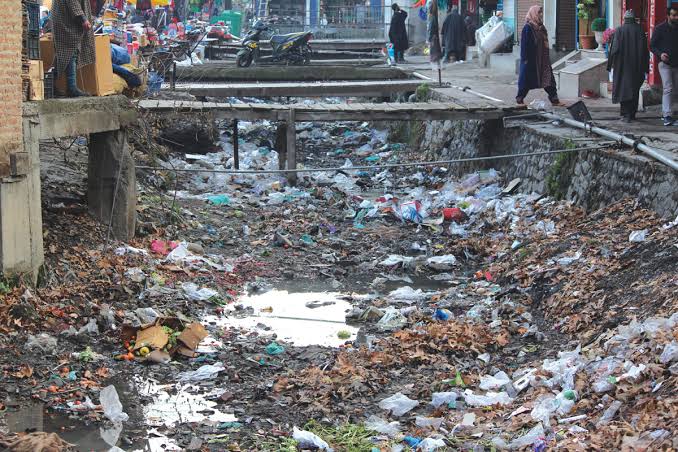
Where treatment infrastructure is inadequate, sewage can find another route. It enters drains. Drains enter streams. Streams enter rivers and lakes. And eventually, pollutants reach the same water bodies on which communities depend.
The consequences have been documented repeatedly around Dal Lake.
Studies have found deterioration in water quality near sewage discharge points, adding to concerns over the ecological health of one of Kashmir’s most recognisable natural landmarks.
The lake’s problem is not only environmental.
Dal Lake is an economic and cultural asset. Tourism, houseboats, recreation and local livelihoods are tied to its health.
When sewage enters the lake, the damage is therefore distributed across an entire ecosystem.
Rivers and streams across J&K face similar pressures.
The geography of the Valley can make the problem easy to overlook. A drain may appear insignificant when viewed from the roadside. But a network of drains carrying household and commercial waste can become a major source of pollution when it ultimately empties into a river or lake.
Water carries the consequences downstream.
The environmental damage has an obvious human dimension.
Waste accumulated in open spaces can attract stray animals and insects. Organic material can decompose and create foul conditions. Stagnant water around waste can create additional breeding grounds for disease vectors.
Waheed-ur-Rehman Para, a legislator, recently drew attention to garbage piling up along roadsides, in open spaces and neighbourhoods, warning that such accumulation could become breeding grounds for diseases, epidemics and stray dogs.
Bhat has similarly warned that Kashmir could be heading toward a public-health disaster without urgent intervention.
The danger is not limited to one neighbourhood or one dumping site.
A poorly managed waste system can affect air, soil and water. Burning waste can release harmful pollutants. Leachate from dumpsites can contaminate soil and groundwater. Plastics can enter waterways. Untreated sewage can carry pathogens and nutrients that disrupt aquatic ecosystems.
The longer waste remains untreated, the more complicated and expensive its eventual remediation becomes.
One of the more revealing aspects of the official data is that J&K reports complete collection of urban municipal waste from sources or common collection points. On paper, that sounds like a success.
But the next question is more important: where does the waste go?
The answer, increasingly, appears to be that a substantial portion goes to places where it can be stored or dumped but not scientifically processed.
That creates the illusion of a functioning system. The garbage disappears from the household. It does not disappear from the environment. The truck simply carries it beyond the resident’s immediate field of vision. This is why waste management cannot be measured only by collection rates.
A city can collect every kilogram of garbage it produces and still have a waste crisis if it lacks the capacity to segregate, recycle, compost and safely dispose of what it collects.
Srinagar’s experience demonstrates that distinction.
The government has announced an expansion of waste-processing infrastructure and the remediation of legacy dumpsites under Swachh Bharat Mission-Urban 2.0.
The programme includes door-to-door collection, source segregation and waste processing.
The direction is significant because source segregation is one of the basic requirements of an efficient waste-management system.
Wet waste can be composted or processed separately. Recyclable material can enter recovery systems. Only the residual fraction needs final disposal.
But the success of the approach depends on what happens after the collection truck arrives.
If segregated waste is mixed again during transportation or at the processing site, much of the benefit is lost.
Similarly, new processing plants will have limited value if they are not matched by sustained segregation, maintenance, staffing, and enforcement.
The challenge is therefore not simply to build more infrastructure.
It is to build a system that works from the kitchen bin to the final disposal site.
Srinagar’s waste problem is visible because the city is running out of places to hide it.
The 11 lakh metric tonnes of legacy waste at Achan is one manifestation. The estimated 14 lakh metric tonnes accumulated over eight years is another. The 600 tonnes of waste generated each day is another. And beneath all of it lies the sewage problem – 158.3 million litres generated against an installed treatment capacity of about 67 million litres a day.
These are not isolated statistics. They describe the same underlying phenomenon: urban growth moving faster than environmental infrastructure.
Srinagar is not literally a slum. But Bhat’s phrase, “a slum in the making,” captures a fear about what happens when infrastructure falls persistently behind population, consumption, and waste generation.
A city does not become environmentally degraded overnight. It happens gradually. A dumping site expands by another truckload. A drain carries another day’s sewage. A stream absorbs another discharge. A lake loses another measure of ecological resilience. By the time the crisis becomes impossible to ignore, the accumulation is enormous.
Srinagar may still have time to reverse that trajectory. But the official numbers suggest that the city cannot collect its way out of the problem.
It must process its way out. It must segregate what it throws away, expand sewage treatment, rehabilitate legacy dumpsites, and prevent rivers and lakes from becoming the final disposal system. Because the real measure of a clean city is not how quickly its garbage disappears from the roadside. It is what happens to that garbage after it disappears.
And right now, much of it is simply going somewhere else.
About the Author
Wajahat Iqbal Kashtwari is a filmmaker and multimedia professional with a keen interest in the environment, ecology, and climate change.