
Kashmir Impulse Desk
Srinagar, Sep 28
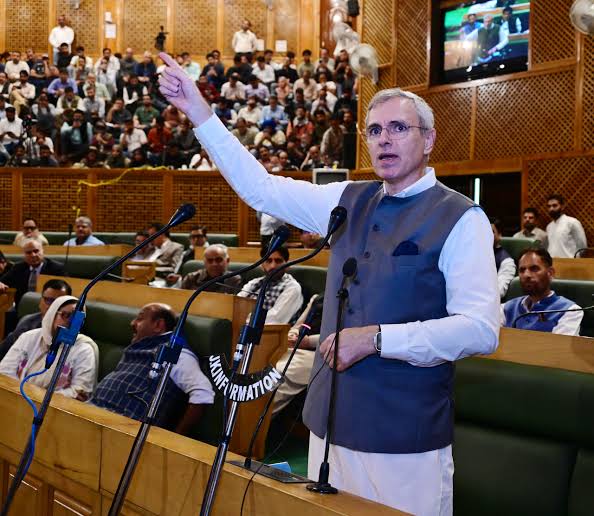
Jammu and Kashmir Legislative Assembly on Monday passed a resolution calling for the immediate restoration of the region’s full statehood, after a stormy debate in which opposition BJP lawmakers protested references to earlier resolutions on autonomy and special status.
Chief Minister Omar Abdullah, who moved the resolution, questioned why statehood had not been restored nearly two years after assembly elections, citing a Supreme Court direction that it should be restored “at the earliest” and “as soon as possible”.
“Tell me, Speaker (Sir), in which English, as soon as possible means two years?” Abdullah said during the debate.
The BJP supported restoration of statehood in principle but opposed the wording of the resolution, particularly its reference to resolutions passed by the assembly in 2000 and 2024.
BJP lawmakers entered the Well of the House, raised slogans and staged parallel proceedings before walking out as the resolution was put to a vote.
Abdullah said his government had deliberately confined the statehood resolution and was not seeking a vote on the restoration of Article 370, Article 35-A, or special status.
“Where are we asking them to vote on Article 35-A or to vote on special status? We are asking them to vote on statehood,” he said.
The resolution calls for the “immediate and urgent restoration of full statehood” to Jammu and Kashmir and refers to resolutions adopted by the assembly in June 2000 and November 2024.
The 2000 resolution had endorsed the report of a State Autonomy Committee and sought restoration of greater constitutional autonomy to the erstwhile state.
The 2024 resolution had reaffirmed the importance of special status and constitutional guarantees and called for dialogue with the central government.
BJP lawmakers argued that invoking those resolutions alongside the statehood demand sought to reopen constitutional issues settled after the August 2019 changes that removed Jammu and Kashmir’s special status and reorganised the former state into two federally administered territories.
Leader of Opposition Sunil Sharma said the BJP was committed to restoration of statehood but would not support what he described as unconstitutional references to the earlier resolutions.
“J&K is an integral part of India, and it will always remain. There is no room for any Pakistan agenda here,” Sharma told reporters.
He said the BJP would support a resolution dealing solely with statehood and rejected any deadline imposed by the chief minister.
Abdullah, meanwhile, said restoration of statehood should not be made conditional on a complete end to militancy.
“If you are saying that until the militancy in Jammu and Kashmir is silenced, the status of a state will not be restored, then the decision of the state of Jammu and Kashmir will not be made in New Delhi, but in Islamabad,” he said.
The chief minister also cited administrative restrictions faced by the elected government while Jammu and Kashmir remains a Union Territory.
He questioned why the Revenue Department remained outside the elected government’s jurisdiction when law and order and security were assigned to the Lieutenant Governor.
He also cited the Jammu and Kashmir Academy of Art, Culture, and Languages and universities including the Islamic University of Science and Technology and Baba Ghulam Shah Badshah University.
Abdullah said the government’s business rules had been sent to the Centre nearly two years ago but had yet to receive approval.
He also raised the absence of an Advocate General for two years and said the government had completed its part of the process on reservations before sending the matter to the Centre for consideration.
The debate also saw several amendments proposed by lawmakers from the National Conference, Congress, and People’s Democratic Party.
Eight NC legislators sought references to Article 370 and Article 35-A as they existed before August 2019.
PDP legislator Waheed-ur-Rehman Para sought restoration of autonomy and the earlier constitutional provisions, while other members proposed language referring to commitments made by the Centre and objections to the changes introduced after August 2019.
Abdullah opposed widening the resolution, saying the amendments could give the BJP grounds to vote against it.
People’s Conference (PC) President and MLA Sajad Gani Lone supported the statehood resolution but said the political commitments underlying Jammu and Kashmir’s constitutional position predated recent assurances from the Centre or the Supreme Court.
PDP MLA Waheed Para also supported the resolution but described its wording as vague because it did not mention Article 370, Article 35-A or autonomy.
AIP MLA Sheikh Khursheed backed the demand for statehood, describing it as a political right rather than a concession.
The debate unfolded against a backdrop of sharp disorder in the House.
BJP members moved a motion seeking the removal of Assembly Speaker Abdul Rahim Rather, accusing him of allowing Abdullah’s resolution in violation of legislative rules.
Rather said the motion would be listed for business after 14 days in accordance with the assembly’s rules.
The protest later escalated, with BJP members entering the Well, tearing business papers and conducting mock proceedings. Assembly marshals intervened as the confrontation intensified, and BJP legislators Vikram Randhawa and Arvind Gupta, along with Congress legislators Irfan Hafiz Lone and Iftikhar Ahmad, were marshalled out.
The assembly nonetheless continued its scheduled business and passed the statehood resolution after the BJP walkout.
The statehood issue has remained a central political demand in Jammu and Kashmir since the region was reorganised as a Union Territory in 2019.
Abdullah said the restoration of statehood was a commitment to the people rather than a favour from the central government.
“J&K does not need any favour. We are not begging,” he said. “The Centre has promised the people of J&K that the Centre should fulfil its promise.”