
On the Srinagar-Jammu highway, some place names carry the memory of journeys interrupted. Khooni Nallah is one of them. The name has entered the road’s folklore through accounts of falling rocks, dangerous weather and accidents on a corridor where travellers have often had little choice but to wait for the mountain to settle.
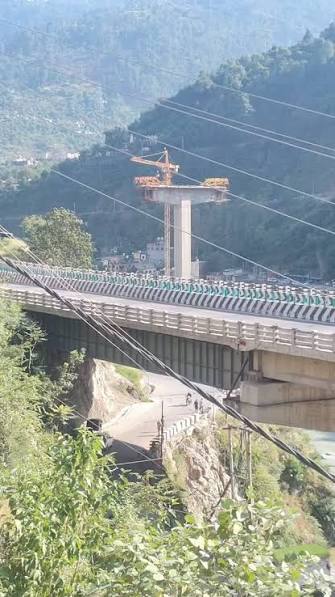
A new tunnel is expected to change that experience. Work is nearing completion on the 2.6-kilometre northbound tube of the Digdol–Panthiyal tunnel, which will carry traffic towards Srinagar. Along with an additional 619-metre section, it is scheduled to become operational by December 2026, according to National Highways Authority of India Project Director Shubham Yadav. He said only a 170-metre diversion remained. The 3.08-kilometre southbound tube towards Jammu opened in July.
The nearly 5.7-kilometre twin-tube project, which began in 2022 and is being built for Rs 866.37 crore, uses the New Austrian Tunnelling Method. Each tube is 10 metres wide. A separate 619-metre tube, referred to in the project reporting as the 84 tunnel, is also expected to open by December. The 870-metre twin-tube T5 cut-and-cover tunnel, built with a protective canopy, is already operational.
Together, the structures are intended to bypass vulnerable stretches around Digdol and Panthiyal, where falling rocks and landslides have repeatedly disrupted traffic. The route is expected to shorten the journey between Digdol and the Ramsoo–Magarkote side to about five minutes. The project has been described as part of a broader effort to improve all-weather connectivity along the Ramban–Banihal corridor and reduce exposure to slope failures and shooting stones.
For residents who have lived with the old route, the change is measured in time and uncertainty. Abdul Majid, a Digdol resident, recalled that heavy rain and falling rocks could leave people waiting for days on either side. He said the new tunnel would allow them to reach the Ramsoo–Magarkote side in about five minutes. His account captures what infrastructure projects often promise in a mountain region: not merely a faster drive, but a journey that is less dependent on weather and the condition of an exposed slope.
The highway’s history helps explain why such projects matter. Long before modern tunnels and flyovers, a steep cart road through Banihal connected Kashmir with Jammu. The Jawahar Tunnel, opened in 1956, later became the principal passage through the mountains. The route was known as NH-1A before being renumbered NH-44, and the Border Roads Organisation maintained it before the National Highways Authority of India took over in the early 2000s.
The four-laning project began in phases in 2011, with an original ambition to reduce the journey by more than 50 kilometres and cut travel time from about nine hours to four. It was divided into six sub-projects: Srinagar–Qazigund, Qazigund–Banihal, Banihal–Ramban, Ramban–Udhampur, Chenani–Nashri and Jammu–Udhampur. Difficult terrain, land acquisition, utility shifting, work stoppages and slow execution delayed several sections, particularly along the Ramban–Banihal stretch.
The early approach to widening relied heavily on cutting into mountain slopes. But repeated rockfalls, landslides and slope instability showed the limits of simply carving a wider road through difficult terrain. Tunnels, bypasses, flyovers and protective structures became increasingly important to the effort to make the corridor more reliable.
The road is more than a transport link. Before rail services reached Kashmir, it was the Valley’s principal surface connection with Jammu and the rest of the country. It carries passengers, goods, essential supplies and produce from the region’s horticultural economy. When it closes, the consequences spread beyond travellers stranded on the carriageway. Transport costs rise, deliveries are delayed and the movement of people becomes uncertain.
Mushtaq Ahmad Bhat, 65, from Anantnag, recalled travelling to Aligarh Muslim University for postgraduate studies in sociology in 1980, when avalanches and snow could stop travel for days. Such memories underline how much the road has changed, but they also show why its reliability remains a public concern. A journey that once depended on seasonal openings and exposed stretches is now being reshaped by major engineering works.
A tunnel, however, is not a complete answer to every risk on the highway. The opening of the Digdol–Panthiyal tube will remove traffic from particular vulnerable sections; it will not eliminate landslides elsewhere, nor will it end the need for maintenance, slope monitoring, emergency response and disciplined driving. The promise of safer connectivity depends on the entire corridor, not a single project.
There is also a distinction between a project being scheduled to open and its long-term performance. Once operational, the tunnel will need effective ventilation, lighting, drainage, surveillance, emergency exits and a maintenance regime suited to the traffic it carries. Authorities will need to ensure that drivers understand the new alignment and that old hazardous stretches are not allowed to become neglected or unsafe access points.
The project nevertheless represents a meaningful shift in how the highway’s most difficult sections are being approached. Instead of asking travellers to pass beneath unstable slopes, the new alignment takes the road through the mountain. It is an engineering response to a landscape in which road construction has always had to negotiate geology, weather and the needs of communities.
For generations of travellers, Khooni Nallah has been a warning embedded in the route. The second tube of the Digdol–Panthiyal project may soon make that stretch less central to the journey. The name will remain in memory, but the measure of the project will be whether fewer people have to wait beneath falling rock, whether supplies move more reliably and whether the highway becomes safer in ordinary weather as well as during the difficult months.
About the Author
Bilquees Punjabi holds a Master’s in Computer Applications and explores the evolving relationship between technology, digital media, audiences, and journalism.