

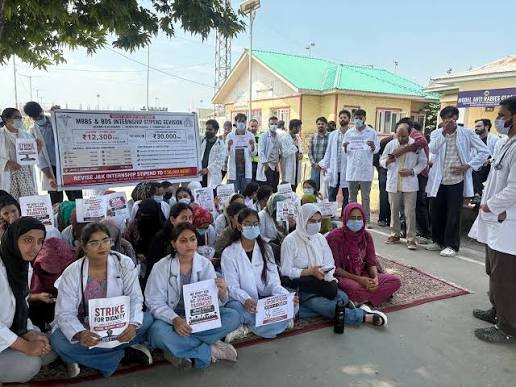
For nearly seven years, the number on the stipend slip has barely changed.
The workload has.
So have the costs of commuting to hospitals, buying food during long shifts and living away from home. Yet MBBS interns across Jammu and Kashmir say they are still being paid Rs 12,300 a month – an amount they consider increasingly out of step with their responsibilities and stipends offered elsewhere in the country.
On August 31, after years of representations and appeals, the interns intensified their protest and withdrew services from government hospitals across the Union Territory.
Eight days later, they returned to work.
The strike ended after the government assured the interns that their long-pending demand for an increase in stipend would be finalised within 30 days.
The assurance brought an end, for now, to a dispute that had moved from representations and committee recommendations to sit-ins, a hunger strike and a confrontation over whether the interns would continue working without a written order.
The demand is simple: increase the monthly stipend.
But the dispute has become a story about something larger than the difference between two figures. It is about a government recommendation that has not translated into an order, a proposal that has remained with the Finance Department and a generation of young doctors who say they have waited long enough.
A government committee constituted in 2023 to examine the issue recommended increasing the stipend to Rs 25,000 a month.
That recommendation, however, remained unimplemented.
The government told the Legislative Assembly in February that the proposal was under consideration by the Finance Department.
For the interns, the delay became a symbol of the problem.
A committee had examined the matter. A recommendation had been made. The issue had reached the government.
Still, the amount reaching interns’ accounts remained Rs 12,300.
The strike changed the pressure around the dispute.
But it also brought a new complication.
As interns stopped attending duties, several government medical colleges issued show-cause notices warning of possible disciplinary action against those who had participated in the protest.
At SKIMS Medical College in Bemina, the principal directed interns who had not attended duty to explain within 24 hours why action should not be taken against them.
The notice described participation in the strike as “gross indiscipline and professional misconduct” under National Medical Commission rules. It also referred to affidavits submitted by interns undertaking not to participate in strikes or acts of indiscipline.
Similar notices were issued by Government Medical College Anantnag, GMC Rajouri and GMC Handwara.
The notices warned that disciplinary action could include curtailment, temporary suspension or even cancellation of internships.
For interns already arguing that the government had taken too long to address their stipend, the warnings added another dimension to the standoff.
The protest had entered a more serious phase on Monday, when interns launched a 48-hour hunger strike after saying that earlier talks with the government had produced only verbal assurances.
They had wanted something in writing.
They eventually received it in the form of an official record of meetings with Health and Medical Education Minister Sakeena Itoo.
According to the record, the government said the matter would be finalised within 30 days on the basis of recommendations of the committee constituted to examine the stipend and while taking into account the “legitimate interests and concerns” of the medical interns.
The interns then agreed to call off the strike and resume their duties.
The decision was also framed around patient care and the interns’ own academic and professional interests.
That ending was important for a health system that had watched the dispute unfold inside government hospitals.
Medical internships occupy an awkward space in the health-care system.
Interns are still in training, but they are also working inside hospitals, often at the sharp end of patient care. They are posted in emergency departments, wards, operation theatres and other clinical areas. They assist doctors in treating patients, contribute to inpatient care and work through long and overnight shifts.
They are also part of outpatient departments, or OPDs, helping keep routine services moving.
The Rs 12,300 stipend, interns and doctors’ associations argue, does not adequately reflect either that workload or the cost of performing it.
For someone spending long hours at a hospital, even basic expenses can accumulate: transport to and from duty, meals during shifts and other daily costs.
The argument is not that interns should be treated as fully qualified permanent employees. It is that compensation should keep pace with the demands placed on them during a compulsory period of clinical training.
A senior faculty member at Government Medical College Srinagar had offered a similar perspective, arguing that stipend increases should ideally be considered annually, with an incremental rise of about 5 to 6 percent.
Such an approach, the faculty member said, would be comparable to the way dearness allowance is periodically adjusted for permanent employees and would provide a more equitable framework.
Instead, the stipend remained effectively frozen.
The most frustrating part of the dispute for the interns may be that the government had already had a chance to resolve it.
The committee formed in 2023 examined the issue and recommended a monthly stipend of Rs 25,000.
That would represent a substantial increase over Rs 12,300.
But the recommendation did not become policy.
The file remained under consideration, with the Finance Department yet to clear the proposal.
For young doctors who had spent years seeking a revision, the administrative delay became difficult to distinguish from inaction.
Representations had been made. Associations had raised the issue. A committee had considered it. A recommendation had been made.
Still, the amount reaching interns’ accounts remained Rs 12,300.
The strike was therefore not the beginning of the dispute. It was the point at which the dispute ran out of patience.
The interns’ frustration was also fuelled by comparisons with other states.
Jammu and Kashmir’s stipend is lower than payments offered to interns in several parts of the country. Figures cited in the latest discussions put monthly stipends at Rs 44,319 in Odisha, Rs 43,099 in West Bengal and Rs 35,000 in Assam.
The comparison is not entirely straightforward because stipend structures, allowances and institutional arrangements vary between states.
But the disparity has become a powerful argument for the interns.
For a medical student who has completed years of demanding education and entered hospital-based clinical training, the difference is not abstract.
It is the difference between a stipend that can cover a meaningful share of daily expenses and one that may barely meet the cost of getting to work and eating during duty hours.
The potential impact of the strike extended beyond the interns themselves.
Government hospitals depend on layers of doctors, nurses, technicians and support staff to provide care. Interns form one of those layers.
Their role is especially visible in busy emergency departments and OPDs, where patient numbers can be high and clinical work continues around the clock.
That is why the strike had raised concerns about routine hospital services and patient care.
The intervention of Chief Minister Omar Abdullah added political weight to the dispute.
Abdullah called for the matter to be resolved at the earliest, saying the prolonged disagreement was affecting the interns’ work and internship and was “not in anyone’s interest”.
He also said the decision on stipend enhancement rested with the Health Department.
“It’s sad. The matter shouldn’t have come to this,” he said, arguing that the issue should have been settled without allowing the dispute to reach the point of a prolonged strike.
The government’s latest assurance has now bought it another 30 days.
For the interns, however, the assurance also carries a deadline.
The question is whether the government will now convert the committee’s recommendation into an actual order.
That distinction has become central to the dispute.
For years, the interns have heard that the matter is under consideration. They have now been told that it will be finalised.
The difference lies in what happens next.
There is also the question of how the strike will affect the interns themselves.
Several colleges have warned of disciplinary consequences for absence from duty. At some institutions, interns have been told that their failure to explain their absence could lead to action affecting completion of their internship.
One medical college principal said prolonged strikes could have consequences for doctors later in their careers and that interns may be required to make up missed days under NMC guidelines.
The notices have added a layer of anxiety to what was already a contentious dispute.
The interns had argued that they were seeking a written decision from the government on a financial issue that had remained unresolved for years.
The colleges, meanwhile, were responding to absence from assigned duties and the rules governing medical internships.
The two positions collided inside institutions where the same interns were expected to continue providing clinical services while protesting the terms under which they were working.
The action drew criticism from the opposition People’s Democratic Party and others.
Yet the strike ultimately ended without the government immediately announcing a revised stipend.
Instead, the two sides settled on a 30-day window.
That may offer the administration some breathing space.
It also leaves the underlying arithmetic unchanged.
For now, an intern in J&K still receives Rs 12,300 a month.
The government’s own committee has recommended Rs 25,000.
The interns have spent years asking why the first figure has remained fixed while the cost and demands of clinical training have changed.
The answer may now come from the Finance Department and the Health Department, after years of movement through government files.
There is an irony in the fact that the demand for a more regular adjustment comes from a profession accustomed to precision.
A stipend of Rs 12,300 set years ago does not have the same purchasing power today.
If the amount had been periodically increased by even modest increments, the current dispute might look very different.
Instead, the question accumulated over time.
How much should an intern receive?
Should the figure be linked to prevailing norms elsewhere?
Should it be revised annually?
Should the government first implement its committee’s recommendation and consider a further increase later?
And how quickly can the departments involved turn a recommendation into an order?
For the interns, the immediate answer is that Rs 12,300 is no longer enough. For the government, the committee’s recommendation of Rs 25,000 provides an existing reference point.
The distance between those numbers is smaller than the distance between Rs 12,300 and any meaningful revision.
That may offer room for a settlement – if the administrative machinery moves.
The dispute has also exposed the unusual position of interns in the public health system.
They are trainees, but their work has consequences for patients. They are junior members of the medical profession, but hospitals depend on their presence. They have limited institutional leverage, but withdrawing their services can make their absence visible almost immediately.
The eight-day strike demonstrated that tension.
By stepping away from their duties, the interns highlighted work that often happens quietly: overnight shifts, assisting in emergency rooms, moving between wards, helping with patient care and supporting doctors through busy clinical periods.
Their return to work has restored those services.
But it has not settled the question that led them to stop working in the first place.
The government has promised a decision within 30 days.
For the interns, that promise will be measured against the history of the past seven years.
They have already seen a committee recommendation remain unimplemented. They have already heard that the matter is under consideration. They have already waited.
Now the clock is running again.
This time, the interns are back in the hospitals.
The stipend remains Rs 12,300.
And the government has 30 days to decide whether that number will finally change.
About the Author
Bilquees Punjabi holds a Master’s in Computer Applications and explores the evolving relationship between technology, digital media, audiences, and journalism.