
For more than a thousand years, Kashmir’s Buddhist past survived in fragments — in travellers’ accounts, scattered archaeological remains, weathered mounds and, unexpectedly, photographs preserved in a museum thousands of kilometres away.
Now, archaeologists are digging into that buried history.
The second phase of excavation at the Zehanpora archaeological site in north Kashmir’s Baramulla district began Saturday, opening a new chapter in an investigation that could substantially deepen understanding of the Valley’s role in the ancient Buddhist world.
Chief Secretary Atal Dulloo formally inaugurated the excavation by making the first dig at the site before touring the excavation area and reviewing the work.
The excavation is being conducted jointly by the Centre of Central Asian Studies at the University of Kashmir and the J&K Department of Archives, Archaeology and Museums.
The team, led by Prof Muhammad Ajmal Shah of the Department of Central Asian Studies, has been given roughly three months for the second phase.
The immediate objective is deceptively simple: find out how large the ancient settlement was.
The larger question is far more consequential.
What exactly was Zehanpora, when did it flourish, and what can its remains tell us about the place of Kashmir in the Buddhist world?
Evidence recovered during the first phase suggests that the site dates back nearly 2,000 years. Dulloo described it as a 2,000-year-old Buddhist archaeological site and said the findings could eventually make Zehanpora one of the region’s largest archaeological and cultural excavations.
For a valley whose ancient history has often been reconstructed through texts and accounts written centuries ago, the prospect of uncovering an extensive Buddhist settlement is significant.
The ground may have more to say.
The story of Zehanpora’s excavation did not begin with a shovel. It began with a photograph.
In October 2023, while on a fellowship in France, Prof Shah visited the Guimet Museum and came across nearly 100 old photographs.
Among them were images of three Buddhist stupa domes in Baramulla.
Shah recognised the landscape. He had visited the site before.
But the photographs showed something that no longer existed in the same form.
“I immediately realised that I had visited that site in Baramulla. What struck me was that the domes in the photograph looked much larger than what we see today,” he said.
The century-old photographs provided an unexpected archaeological clue.
The three stupa domes appeared considerably larger than the surviving remnants at Zehanpora. They suggested that the mounds in the landscape might not simply be natural formations or isolated ruins but remnants of a much larger Buddhist complex.
The photographs helped researchers connect the Zehanpora mounds with the stupas captured by an earlier generation of photographers.
A forgotten landscape suddenly acquired a visual past.
Shah subsequently approached the International Buddhist Confederation in New Delhi and the J&K archaeology department for support.
The excavation that followed has now entered its second phase.
The first excavation season began in November last year.
It produced enough evidence to persuade the authorities that the site warranted a deeper investigation.
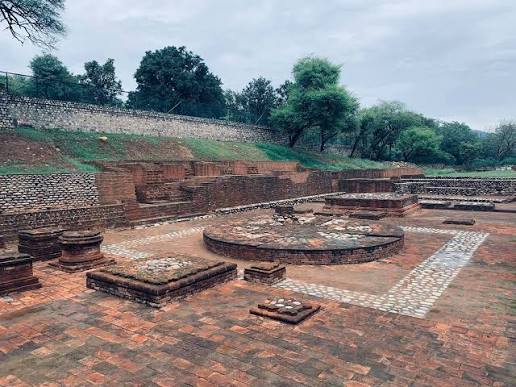
Archaeologists exposed a wall, a hall complex and an apsidal stupa. They also uncovered the remains of several other structures and recovered iron and copper artefacts, needles, decorated and ornamental objects and other fragments.
An apsidal structure is particularly significant in the archaeological interpretation of the site because of its association with certain Buddhist architectural traditions.
But the researchers are not yet treating every interpretation as settled.
The second phase will seek to establish the site’s extent and investigate areas beyond those already excavated.
Drone imagery is playing a central role.
By surveying the terrain from above, archaeologists were able to identify patterns and wall alignments that were difficult to discern from ground level.
“We identified these wall alignments through drone imagery and carried out the excavation precisely at those points,” Shah said.
The technique has allowed the team to target areas where buried structures are most likely to survive rather than excavating blindly across the landscape.
And there may be much more beneath the surface.
Shah believes many structures and artefacts could still be preserved underground.
The excavation, in other words, may be revealing only the outer edge of a much larger archaeological story.
The site has not remained untouched.
A canal constructed in the 1970s divided the archaeological area into two parts. Walls between the stupas were also removed during construction.
That intervention complicates the archaeological record.
Modern infrastructure can erase precisely the relationships archaeologists need to understand how an ancient complex was organised.
Yet the remnants that survived may still provide clues.
The task now is to reconstruct the site from fragments – excavated structures, buried remains, old photographs, aerial imagery and historical accounts.
Each source offers a different piece of the puzzle.
The photographs show what the stupas looked like roughly a century ago. Drone imagery reveals possible buried alignments. Excavation provides physical evidence. Historical accounts offer a glimpse into how the region functioned centuries earlier. Together, they can turn an apparently ordinary landscape into an archaeological map.
The significance of Zehanpora extends beyond the site itself.
Shah argues that Kashmir was a major centre of Buddhism in antiquity and played an important role in the development of Buddhist thought.
“Kashmir was a major centre of Buddhism in ancient times. It was here that Hinayana Buddhism evolved into Mahayana Buddhism, giving the religion a new philosophical and cultural form,” he said.
The excavation team will also explore a possible connection between Zehanpora and the Fourth Buddhist Council, traditionally associated with Kashmir.
The council is believed to have taken place in the first century CE, a period broadly compatible with the age suggested for the archaeological site.
At this stage, the connection remains a question for researchers rather than a fact. That distinction is important.
Archaeology can test historical traditions. It can corroborate them, complicate them, or sometimes overturn them.
The second phase of excavation may provide evidence that allows scholars to assess whether Zehanpora formed part of the religious and intellectual networks associated with the Buddhist centres of ancient Kashmir.
If it does, the significance could extend well beyond Baramulla.
One of the most intriguing historical threads leads to a Chinese traveller who came to Kashmir more than 1,300 years ago.
Xuanzang, the seventh-century Buddhist monk and scholar, visited Kashmir between 631 and 633 CE.
According to Shah, Xuanzang entered Kashmir through Baramulla, visited several monasteries and spent a night at Uskur, an ancient Buddhist site near the town.
Shah believes this raises the possibility that Xuanzang may also have visited the monastery at Zehanpora.
“This suggests that Xuanzang must have visited the monastery at Zehanpora as well,” he said.
The possibility is tantalising, but again, it remains to be tested.
Ancient travel routes provide another piece of the puzzle.
Shah said the old road to Kashmir from Muzaffarabad passed through Zehanpora.
That would have placed the settlement along a potentially important movement corridor linking Kashmir with the wider region.
A Buddhist monastery located along such a route would not simply have been a religious site.
It could also have been a place where travellers, scholars, monks and ideas converged.
The excavation could therefore illuminate not only architecture but the movement of people and knowledge across ancient Asia.
For the government, the archaeological value of Zehanpora is accompanied by another possibility: tourism.
Dulloo said the site could eventually become a major tourist attraction once excavation and conservation work are completed.
That prospect, however, lies some distance ahead.
Archaeological excavation is slow by nature. Structures have to be documented before they can be exposed. Artefacts need conservation. Materials must be scientifically analysed. Dating has to be established and interpretations tested.
Dulloo said material recovered from the site would undergo scientific examination, including carbon dating, to establish its age and clarify its historical significance.
That process could provide evidence capable of moving the site from intriguing possibility to firmly dated archaeological record.
It could also help researchers understand the sequence of occupation.
A site that was used for centuries may contain several historical layers, each reflecting a different period of settlement and religious activity.
The challenge is to uncover those layers without destroying the information contained within them.
The administration is already thinking beyond excavation.
Dulloo assured support for protecting the site and said efforts would be made to notify it as a monument of national importance.
That would mark a significant step in formally recognising Zehanpora’s heritage value.
But protection will become more complicated if excavation reveals a larger complex.
The site would then require not only archaeological conservation but long-term management.
That could include protecting exposed structures from weather, regulating visitor access, preserving artefacts and ensuring that modern development does not further fragment the archaeological landscape.
The experience of the canal offers a warning about what can happen when ancient remains and modern infrastructure occupy the same landscape without adequate protection.
The second phase therefore carries two tasks at once: discovering the past and ensuring that what is discovered survives.
The renewed excavation has already attracted attention beyond the archaeological community.
Prime Minister Narendra Modi mentioned Zehanpora during the 129th episode of Mann Ki Baat on Dec. 28 last year, highlighting the old French photographs that helped researchers connect the mounds with Buddhist stupas.
The reference brought national attention to a site that had remained relatively obscure.
Within Kashmir, meanwhile, the excavation has created a new opportunity for scholars and students.
Dulloo congratulated the University of Kashmir’s vice chancellor, scholars and students involved in the work. University Vice Chancellor Prof Nilofer Khan reiterated the institution’s support and expressed hope that the second phase would produce further discoveries.
District authorities have also pledged cooperation.
The presence of senior officials at the inauguration reflects a growing recognition that archaeology is not merely about antiquities.
It can influence how a region understands itself.
For Kashmir, whose history has been shaped by successive cultural, religious and intellectual currents, Buddhist heritage represents one of the Valley’s oldest connections with the wider Asian world.
The second phase will last about three months.
For the archaeologists, that may be only the beginning.
They will excavate areas identified through drone surveys and ground mapping, follow wall alignments, investigate structures beyond the first excavation zone and search for evidence that can establish the site’s size and chronology.
The most important discoveries may not be dramatic.
A fragment of pottery. A foundation. A coin. A tool. A piece of decorated material.
Each could help establish how people lived at Zehanpora, when they lived there and how the settlement connected with the wider Buddhist world.
And sometimes the most revealing evidence is not what is found, but how the pieces fit together.
The old photographs already provided one remarkable connection: three large Buddhist domes once stood where only diminished remains are visible today.
The excavation is now asking what surrounded them.
Was Zehanpora a monastery, a settlement, a pilgrimage centre, a stopping point on an ancient route – or a combination of all four?
Did monks and travellers pass through it?
Was it connected to the intellectual currents that helped transform Buddhist philosophy?
And could its remains help illuminate the Buddhist networks that once linked Kashmir with Central Asia and beyond?
The answers are still underground.
For now, archaeologists have only begun to uncover them.
But after decades in which Zehanpora’s Buddhist past survived largely in photographs, memories and historical references, the site is finally being allowed to tell its story in its own language – stone, earth, metal, and time.
About the Author
Amir Yaseen is a Srinagar-based journalist interested in Kashmir, policy, progress, and the human stories shaping everyday life.