
There is nothing inherently wrong with borrowing a good idea. Mountain tourism everywhere has learned to turn altitude, landscape, and experience into economic opportunity. A revolving restaurant at Apharwat Top Station could do precisely that for Gulmarg.
But Kashmir should resist the temptation to mistake novelty for tourism strategy.
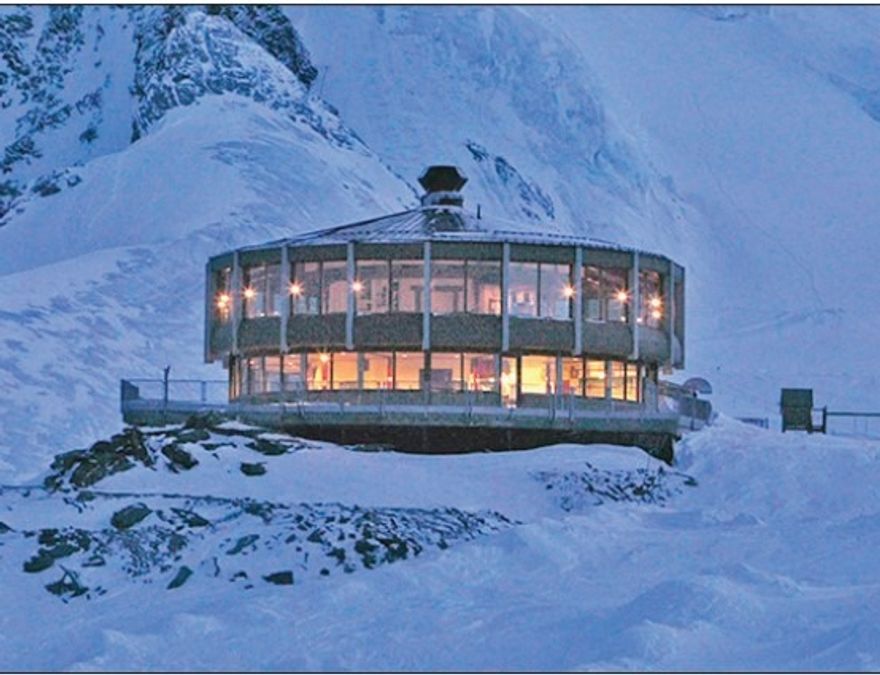
The proposed high-altitude revolving restaurant is an attractive idea. A dining room slowly turning against the backdrop of snow-covered mountains has obvious visual appeal. It could become another distinctive attraction in Gulmarg and extend the visitor experience beyond skiing, gondola rides and conventional sightseeing.
Yet the most important question is not whether the restaurant can turn.
It is whether it can belong.
Apharwat is not an empty platform waiting for an architectural spectacle. It is an alpine environment with heavy snow, strong winds, seismic risks, extreme temperature variations and ecological sensitivities. Any permanent structure at such an altitude has to be judged not simply by how impressive it looks, but by how lightly it sits on the mountain.
The government has, to its credit, begun with the right instrument: a detailed project report and extensive technical investigations. That process must now be allowed to do its job without predetermining the outcome.
The first principle should be simple: build only after the mountain has said yes.
The existing foundation at the site must undergo a rigorous structural audit. Geotechnical and subsoil investigations must establish the site’s carrying capacity. Snow loads, wind forces, and seismic conditions need to be treated as fundamental design parameters rather than technical footnotes.
The environmental assessment should be equally serious.
Gulmarg’s greatest asset is its landscape. If a new attraction damages the very setting that draws visitors, the project will have defeated its purpose. The government should therefore make the environmental and visual assessment publicly available and invite independent expert scrutiny before construction decisions are finalised.
There is also a larger question of carrying capacity.
Gulmarg already attracts substantial visitor numbers. A new attraction at Apharwat could increase pressure on roads, cable-car infrastructure, waste systems, water supplies and emergency services. The restaurant cannot be planned as an isolated building. Its impact on the entire tourism ecosystem needs to be calculated.
Water may be particularly important. At high altitude, supplying, storing and treating water is not a trivial exercise. Neither is disposing of wastewater and solid waste. The project should establish strict limits on consumption and require systems capable of minimising the need to transport materials and waste up and down the mountain.
Energy is another test.
If the restaurant is promoted as an icon of modern mountain tourism, it should also become a demonstration of low-impact high-altitude infrastructure. Solar generation, efficient heating, high-performance insulation, energy recovery and intelligent building systems should be prioritised wherever technically feasible.
The government should also resist excessive architectural ambition.
Apharwat does not need a building that competes with the mountains. The strongest design may be the one that allows the landscape to remain the protagonist. Panoramic glazing and a revolving floor already provide the spectacle. The architecture can afford to be restrained.
Accessibility and safety must likewise remain non-negotiable. People with disabilities, elderly visitors and families must be able to use the facility safely. Fire protection, emergency evacuation, medical response and evacuation during severe weather require particular attention at a location where conventional emergency access may be limited.
Then comes the question of economics.
A spectacular restaurant can attract visitors, but construction and maintenance at high altitude can be expensive. The government should publish a credible assessment of capital expenditure, operating costs, expected visitor numbers and revenue. Public money should not be committed to an attraction whose long-term economics have not been tested.
There is also a lesson in the Swiss example.
The value of the Mittelallalin revolving restaurant does not come merely from the machinery that makes it rotate. It comes from the way the facility is integrated into an established mountain-tourism ecosystem. Kashmir should borrow the principle, not simply the appearance.
Apharwat’s restaurant should therefore be connected to a wider tourism strategy – one that promotes local cuisine, Kashmiri design, regional art and culture, local employment and high-quality visitor services.
The attraction should feel unmistakably Kashmiri even if its engineering concept has Swiss roots.
Most importantly, the government should maintain transparency about the project’s evolution. The earlier reference to a revolving restaurant at the site and the present proposal for a fresh DPR make it important to clearly communicate what is being planned, what already exists, and whether any earlier facility is being modified, replaced, or incorporated.
Good public projects do not fear questions.
The idea deserves to be explored. But exploration should not become construction by momentum.
If the studies establish that Apharwat can safely accommodate the facility, that its ecological footprint can be controlled, that its infrastructure requirements are manageable and that its economics are sound, the project could add a genuinely distinctive dimension to Kashmir’s mountain tourism.
If they do not, the government should be equally willing to change the design, reduce its scale, relocate it or abandon it.
That is the real test of modern mountain tourism.
The Alps may have supplied the inspiration. Kashmir must supply the judgment.
At Apharwat, the best project will not necessarily be the one that turns the most dramatically.
It will be the one that lets the mountain remain the main attraction.
About the Author
Syed Sameer Ahmad Nazki is a filmmaker skilled in editing and videography, with an interest in visual storytelling and sports.