
On the banks of the Jhelum at Rajbagh, inside a space called Maqam, restored in the vocabulary of traditional Kashmiri architecture, Lal Ded has acquired something she has not possessed for centuries: a surface.
Not a page, exactly. Not a wall. Not the human voice in which her words travelled for generations.
Pashmina.
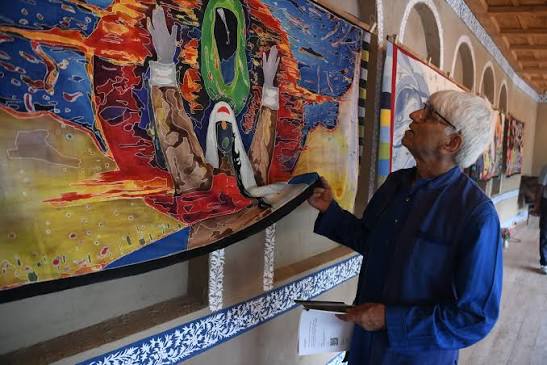
Twenty shawls, stripped of the familiar grammar of floral borders and paisleys, carry twenty of the fourteenth-century mystic’s vaakhs. The designs are by painter Masood Hussain; the English translations are by writer and scholar Avtar Mota. The craft vision belongs to Mujtaba Qadri, whose work has been devoted to asking an old Kashmiri question in a contemporary way: how does a tradition survive without becoming a relic?
The answer, at Maqam, is soft to the touch.
Lal Ded – Lalleshwari to Kashmiri Pandits and Lal Arifa to Kashmiri Muslims – is one of the foundational voices of Kashmiri literature. Her vaakhs, brief utterances that commonly survive in four-line form, were born in speech and memory. They circulated before they were fixed on paper, and over the centuries they entered the bloodstream of the language itself.
They became proverbial, devotional, philosophical and, eventually, almost anonymous. A Kashmiri could encounter Lal Ded without necessarily opening a book of Lal Ded.
Now the vaakh can be encountered on a shawl.
It is an improbable meeting: a medieval mystic, a twentieth and twenty-first-century painter, a contemporary craft entrepreneur, and a textile whose history stretches across the highlands of the Himalayas and into the courts and wardrobes of distant worlds.
But the more closely one looks, the less accidental the meeting seems.
Lal Ded’s poetry has always been concerned with what lies beneath appearances. Pashmina, in its own way, is a material lesson in the same idea. Beneath the coarse outer hair of the Himalayan goat lies the extraordinarily fine fibre from which the shawl is made.
Look beneath.
That instruction could serve as a quiet epigraph to both.
Masood Hussain’s Kashmir has rarely been the Kashmir of the postcard.
For decades, the Valley has been rendered through mountains, lakes, gardens and snow – a landscape so visually persuasive that it can become a substitute for the people who inhabit it. Hussain’s art emerged from another Kashmir, one marked by violence, grief, displacement, and endurance.
He began teaching at the Fine Arts College in Rajbagh in 1977, after studying art in Bombay. The upheavals that transformed Kashmir from the late 1980s onward also transformed his work. His paintings confronted violence and suffering rather than allowing landscape to become an escape from them. A fire in 1993 destroyed paintings and accumulated work in his studio. One of his paintings, A Peep Out of the Past, was selected by the poet Agha Shahid Ali for the cover of The Country Without a Post Office.
For Hussain, Kashmir was not scenery. It was evidence.
His journey toward Lal Ded began elsewhere.
He had encountered the possibility of translating poetry into visual art while working with Irish writer Gabriel Rosenstock, who had written haiku on Mahatma Gandhi and asked Hussain to illustrate them. The resulting book, published in Ireland, encouraged the painter to consider what happens when a poem is released from language and made visible.
Later came Kabir.
Hussain produced more than thirty paintings on the Indian mystic-poet. It was, he has said, during this engagement that the idea of giving spiritual poetry a visual vocabulary became more compelling.
Then Qadri approached him.
“If I could work on Kabir, why not take Kashmir as a subject?” Hussain recalled thinking.
Lal Ded came to mind immediately.
He studied around 300 vaakhs and selected twenty.
Each required a visual language of its own. Hussain did not set out simply to illustrate the verses. A literal painting of a poem would have been too easy, and perhaps too limiting. Instead, he searched for symbols capable of holding something of the poem’s inwardness.
One shawl contains a celestial horse, a rider moving beneath a sky marked by constellations. Other works turn toward death, passage and the unseen.
The images do not behave like captions. They behave like questions.
Why Pashmina?
The question might have been simpler had Hussain chosen paper.
But Pashmina offered something paper could not: a material already saturated with Kashmir.
The fibre comes from the exceptionally fine undercoat of Himalayan goats associated with the high-altitude regions of Ladakh and the Tibetan plateau. For centuries, the movement of this fibre was bound to the geography and commerce of the region. Traders who travelled to fetch Pashmina from Tibet and Ladakh came to be known as Tibet Bakals.
The fibre descended from the mountains and entered Kashmir’s intricate world of spinning, weaving and finishing.
The history of the Kashmir shawl is older and more complicated than any single origin story. Some accounts place its beginnings deep in antiquity; others emphasise the development of an organised shawl industry through medieval courtly patronage. Sultan Zain-ul-Abidin, who ruled Kashmir from 1420 to 1470, is particularly associated with the encouragement of arts and crafts.
There is an intriguing chronological proximity here.
Lal Ded belongs to the fourteenth century.
The great flowering of the Kashmiri shawl tradition under courtly patronage followed not long after.
The two traditions did not necessarily grow together in the tidy manner of a retrospective cultural narrative. But both eventually became part of the same inheritance: Kashmir’s ability to make meaning portable.
A shawl could carry warmth. Then wealth. Then honour. Then prestige. Then memory.
During the Mughal period, Kashmiri shawls entered royal gift-giving and the ceremonial world of khil’at, the presentation of robes of honour. By the eighteenth and nineteenth centuries, they had become an international commodity and acquired a particular glamour in Europe. Kashmiri shawls moved from elite male dress in South Asia into European women’s fashion, becoming associated with figures such as Josephine Bonaparte and Queen Victoria.
The shawl travelled. But its raw material had travelled farther.
From highland pasture to spinner, from spinner to weaver, from workshop to court, from court to overseas market: Pashmina was geography made portable.
There is an irony in the modern luxury image of Pashmina.
The finished shawl appears almost weightless. Its making is anything but.
Cleaning fibre, spinning thread and weaving by hand are painstaking processes. Behind the celebrated softness of the shawl lies a chain of labour that has often remained invisible, particularly the work of women who traditionally spun yarn.
Qadri’s interest in Pashmina has extended precisely into this hidden part of the craft.
In 2021, associated with the Kashmir craft enterprise ‘Me & Kashmir’, he established a centre in Srinagar focused on traditional hand-weaving and the revival of craft practices. His work has included attention to hand-spun yarn, artisan livelihoods and the conditions in which craftspeople work.
The question for Qadri has never been preservation alone.
A tradition preserved too carefully can become a museum object.
He wants it to remain alive.
“Four years ago, I worked with the French artist Maximilien Pellet, and we showed the collection in Paris,” Qadri said. “But I always wanted to do something with a Kashmiri artist.”
He already knew Hussain and admired his work.
“Masood Sahab was the one who started the conversation that something like this could be done,” Qadri said. Hussain, he recalled, came to him with a concept around Lal Ded. “He visualised Lal Ded’s vaakhs and mastered the process very quickly.”
The process, however, was anything but quick.
Hussain spent roughly two and a half years developing the twenty designs. He worked with Qadri’s studio in Delhi, where he also learnt about dyes and the technical demands of working with the textile.
The final shawls therefore contain more than images.
They contain a collaboration between disciplines.
Lal Ded has always resisted easy ownership.
Her legacy has travelled through Kashmiri Pandit and Muslim traditions. Her thought is frequently discussed alongside the later Rishi-Sufi culture of Kashmir, particularly in relation to Sheikh Nooruddin Noorani, whose spiritual inheritance is often placed in conversation with hers.
She is also remembered as a woman who abandoned the conventions of domestic life and became an itinerant mystic. Her life has consequently been interpreted through questions of gender, social hierarchy, and the religious and political transformations of medieval Kashmir.
But biography is not where Lal Ded’s deepest afterlife resides. The vaakhs are. They are what survived. And survival through language has consequences.
A historical person can be reconstructed, disputed, sanctified or simplified. A poem can continue to disobey its biographer.
That is one reason Lal Ded belongs to a much larger international tradition of women mystic-poets.
In Arabic, there is Rabia al Adawiyya, whose poetry of divine love helped shape early Sufi thought. In Middle Dutch, there is Hadewijch, whose ecstatic poetry explored union with the divine. In English, Lal Ded’s near-contemporary Julian of Norwich turned mystical experience into one of the great works of medieval English spiritual writing. Teresa of Ávila did something similar in Spanish several centuries later. The Indian subcontinent offers its own constellation: Mirabai in Braj and Hindi traditions, Akka Mahadevi in Kannada.
The comparisons are useful only up to a point.
What distinguishes Lal Ded is the peculiar fate of her language. Her poetry did not remain confined to a monastery, court, or literary canon. It entered everyday Kashmiri speech.
She became part of the language.
That makes the Pashmina experiment more interesting than a simple act of cultural branding.
It is another form of transmission.
Qadri’s role is easy to overlook because Hussain’s name dominates the visual encounter.
But somebody had to create the conditions for the encounter.
Qadri says he did not want Maqam to become another tourist-oriented Kashmiri craft outlet.
“I wanted to create something Kashmir-centric, something made for Kashmiris, something that shouldn’t feel like a tourist shop,” he said. “I want Kashmiri people to come to us.”
His ambition is to bring contemporary design into traditional crafts without stripping them of their identity.
That tension – between preservation and reinvention – runs through the twenty shawls.
A craft cannot survive solely because people once loved it. It survives because people find reasons to love it again.
This is where the Lal Ded project becomes an experiment in cultural economics as well as art.
A Pashmina shawl painted with a vaakh is not merely an expensive object with an old quotation attached. It proposes a different relationship between literature and craft, between heritage and contemporary design.
The shawl becomes a carrier of an idea. And the idea becomes wearable.
There is, inevitably, a danger in reviving Lal Ded.
A historical mystic can be made harmless. She can become a portrait, an emblem, a slogan, a convenient invocation of Kashmir’s plural past. Her poetry can be polished until all its discomfort disappears. But Lal Ded’s vaakhs are not merely decorative fragments of Kashmiri heritage.
They question authority. They question ritual. They question the distinction between appearance and truth. They turn inward.
That is why reducing her to an icon would miss the point.
Her importance lies partly in the fact that her poetry refuses to stay in one category. It is spiritual but not merely devotional; philosophical but not abstract; intimate but public; rooted in Kashmir but intelligible far beyond it.
The international sisterhood of mystic-poets offers a useful reminder. Rabia, Hadewijch, Julian, Mirabai, Akka Mahadevi and others did not become enduring figures because their poetry was convenient.
They endured because they asked difficult questions in unforgettable forms.
At Maqam, the twenty shawls can therefore be seen in several ways.
They are paintings. They are textiles. They are an experiment in craft revival. They are an attempt to return Lal Ded to younger audiences. They are also a contemporary painter’s conversation with a medieval voice.
But perhaps the simplest way to understand them is as objects of transmission.
The vaakhs travelled from speaker to listener before they travelled from manuscript to manuscript.
Pashmina travelled from mountain to workshop and from workshop to the world.
Both traditions depend on someone carrying something forward.
A woman spins the thread. A weaver makes the cloth. A poet speaks. A listener remembers. A painter sees. A translator carries the meaning into another language. A craft practitioner creates the conditions for the work. A visitor enters a room and looks. The chain is long. The object at the end is soft. The history inside it is not.
The most affecting thing about the project may be that it does not really make Lal Ded contemporary. She already is.
What Hussain has changed is the place where she is encountered.
For more than six centuries, the vaakh lived principally in the voice – in memory, repetition and the ordinary speech of Kashmir.
Now it lives, temporarily, in colour.
And beneath the colour is Pashmina: fibre brought down from the high Himalayas, transformed by Kashmiri hands and eventually turned into one of the world’s shorthand words for luxury.
The pairing carries its own quiet logic.
Lal Ded repeatedly asks the seeker to look beyond the surface. Pashmina is itself a lesson in looking beneath the surface.
The visible is not necessarily the essential. The thing worth finding may be underneath.
Perhaps that is why Lal Ded survived. And perhaps that is why, in a room beside the Jhelum in Rajbagh, her words seem less like an inscription on a shawl than a return to something that was waiting for them there.
About the Author
Amir Yaseen is a Srinagar-based journalist interested in Kashmir, policy, progress, and the human stories shaping everyday life.